
Best 48V to 12V Voltage Reducer for Golf Carts: 20A to 60A Picks by Accessory Load
CartVoltage is reader-supported. If you buy through links on this page we may earn a commission at no extra cost to you. As an Amazon Associate we earn from qualifying purchases. Details
Every lithium golf cart with lights, a horn or a stereo needs a 48V to 12V voltage reducer, and the listings all look alike: a sealed aluminum box, two wires in, two wires out. The differences that matter are the input voltage ceiling, the output current, and whether the unit is isolated. This guide picks a reducer for each kind of accessory load and explains the three specs so you can check any listing yourself. If you are still deciding whether you need one, start with our voltage reducer guide, which covers sizing and wiring in detail.
Best 48V to 12V Voltage Reducers Compared
| Reducer | Input range | Output | Isolated | Best for |
|---|---|---|---|---|
| Pro Chaser 36V/48V to 12V 30A | 36V and 48V packs, rated above 58.4V | 12V, 30A | No | Most carts: LED lights, horn, USB, small stereo |
| Sealed 48V to 12V 40A to 60A reducer | Check listing: at least 60V ceiling | 12V, 40 to 60A | No | Amplified stereo, light bar, seat heaters |
| Victron Orion-Tr 48/12-20 | 32 to 70V | 12V, 20A continuous (25A peak), 87% efficiency | Yes | Clean audio, GPS, cameras; 48V and 72V-nominal 70.4V packs |
| Small 48V to 12V 5A to 10A module | Typically 40 to 60V | 12V, 5 to 10A | No | One accessory only: USB port, meter, single LED strip |
The Three Specs That Matter
- Input ceiling of at least 60V. A 48V lithium pack rests near 53V and charges at up to 58.4V. A reducer with a hard 50V or 52V limit can fail the first time the charger runs with the lights on. For a 72V cart, note the pack’s charging voltage (over 80V on a 76.8V pack) and buy a reducer rated for it.
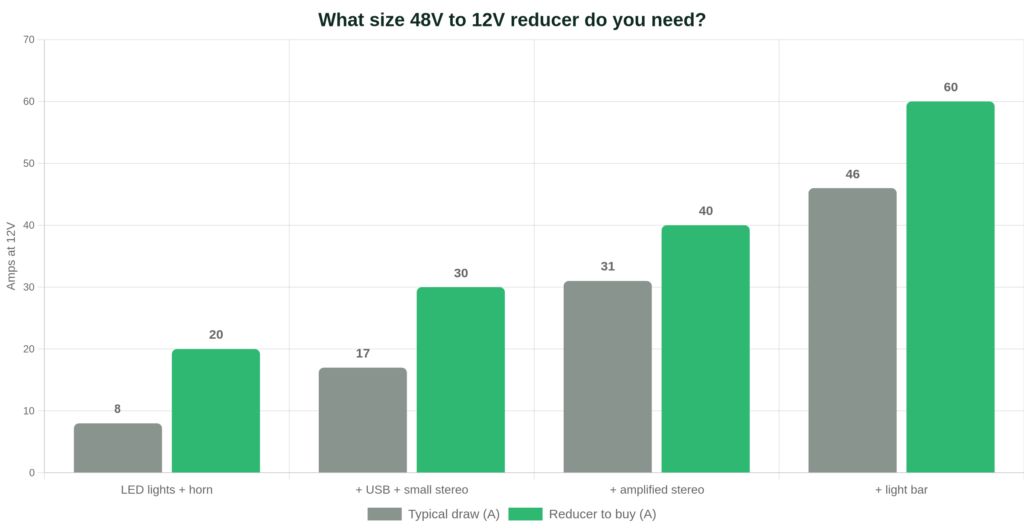
- Output current with 25% headroom. LED lights and a horn draw under 10A; add USB and a small stereo and you are near 17A; an amplified stereo or a light bar pushes past 30A. Undersized reducers dim the lights and run hot.
- Isolated or not. Non-isolated units share a ground between the 48V and 12V sides; they are cheaper and fine for lights and horns. Isolated units keep the sides separate, which removes whine from stereos and protects GPS units and cameras.
Our Picks
1. Pro Chaser 36V/48V to 12V 30A: Best for Most Carts
The standard choice for a stock accessory load. It accepts both 36V and 48V packs with headroom above lithium’s charging voltage, delivers 30A for lights, horn, stereo and USB together, and comes sealed and potted for under-seat mounting. Check the input range on the current listing before ordering.
2. 40A to 60A Sealed Reducer: Best for Stereos and Light Bars
An amplified stereo can pull 10 to 20A on its own and a light bar 8 to 15A, so carts with either want a 40A unit, and carts with both want 60A. Several brands sell sealed 36 to 60V input units at these ratings; pick one that states its input ceiling in volts, has an IP55 or better rating if it lives under the seat, and mounts on a metal surface for cooling.
3. Victron Orion-Tr 48/12-20: Best Isolated Converter
Victron’s Orion-Tr is an isolated converter with a 32 to 70V input range, 20A continuous output (25A peak), 87% efficiency, an adjustable 10 to 15V output and a remote on/off terminal that can be wired to the key switch without a relay. It costs more than a generic reducer and its 20A limit rules out big stereos, but for a clean, quiet 12V supply to audio, GPS or cameras it is the better tool. Its 70V ceiling also suits 70.4V-nominal 72V packs, but not 76.8V packs.
4. Small 5A to 10A Module: One Accessory Only
Tiny potted modules rated 5 to 10A, usually IP68 and non-isolated, are enough to run a single USB port, a battery meter or one LED strip. They are not a substitute for a proper reducer on a cart with lights and a horn.
Installation Reminders
- Fuse the input. A 10A blade fuse suits a 30A reducer, since the 48V side draws roughly a quarter of the 12V output current.
- Key-switch it through a relay, or use the unit’s ignition or remote terminal, so nothing drains the pack while parked.
- Mount it on metal with airflow, not under the battery.
- Never tap cells inside a lithium pack for 12V. Step-by-step wiring is in the reducer guide, and cable and fuse sizing in wiring basics.
Frequently Asked Questions
What size voltage reducer do I need for a golf cart?
Add up every accessory that can be on at once and buy at least 25% more. 20A covers LED lights and a horn, 30A adds USB and a small stereo, 40A an amplified stereo, and 60A a light bar as well.
Do I need an isolated reducer for a golf cart stereo?
Not always, but an isolated unit removes the whine that a shared ground can feed into speakers, and it protects sensitive electronics. For lights and a horn alone, non-isolated is fine.
Will a 48V reducer work on a 36V golf cart?
Only if its input range starts at or below 36V. Units sold as “36V/48V to 12V” do; a unit sold only as “48V to 12V” may not regulate properly at 38V.
Can I use a 48V reducer on a 72V golf cart?
Usually not. Most 36 to 60V reducers would be destroyed by a 72V pack. Buy a reducer rated for your pack’s full charging voltage; the Victron Orion-Tr 48/12 covers 70.4V-nominal packs only (72V battery guide).


