72V Lithium Golf Cart Battery Guide: 70.4V vs 76.8V, Which Carts Use It, and the Packs Worth Buying
CartVoltage is reader-supported. If you buy through links on this page we may earn a commission at no extra cost to you. As an Amazon Associate we earn from qualifying purchases. Details
Shopping for a 72V lithium golf cart battery has a trap that 36V and 48V buyers never meet: “72V” packs are sold at two different real voltages. Some are built from 22 LiFePO4 cells (70.4V nominal, 80.3V full), others from 23 or 24 cells (73.6V or 76.8V nominal, 84 to 87.6V full). The cart usually runs on either. The charger only works with one. Get that wrong and the new pack never fills, or the old charger pushes past the BMS ceiling and trips it on every cycle. This guide explains how to tell which you need, which carts are 72V in the first place, and which packs are worth buying in a market where most listings are new and thinly reviewed. Specs come from manufacturer listings; we don’t run a test lab.
Which Carts Are 72V?
| Cart | Stock battery | Notes |
|---|---|---|
| Evolution D5 Ranger and select LSV trims | Factory 72V lithium | Match the factory pack’s nominal voltage; see Evolution guide |
| Kandi, Bintelli, Vitacci and similar import LSVs | Six 12V lead-acid or factory lithium | Common in Florida and Texas street-legal fleets |
| GEM (Polaris) e2, e4, e6 2000 to 2015 | Six 12V lead-acid (older GEMs) or 8V sets | Bolt Energy sells a heated 72V pack specifically for GEM |
| Moke America | 72V lead-acid or lithium | Cart-specific kits exist |
| Custom high-speed builds | Six 12V lead-acid | Owners who converted a 48V cart to 72V with a new motor and controller |
| Sightseeing and 6 to 8 seat shuttle carts | Six 12V lead-acid | Resort and campus fleets |
Count the batteries: six 12V units is a 72V cart. A single factory lithium box will have the voltage on its label. If it says 70.4V, 73.6V or 76.8V rather than “72V,” that’s the number you need to match. Six 6V or six 8V batteries is a 36V or 48V cart instead; 36V vs 48V golf cart has the full check.
70.4V vs 73.6V vs 76.8V: The Cell-Count Problem
A LiFePO4 cell is 3.2V nominal and 3.65V full. Pack makers reach “72V” with 22, 23 or 24 cells in series, and the choice changes every voltage in the system:
| Cells in series | Nominal | Full charge | Charger needed | Who uses it |
|---|---|---|---|---|
| 22S | 70.4V | 80.3V | 80.3V charger | Vatrer, VEVOR, Elefast 70.4V kits |
| 23S | 73.6V | 84.0V | 84V charger | ELEFAST 73.6V, Mosasaur, VPauexii, Bolt Energy |
| 24S | 76.8V | 87.6V | 87.6V charger | Cloudenergy 72V, AOUSK, FORM’s 72V charger |
Does the cart care?
Usually not, within limits. A 72V lead-acid cart’s controller was designed around a pack that sits at 76V resting and reaches 88V or more on the charger, so an 87.6V lithium ceiling is inside its comfort zone. A 22S pack at 70.4V nominal runs the same controller a little lower; the cart works, with slightly less top-end. The only carts that genuinely care are factory-lithium models whose controller was set up for one specific pack voltage, and any cart with a controller whose over-voltage cutoff is below 88V. Check the controller’s rated input range on its label or datasheet; if the maximum is 90V or higher, any of the three works. If it’s 84V, stay with 22S. The general rule that a lithium swap keeps the stock controller is explained in do you need a new controller for lithium.
The charger cares completely
An 80.3V charger on a 76.8V pack stops at about 65% and never shows full. An 87.6V charger on a 70.4V pack drives cells past 3.65V, the BMS disconnects to protect them (what a BMS cutoff is), the charger loses the battery and restarts, and the cycle repeats until something gives; the lights it shows while doing that are decoded in charger blinking and error codes. Buy the pack and charger as a matched pair, or read the charger’s CV voltage off its label and match it to the pack’s cell count. Bundles that include the charger avoid the problem; that’s the strongest argument for a kit at this voltage. A 72V lead-acid charger is no better than a mismatched lithium one: why lead-acid chargers fail on lithium.
Engineer’s Note: Why 72V Packs Need Higher BMS Ratings Than You’d Think
A 72V cart pulls fewer amps than a 48V cart for the same power, which sounds like it should make the BMS rating less critical. It doesn’t, because 72V carts are the heavy, fast ones: six-seat shuttles, lifted LSVs, GEMs with cargo, custom builds with 7 kW motors. A 200A BMS at 76.8V is 15 kW, which sounds generous until a loaded eight-seater starts up a ramp. The AOUSK 170Ah at 300A and the Bolt Energy at 250A are rated that way for a reason. For a light two-seat 72V Moke on flat ground, 200A is fine. For anything that carries people uphill, treat 250A as the floor. The same logic at 48V is worked through in best lithium battery for hills and lifted carts.
72V Packs Compared
This market is young. Only one pack here has a review history in the hundreds; most were listed in the past year. We’ve included them because they’re what’s actually for sale, and noted the thin track record where it applies.
| Pack | Nominal | Capacity | Energy | BMS continuous | Charger included | Case | Track record | Price |
|---|---|---|---|---|---|---|---|---|
| Vatrer 72V 105Ah | 70.4V (22S) | 105Ah | 7.39 kWh | 200A | Sold with or without | Plastic | Established; the most-reviewed 72V pack on Amazon | Check on Amazon |
| Cloudenergy 72V 120Ah | 76.8V (24S) | 120Ah | 9.22 kWh | Listed; see datasheet | Yes | Metal | New listing | Check on Amazon |
| ELEFAST 72V 105Ah (3C) | 73.6V (23S) | 105Ah | 7.73 kWh | 3C discharge rating (high) | Yes (kit variants) | Plastic | New, early reviews strong | Check on Amazon |
| Elefast 72V 100Ah kit | 70.4V (22S) | 100Ah | 7.04 kWh | 200A | Yes | Plastic | New, few reviews | Search Amazon |
| VEVOR 72V 105Ah kit | 70.4V (22S) | 105Ah | 7.39 kWh | 200A (2C) | 15A | Plastic | New, few reviews | Search Amazon |
| Mosasaur 72V 105Ah | 73.6V (23S) | 105Ah | 7.73 kWh | 200A | 20A | Plastic | New, few reviews | Search Amazon |
| AOUSK 72V 170Ah | 76.8V (24S) | 170Ah | 13.1 kWh | 300A | 87.6V 15A | Not stated | New, almost no reviews | Search Amazon |
| Bolt Energy 72V 105Ah heated (GEM / Moke) | 73.6V (23S) | 105Ah | 7.73 kWh | 250A | 18A, cart-specific kit | Not stated | Premium US brand; sold with fit-specific hardware | Search Amazon |
From Amazon and manufacturer listings as of September 2026. Energy calculated at nominal voltage. “3C” means the BMS is rated for three times capacity in amps (315A continuous for a 105Ah pack) per the listing; treat as a claim until a datasheet confirms duration.
Our Picks
Vatrer 72V 105Ah: Best Overall (for now)
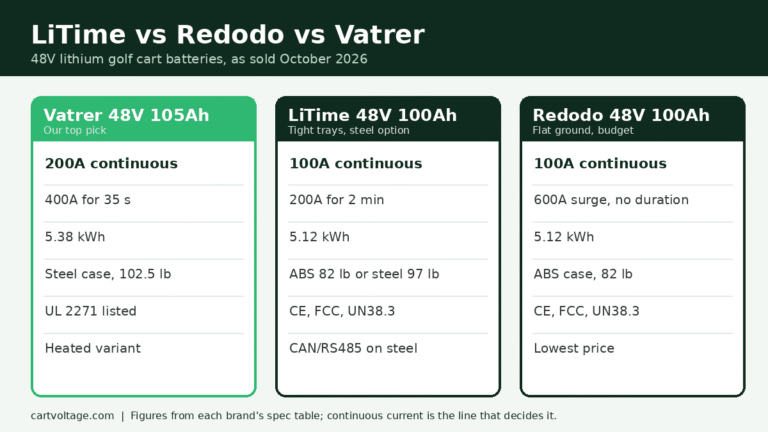
The only 72V pack with a meaningful review history, from the brand whose 48V packs anchor our other guides (Vatrer 48V 105Ah review). 22S at 70.4V, 200A BMS, Bluetooth app, standard footprint. It runs any 72V lead-acid cart and pairs with an 80.3V charger; buy the kit variant so the charger matches. The 200A rating suits two and four-seat carts; for a loaded six-seater on hills, look at the higher-current options below.
Cloudenergy 72V 120Ah: Best for Range
Metal case, charger included, 9.2 kWh, from a brand whose 48V 250A packs we recommend for hills. It’s 24S, so the bundled 87.6V charger is the one to use; don’t mix it with a 70.4V charger you already own. New listing, so the review history is thin; the brand’s record on lower voltages is the reason it’s here.
ELEFAST 72V 105Ah 3C: Best for Heavy Carts and Hills
A 3C discharge rating means the BMS is specified for roughly 315A continuous, which is the number a loaded shuttle or lifted LSV actually needs. 23S at 73.6V. Early reviews are strong but few. If your cart carries six or eight people, this or the Bolt Energy are the two packs on this list rated for the job.
Bolt Energy 72V 105Ah Heated: Best for GEM and Moke, Cold Climates
A US-brand, cart-specific kit at roughly double the price of the generic packs, with 250A continuous, a heater for sub-freezing charging (why that matters), and hardware matched to GEM and Moke trays. For a GEM owner who wants one purchase and a company to call, it’s the answer; for a generic 72V cart on a budget, it’s more than you need. Sold on Amazon and direct.
72V charger if you buy a bare pack
Match the cell count. For 24S (76.8V) packs, the FORM 72V 15A charger has lead-acid and LiFePO4 profiles and ring terminals, from the same brand as our Club Car and Yamaha picks. For 22S (70.4V) packs, look for an 80.3V LiFePO4 charger; for 23S (73.6V), an 84V unit. When in doubt, buy the pack maker’s own charger. The profile rules are in the charger compatibility guide.
Fitment: 72V Packs Are Taller
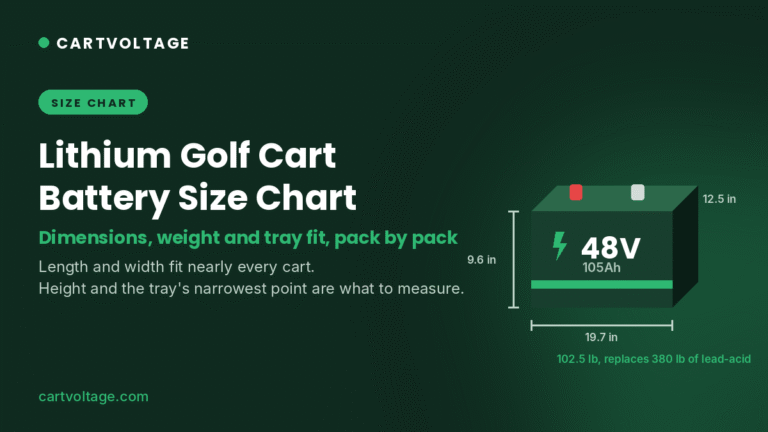
More cells means a bigger box. A 72V 105Ah pack is typically 12 to 13 inches tall versus 9.5 for a 48V 105Ah, and heavier at 130 to 150 lb. Six 12V lead-acid batteries occupy a large tray, so length and width are rarely the problem; height under the seat is. Measure from tray floor to the seat frame’s lowest point and compare to the listing’s dimensions with half an inch to spare. GEMs and some import LSVs have split trays (batteries in two locations); a single pack needs the larger of the two, and the cables from the other location get consolidated. Pack dimensions by model are in the size chart.
Install Differences From 48V
The sequence in how to convert a golf cart to lithium applies, with these additions:
- Respect the voltage. 80 to 88V DC across a wrench is a serious arc. Insulated tools, one connection at a time, main negative off first and on last.
- Accessories need a 72V-to-12V reducer, not the 48V unit most guides mention. Confirm the reducer’s input range covers 88V, the charging ceiling of a 24S pack. Sizing and wiring are otherwise the same as in the reducer guide.
- Split trays: consolidate to the main tray, run one main positive and one main negative, and cap the unused cable ends from the second location.
- Factory-lithium 72V carts: disconnect any communication cable from the old pack and expect the dash to lose battery data unless the new pack includes a CAN adapter (how to read charge without the dash).
- Onboard chargers (GEM, some LSVs) need to be set to a lithium profile at the right voltage or replaced.
Frequently Asked Questions
What is the difference between a 70.4V and 76.8V lithium golf cart battery?
Cell count: 22 cells versus 24. Both are sold as “72V.” The 76.8V pack charges to 87.6V and needs an 87.6V charger; the 70.4V pack charges to 80.3V and needs an 80.3V charger. The cart usually runs on either; the charger must match the pack.
Can I put a 72V lithium battery in a 48V golf cart?
Not without replacing the controller, solenoid and motor with 72V-rated parts. A 48V controller fed 76V will fail. That’s a full drivetrain conversion, not a battery swap; the parts list for a voltage change is in 36V vs 48V golf cart, and the cheaper ways to add speed are in does lithium make a golf cart faster.
How far does a 72V 105Ah lithium battery go?
About 7.4 to 7.7 kWh nominal, roughly 6.8 kWh usable. A two-seat LSV at 250 Wh per mile gets around 27 miles; a loaded six-seater at 450 Wh per mile, around 15. The range calculator has a 72V setting.
Why are 72V lithium batteries more expensive than 48V?
Fifty percent more cells for the same amp-hours, a higher-voltage BMS, and a smaller market with less competition. Expect $1,400 to $2,300 for a 105 to 120Ah pack with charger. Whether the extra cost pays off for your cart is covered in 48V vs 72V golf cart.
Is a 200A BMS enough for a 72V cart?
For a two or four-seat cart on easy terrain, yes. For six to eight seats, cargo, or hills, choose 250A or higher. 72V carts tend to be the heavy ones, and the BMS rating matters more than the capacity number.
Next Steps
Confirm your cart’s voltage and tray height in the fitment guide. If your cart turns out to be 48V, the 48V comparison has a much deeper field. All voltages together: Best Lithium Golf Cart Battery.
3 Comments