Vatrer 48V 105Ah Golf Cart Battery Review: Variants, Datasheet, and Who It’s Right For
CartVoltage is reader-supported. If you buy through links on this page we may earn a commission at no extra cost to you. As an Amazon Associate we earn from qualifying purchases. Details
The Vatrer 48V 105Ah is the lithium golf cart battery we point to most often on this site, and this review is where we explain why, and where it falls short. The short version: it’s the one Amazon pack with a UL 2271 listing from an independent lab, its datasheet publishes peak-current durations that most brands leave vague, and it’s sold in enough variants (standard, Mini, self-heating, 300A UTV, kits with cart-specific plugs) that there’s a version for nearly every cart. The long version covers what those variants are, what the 200A BMS actually means on a hill, why the “up to 50 miles” claim needs translating, and which alternatives beat it for specific carts. We haven’t tested the pack; specs come from Vatrer’s listings and datasheet, and owner experience from published reviews.
Verdict in Short
For a stock or lightly modified 48V EZGO, Club Car or Yamaha, the Vatrer 105Ah is the pack we’d buy: certified, well documented, mature app, and available as a kit with the right charger plug so nothing needs adapting. For a lifted cart on big tires or a hilly property, its 200A continuous rating is the class standard rather than a strength; Vatrer’s own 300A UTV version or a 250A pack from Cloudenergy or Eco is the better spec. For a cart that lives outside in a cold climate, the self-heating version is the one to buy.
The Variants: Which Vatrer 105Ah Are You Looking At?
Vatrer sells the 48V 105Ah in several forms, and Amazon shows them as separate listings. Confusing them is the most common complaint in owner reviews.
| Variant | What’s different | Who it’s for |
|---|---|---|
| Standard 48V 105Ah (UL 2271) | The base pack: 200A BMS, Bluetooth app, standard drop-in footprint. Sold bare or with a charger | Most 48V carts |
| Complete Upgrade Kit | Same pack plus 20A charger, LCD display, 48V-to-12V reducer, and on newer listings a retention strap; cart-specific plug options | First conversions; anyone who wants one purchase |
| Mini / Narrow 105Ah | Same capacity in a slimmer case for tight or oddly shaped trays | Older Yamahas, some utility carts, carts where the standard box won’t seat |
| Self-Heating 105Ah | Internal heater lets the BMS charge below freezing | Carts that can’t be charged above 32°F |
| UTV 105Ah, 300A BMS | Higher-current BMS for sustained heavy draw | Lifted carts, hills, upgraded controllers, UTVs |
| 48V 150Ah | 43% more energy, 200A BMS, taller case | Six-seaters, long days; measure tray height |
The UL 2271 listing is stated on the standard and kit versions; check the specific listing for the Mini, self-heating and UTV variants, which have been added more recently. Exact dimensions for each variant against each tray are in the size chart.
Reading the Datasheet
| Spec | Vatrer 48V 105Ah | What it means for your cart |
|---|---|---|
| Nominal voltage / energy | 51.2V / 5.376 kWh | About 4.8 kWh usable at 90% depth |
| Continuous discharge | 200A (10.24 kW) | Class standard; fine for stock controllers |
| Peak discharge | 400A for 35 seconds; 600A for 3 seconds | Unusually transparent. Covers pull-away and short climbs; not a long hill on a lifted cart |
| Cells | Vatrer states Grade A prismatic LiFePO4 (EVE cells per some reviews) | Reputable cell source if accurate; unverifiable from outside |
| Cycle rating | 4,000+ to 80% capacity | Over ten years at a cycle a day (what cycle ratings mean in practice) |
| Certification | UL 2271 by Intertek | Independent lab has checked BMS protections and abuse tolerance |
| Charger (kit) | 58.4V 20A | Empty to full in about 5.5 hours |
| Low-temperature charge cutoff | Blocks charging in cold; resumes automatically above about 41°F | Conservative and safe; expect no charging on freezing mornings without the heated version |
| Monitoring | Bluetooth app; LCD touch display on kits | True state of charge, cell voltages, temperature |
| Warranty | 5-year limited | Standard for Amazon brands; shorter than Eco or Allied |
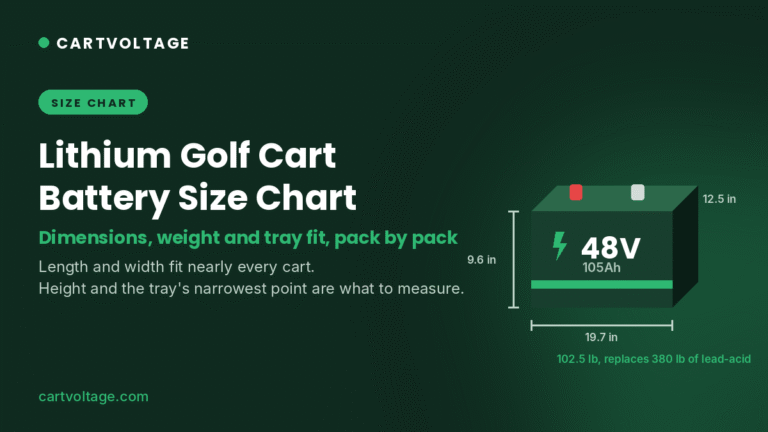
| Dimensions (standard) | About 19.7 by 12.5 by 9.6 inches | Drops into EZGO, Club Car, Yamaha, ICON trays |
From Vatrer’s product pages and datasheet as of September 2026. Peak figures with durations are Vatrer’s; treat cell-supplier claims as the manufacturer’s statement.
An engineer’s note on the peak ratings
Most listings say “1000A peak” and stop. Vatrer says 400A for 35 seconds and 600A for 3 seconds, and that’s the kind of number a pack designer can actually use. It tells you the BMS will carry double its continuous rating for over half a minute, which is longer than a stock cart ever asks. It also tells you the limit: a lifted cart holding 250 to 300A up a long grade will pass 35 seconds and the BMS will open (what that cutoff feels like and how to reset it). That isn’t a flaw in the pack; it’s the reason the 300A UTV version exists. Match the variant to the cart’s draw and both behave exactly as the datasheet says.
Why this happens, from a pack engineer: Engineer’s Note on continuous vs peak current.
“Up to 50 Miles”: Translating the Claim
Vatrer quotes up to 50 miles for the 105Ah and up to 70 for the 150Ah. Those figures need a light cart on flat pavement at a gentle pace, around 100 Wh per mile. A typical four-seat cart in mixed use runs 250 Wh per mile, which is about 19 miles from 4.8 kWh usable; a lifted cart at 325 Wh per mile, about 15. Owners report the same: excellent, but not 50. The range calculator gives a number for your cart, and the capacity guide explains when to step up to 150Ah.
What Owners Report
- The app is the most-praised feature: easy pairing, real state of charge, cell voltages, and a BMS that balances quickly near full. It also replaces the dash gauge, which reads wrong on any lithium pack.
- Fit is reported as straightforward on EZGO TXT and RXV, Club Car DS and Precedent, Yamaha Drive, and ICON; the Mini exists because a minority of trays don’t take the standard box.
- Performance comments are what you’d expect from any lithium swap: lighter, quicker off the line, steady speed until nearly empty.
- Complaints cluster around listings, not the pack: buying the bare pack when a kit was wanted, or a kit charger with a plug for a different cart. Read the variant and plug option before ordering; golf cart charger plug types shows which plug your cart has.
- Cold-weather charging surprises northern owners the first winter; the 41°F resume threshold is conservative. The self-heating variant is the answer, and our cold-weather guide explains why the cutoff exists.
Vatrer vs the Alternatives
| Vatrer 48V 105Ah | Cloudenergy 48V 105Ah | DC HOUSE 48V 100Ah kit | Eco Battery 48V 105Ah Gen3 | |
|---|---|---|---|---|
| Continuous | 200A (300A UTV variant) | 250A | 200A | 250A |
| Peak stated with duration | Yes (400A/35s, 600A/3s) | Not stated | Not stated | Not stated |
| Certification | UL 2271 | Not stated | Not stated | Not stated |
| Case | Steel, IP67 (102.5 lb) | Plastic | Metal | Plastic |
| Kit charger | 20A, cart-specific plugs | 20A | 18A | High-amp, OEM plug |
| Heated option | Yes | No | No | Yes |
| Warranty | 5 years on Amazon listings; Vatrer’s site states 10 | Stated; check listing | Stated; check listing | Limited lifetime (6 yr full) |
| Where sold | Amazon, brand site | Amazon, brand site | Amazon | Dealers, specialist retailers |
| Price | Check on Amazon | Check on Amazon | Check on Amazon | Dealer quote |
| Choose it when | Stock cart; want certification and cart-specific kit | Hills, lifted; value plus 250A | Want metal case and monitor in one box | Factory-lithium cart with dash integration; longest warranty |
Full seven-pack comparison in Best 48V Lithium Golf Cart Battery; kits by what’s in the box in the conversion kit guide; Eco in depth in our Eco Battery review; and Vatrer against the two other big Amazon names in LiTime vs Redodo vs Vatrer.
Who Should Buy It
- Owners of a stock or lightly modified 48V EZGO, Club Car, Yamaha or ICON who want a certified pack and a kit with the right plug.
- Anyone who values a published datasheet with real peak durations over marketing numbers.
- Cold-climate owners, in the self-heating variant.
- Carts with awkward trays, in the Mini.
Who Should Look Elsewhere
- Lifted carts, six-seaters and hilly properties on the standard 200A version: choose the 300A UTV variant, or a 250A pack from Cloudenergy or Eco (the 250A packs compared).
- Factory-lithium carts that need CAN integration (EZGO ELiTE, some ICON and Evolution): Vatrer doesn’t offer it; see the cart’s guide.
- Buyers who want the longest warranty in the category: Eco’s lifetime terms or Allied’s 8 years beat Vatrer’s 5.
Frequently Asked Questions
Is the Vatrer 48V 105Ah a good golf cart battery?
For stock and lightly modified 48V carts, it’s the pack we recommend first: UL 2271 listed, well documented, sold in kits with cart-specific plugs. For lifted or hilly use, choose the 300A variant or a 250A competitor.
What does UL 2271 mean on the Vatrer battery?
UL 2271 is the safety standard for batteries in light electric vehicles. Intertek tested the Vatrer pack to it, covering BMS protections, cell construction and abuse tolerance. It doesn’t change performance; it means someone independent checked.
Does the Vatrer battery fit an EZGO TXT, Club Car or Yamaha?
Yes, the standard 105Ah fits the trays on all three and on ICON; kit listings offer the matching charger plug. Carts with tight trays can use the Mini. Confirm in the fitment guide.
How far does the Vatrer 105Ah really go?
Vatrer says up to 50 miles. On a typical cart in mixed use, plan on 18 to 25; on a lifted cart, 13 to 16. The range calculator gives your cart’s number.
Why won’t my Vatrer battery charge in the cold?
The BMS blocks charging when the cells are cold and resumes automatically above about 41°F. That protects the cells from permanent damage. Charge in a warmer space, charge right after driving, or choose the self-heating variant.
Next Steps
Confirm your cart’s plug and tray in the fitment guide, then follow your cart’s install page. Not sure 105Ah is enough? The range calculator settles it in a minute.
4 Comments