Does Lithium Make a Golf Cart Faster? What Changes and What Doesn’t
CartVoltage is reader-supported. If you buy through links on this page we may earn a commission at no extra cost to you. As an Amazon Associate we earn from qualifying purchases. Details
“It feels like a new cart” is the most common thing owners say after a lithium conversion, and the second most common question is whether that means it is faster. The honest answer is: a little, sometimes, and mostly not where people expect. Top speed on almost every golf cart is set by the controller, the motor, the gearing and the tires, and a battery swap changes none of those. What lithium changes is how much of that speed the cart actually reaches: off the line, up a hill, and in the last few miles of the day, where a lead-acid cart slows down and a lithium cart does not. This guide explains why, what to expect on your cart, and what does raise top speed if that is the goal.
Why Lithium Feels Faster

Three things change when six lead-acid batteries become one lithium pack.
- Voltage under load. A 48V lead-acid string rests around 51V when full, but the moment the cart pulls 100A it sags, and it keeps sliding as the charge is used. A 48V LiFePO4 pack rests at 53V or so and stays close to 52V under the same load for most of the charge. A DC motor’s speed follows the voltage it gets, so on a cart that is not speed-governed, more voltage under load means more speed under load.
- Weight. The pack weighs 82 to 140 lb instead of 330 to 380. Taking 200 to 300 lb off the back of the cart is like losing one or two passengers: quicker acceleration, less slowing on grades, shorter braking (how much golf cart batteries weigh, weights by pack).
- No end-of-day fade. A lead-acid cart is noticeably slower on the back nine than the front nine because its voltage keeps falling. A lithium cart drives the same at 20% as at 90%, then stops fairly abruptly near empty, which is why a proper lithium meter matters.
Owners who had a tired lead-acid pack feel the biggest difference, because their cart had been running well below its design speed for months. The conversion restores the speed the cart was built for; it does not add to it.
What Your Cart Will Actually Do
| Cart type | Top speed after lithium | Acceleration and hills |
|---|---|---|
| Speed-governed carts (most EZGO RXV and TXT PDS, Club Car Precedent, Onward, Tempo, Yamaha Drive2) | Unchanged: the controller holds the programmed limit | Noticeably better; holds the limit further up hills |
| Older series-wound carts with no governor (early EZGO TXT, Club Car DS, older Yamaha G-series) | Up to about 1 mph more, from the steadier voltage | Better, especially late in the day |
| Carts with a tired lead-acid pack | Back to the original top speed | Much better; the biggest felt difference |
| Lifted carts on large tires | Unchanged by the battery | Better, if the pack’s continuous rating covers the controller (hills and lifted carts) |
One caveat for hilly carts: lithium only makes the cart stronger on a climb if the pack can deliver the current the controller asks for. A pack whose BMS is rated below the controller’s draw will cut out instead of climbing faster (BMS cutoff explained), and some packs with a “200A BMS” headline are rated 100A continuous in their spec tables (LiTime vs Redodo vs Vatrer).
What Actually Raises Top Speed
If more top speed is the goal, these are the levers, each with a cost. Many factory carts are limited to around 12 to 15 mph for fleet use, and personal carts are often set higher; the first step is always to find out what limits yours.
- Controller programming. Governed carts have a speed setting in the controller. A dealer can often raise it within the factory range, and some carts have published speed codes. This is the cheapest gain and keeps the drive system within its design.
- A performance controller. A 400A to 600A aftermarket controller adds torque and, with programming, speed. It also raises the current the battery has to supply, so the pack’s continuous rating, the cables and the solenoid have to match (controller and solenoid guide, cable and fuse sizes).
- A high-speed motor or gears. Both raise top speed and cost acceleration and hill torque. On a hilly property the trade is usually not worth it.
- Larger tires. A taller tire covers more ground per turn, so top speed rises roughly in proportion to the diameter, and torque at the wheel falls by the same proportion. The speedometer, if fitted, will read low.
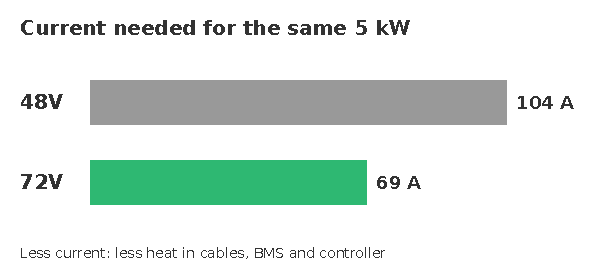
- A voltage upgrade. Going from 36V to 48V, or 48V to 72V, raises speed substantially, but it is a different project: controller, solenoid and often motor must all be rated for the new voltage. Never drop a higher-voltage pack into a cart built for a lower one (36V vs 48V, 72V guide).
Speed also has a legal side. Carts driven on public roads in most US states are limited to about 20 mph unless registered as a low-speed vehicle, and LSVs are capped at 25 mph with their own equipment rules. Check local rules before raising a cart’s speed.
Frequently Asked Questions
Will a lithium battery make my golf cart go faster?
Not in top speed on a governed cart. It will accelerate harder, climb better and keep its speed all day. Ungoverned series-wound carts can gain up to about 1 mph.
Why does my cart feel faster after converting to lithium?
The pack holds its voltage under load and the cart is 200 to 300 lb lighter, so it reaches its speed sooner and holds it on grades. If the old lead-acid pack was tired, the cart is also back to the speed it was built for.
Can I put a 48V lithium battery in a 36V cart to go faster?
No. The 36V controller, solenoid and often the motor are not rated for 48V and can fail. A voltage upgrade means replacing those parts as well. The same applies to going from 48V to 72V (48V vs 72V golf cart).
Does lithium help a golf cart go up hills?
Yes, if the pack’s continuous current rating covers what the controller draws on the climb. Choose 200A continuous for stock carts and 250A or more for hilly or lifted carts.
Next Steps
Decide whether the conversion pays for your cart with is lithium worth it, pick a pack with enough continuous current from the 48V comparison, and follow the conversion guide.