Should You Add a Second Lithium Golf Cart Battery in Parallel?
CartVoltage is reader-supported. If you buy through links on this page we may earn a commission at no extra cost to you. As an Amazon Associate we earn from qualifying purchases. Details
A lithium golf cart pack leaves a third of the battery tray empty, and sooner or later every owner looks at that space and thinks about a second pack. Two packs in parallel double the capacity and double the current the cart can draw, and on the right cart that is the best upgrade available. On the wrong cart it is a thousand dollars to carry a hundred pounds you never use. This guide covers what parallel actually does, how to wire it so both packs share the work, the matching rules that keep one BMS from carrying the other, and the honest comparison with simply buying one bigger pack.
What Parallel Does, and What It Doesn’t
Parallel means positive to positive, negative to negative. The voltage stays the same, 48V stays 48V, and the capacities add: two 105Ah packs make a 210Ah battery with 10.75 kWh. The current limits add too, and this is the part owners underrate. Each pack’s BMS still allows 200A continuous, so the pair can deliver 400A continuous and far more in a burst, which turns a pack that trips on hills into one that never notices them. What parallel does not do is raise the voltage or the speed; that is series wiring, which has no place on a cart built for 48V. The 36V vs 48V guide covers why.
When a Second Pack Is Worth It
- Six-seat and lifted carts on hills. The current headroom matters as much as the range. A 200A BMS working at its limit on every climb heats itself and eventually trips; two packs share the load and each runs at half its rating. The hills and lifted carts guide treats this as the alternative to a 250A or 300A single pack.
- Real long-distance use. A 105Ah pack does 25 to 35 miles on a stock cart. If your days are regularly longer than that, or you want a 40-mile reserve, a second pack is cheaper per amp-hour than most 150Ah or 160Ah packs and gives more capacity. Range by pack size is worked through in 100Ah vs 105Ah vs 150Ah.
- Fleets, rentals and work carts that run all day and cannot stop to charge.
- Redundancy. If one pack’s BMS trips or the pack fails, the other gets you home. For a cart that is the only transport in a large community, that is worth something.
And when it is not: a stock two- or four-seat cart doing under 15 miles a day uses 40 to 50% of one 105Ah pack. A second pack would spend its life at 75% charge, which is a lot of money for a lighter conscience. If the cart is losing range rather than lacking it, diagnose first with the losing range guide; a drifted meter or a charger stopping short looks like “not enough battery” and costs nothing to fix.
One 150Ah Pack or Two 100Ah Packs?
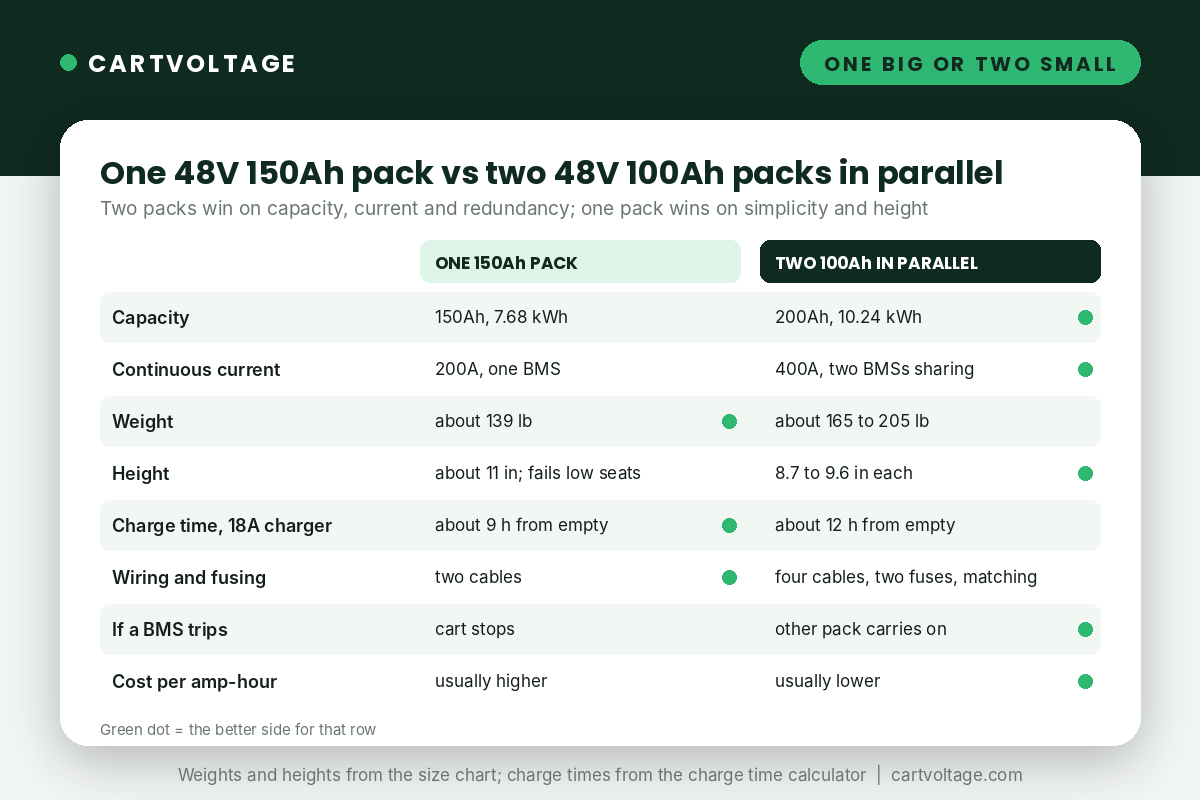
| One 48V 150Ah pack | Two 48V 100Ah packs in parallel | |
|---|---|---|
| Capacity | 150Ah, 7.68 kWh | 200Ah, 10.24 kWh |
| Continuous current | 200A (one BMS) | 400A (two BMSs sharing) |
| Weight | about 139 lb | about 165 to 205 lb |
| Height | about 11 in, the fit problem on low seats | 8.7 to 9.6 in each, side by side |
| Footprint | 22 x 12 in | about 20 x 25 in |
| Charge time with an 18A charger | about 9 hours from empty | about 12 hours from empty |
| Wiring and fusing | Two cables | Four cables, two fuses, matching before connection |
| If a BMS trips | Cart stops | Other pack carries on |
| Cost per amp-hour | Usually higher | Usually lower, especially with kit pricing |
The size chart has the exact dimensions for each pack, and the 150Ah’s height is the deciding factor on older Yamahas and carts with lowered seats. The charge time calculator will tell you whether 200Ah on your charger finishes overnight.
The Matching Rules
- Same model, same capacity, same age. Two packs in parallel share current according to their internal resistance, and resistance differs between brands, between capacities and between a new pack and a two-year-old one. A mismatched pair works, but the stronger pack does most of the work, reaches its limits first and trips first, at which point the weaker pack is alone with the whole load. Most manufacturers allow two to four identical packs in parallel; Eco Battery’s warranty, for instance, excludes more than two.
- Charge both to 100% separately before the first connection. If one pack is at 53V and the other at 51V, connecting them sends a large equalizing current from one to the other through nothing but the cables, which can trip a BMS or spark at the terminal. Full charge, an hour’s rest, and a voltage check within 0.1V of each other, then connect.
- Never parallel lithium with lead-acid, or a 48V pack with a 36V one. The voltages and curves are different and one will try to charge the other until something trips or burns.
- Keep the switches in step. If the packs have power switches, both on or both off; a pack switched off while the other drives is doing nothing, and switching it on under load repeats the equalizing problem.
How to Wire Two Packs So They Share the Load
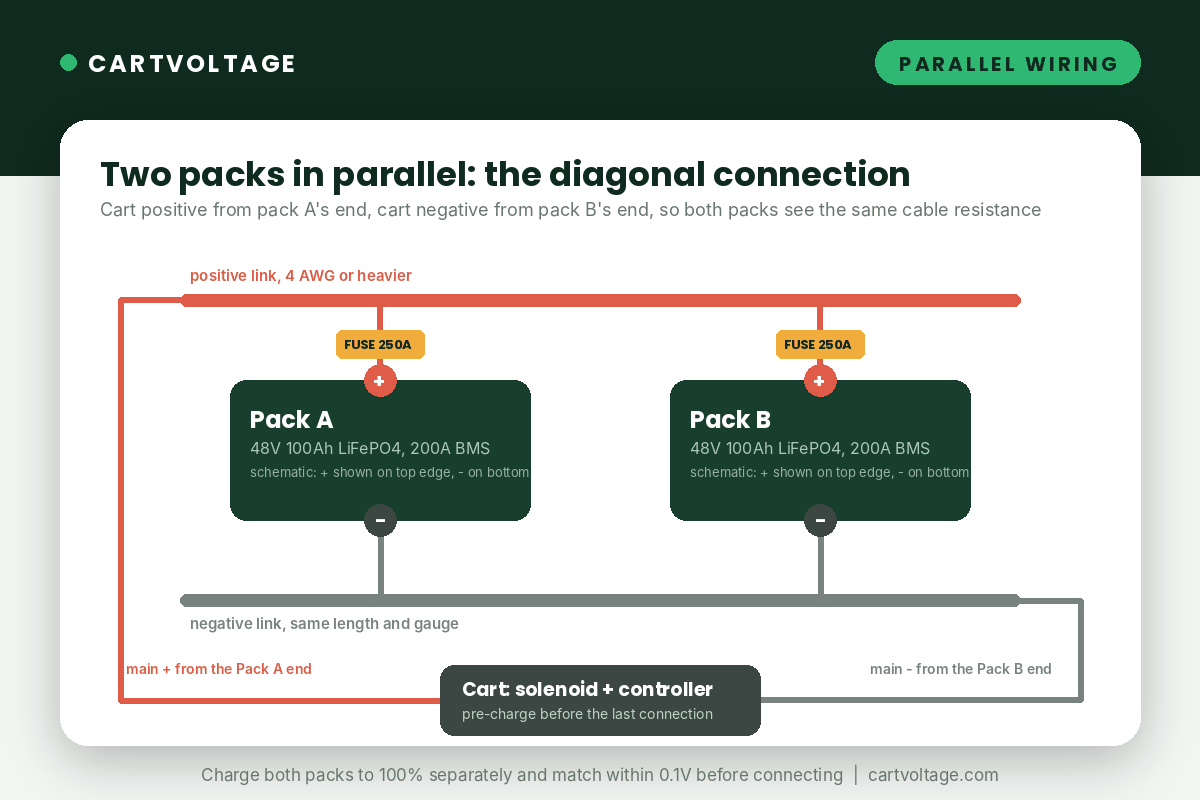
- Link the packs. Positive A to positive B, negative A to negative B, with two short cables of the same length and gauge, 4 AWG or heavier.
- Take the cart’s cables diagonally. Main positive from pack A, main negative from pack B. If both cart cables come off the same pack, that pack sees less cable resistance and does more of the work, and the imbalance never settles.
- Fuse each pack. A 200A to 250A ANL fuse or breaker on each pack’s positive, as close to the terminal as possible. With two packs, a short inside one of them can be fed by the other at full current; the fuses are what stop that. Fuse sizing for a single pack is in do you need a new controller for lithium.
- Pre-charge the controller before the last connection, exactly as for a single pack; two packs make the capacitor inrush bigger, not smaller. The conversion guide covers the pre-charge resistor.
- Hold both down independently. Two packs side by side in a tray built for six lead-acid batteries have room to move.
- Charge through the same cables. The charger connects to the cart’s receptacle as before and both packs charge together. One charger is enough; allow double the time or move up to a 25A to 30A charger, which the charger guide lists by plug.
Living With Two Packs
- Two apps, two readings. Each pack’s Bluetooth app shows its own state of charge. After the first few cycles the two numbers should sit within a few percent; a widening gap means a wiring or matching problem.
- A full charge resets both meters, the same as a single pack, and balances both packs’ cells; give the pair an extra hour on the charger every couple of weeks.
- A cold morning can trip one BMS before the other. Charging below 32°F is blocked by each BMS on its own thermometer; if one pack is in the sun and the other in shade, one charges and the other waits, which is normal (cold-weather rules).
- Storage is the same routine, times two: 50 to 60%, switched off, checked every two months, as in the winter storage guide.
- Replacing one pack later is the one real drawback: a new pack beside a three-year-old one breaks the matching rule. Plan to replace both, or move the old one to a different cart. How long that is likely to be: how long lithium golf cart batteries last.
Frequently Asked Questions
Can I add a second lithium battery of a different brand?
It will run, but the pack with lower internal resistance does most of the work and trips first, leaving the other alone with the full load. Use the same model, capacity and age; if that is not possible, a single larger pack is the better plan.
Can I put two 48V batteries in a golf cart?
Yes, in parallel: positive to positive, negative to negative. The cart stays 48V with double the capacity and current. Never connect them in series; that makes 96V and destroys the controller.
Do I need two chargers for two lithium batteries?
No. One charger through the cart’s receptacle charges both, taking about twice as long. A 25A to 30A lithium charger brings a 200Ah pair back overnight.
Will two batteries make my golf cart faster?
Not faster, since the voltage is unchanged, but stronger on hills: the pair can supply twice the current and sags less under load, so a cart that slowed or cut out on grades keeps its speed.
What size fuse for two lithium golf cart batteries?
One fuse per pack, each rated above the pack’s continuous current and below its peak: 200A to 250A ANL for a 200A BMS. The fuses protect against one pack feeding a fault in the other. Cable gauge and fuse placement for the rest of the cart: lithium golf cart wiring basics.
Next Steps
Pick the second pack to match the first from the 48V comparison or the 36V comparison, check both will fit side by side with the size chart, and read the BMS cutoff guide if the reason you want a second pack is a cart that keeps stopping on hills; the cause may be imbalance rather than capacity.