How to Winterize a Golf Cart: Lithium and Lead-Acid Storage Rules for Winter
CartVoltage is reader-supported. If you buy through links on this page we may earn a commission at no extra cost to you. As an Amazon Associate we earn from qualifying purchases. Details
Most of the golf cart batteries that die over winter were not killed by the cold. They were killed by the storage routine: a lithium pack parked at 100% in a heated garage for five months, a lead-acid set left half-charged in a shed until the electrolyte froze, or a cart whose electronics quietly drained the pack to zero by February. Lithium and lead-acid want almost opposite treatment, so this guide covers both, in the order you’d actually do the work, with the spring restart at the end.
The 10-Point Winter Storage Checklist
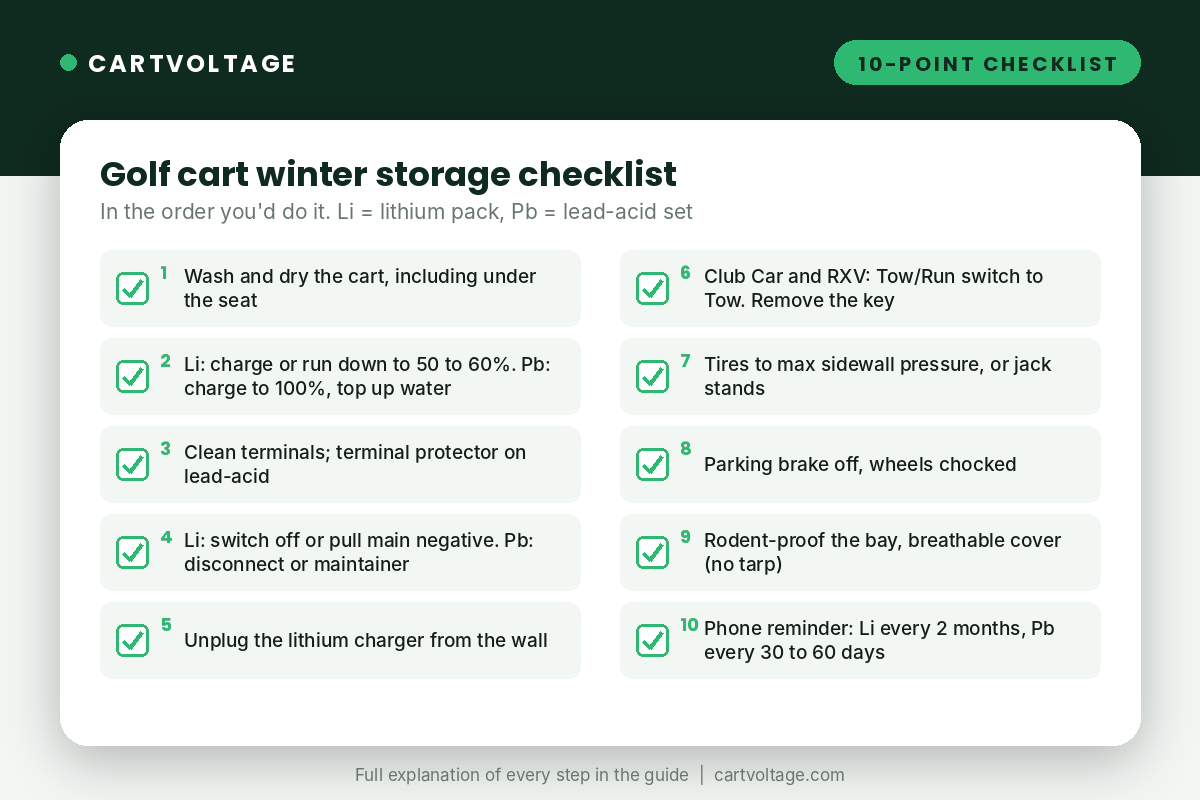
- Wash the cart and let it dry completely, including under the seat.
- Lithium: charge or discharge to 50 to 60%. Lead-acid: charge to 100% and top up with distilled water.
- Clean the terminals; on lead-acid, coat them with terminal protector.
- Lithium: switch the pack off or disconnect the main negative. Lead-acid: disconnect the main negative or connect a golf cart maintainer.
- Unplug the charger from the wall (lithium) or confirm the maintainer is a lead-acid float type (lead-acid).
- Club Car: Tow/Run switch to Tow. EZGO RXV: Tow/Run to Tow. Remove the key.
- Inflate tires to the maximum on the sidewall to avoid flat spots, or put the cart on jack stands.
- Release the parking brake and chock the wheels so the brake cables and pads don’t seize.
- Rodent-proof: no food, dryer sheets or peppermint in the battery bay, steel wool in openings, a breathable cover rather than a tarp.
- Put a reminder in your phone: lithium every 2 months, lead-acid every 30 to 60 days.
Lithium Golf Cart Winter Storage, Step by Step
1. Store it at 50 to 60%, not full
This is the one rule that is backwards from lead-acid, and the one most owners get wrong. A lithium cell ages fastest when it sits at a high state of charge, and faster still when it is warm, which is why a pack stored at 100% in a heated garage is the worst case rather than the best. Vatrer’s own storage guidance is 50 to 70%, with a warning against storing full or empty; most other manufacturers say 50 to 60%. If the cart came in from its last drive at 80%, run it around the block until the app reads 60%, or just leave it there and skip the final charge. On a 48V pack, a rested voltage of about 52.0 to 52.8V is the 50 to 60% zone; on 36V it is about 39.0 to 39.6V. The reasons are explained in how long lithium golf cart batteries last.
2. Switch the pack off or disconnect the main negative
Lithium self-discharge is small, about 2 to 3% a month, but the pack is never truly alone. The BMS and its Bluetooth module draw a few milliamps around the clock, and the cart’s own electronics can draw far more: an EZGO RXV or an ICON controller that stays awake can pull tens of milliamps, and a GPS tracker, a stereo head unit with memory, or a reducer feeding always-on accessories adds to it. Over five months that is enough to take a 50% pack down to the BMS low-voltage cutoff. Once the BMS disconnects, the cells keep self-discharging with nothing watching them, and a pack that spends weeks below the cutoff may refuse to charge in spring, which is cause number one in the won’t-charge guide. If the pack has a power switch, use it. If not, pull the main negative cable off the pack and tape the lug. On a Club Car, set the Tow/Run switch to Tow as well.
3. Unplug the charger and don’t use a maintainer
A lithium charger finishes at 58.4V (48V) or 43.8V (36V) and stops; it does not float. Leaving it connected all winter either does nothing or, on chargers that restart when voltage sags, keeps topping the pack back to 100%, which is exactly the state you are trying to avoid. A lead-acid float maintainer is worse: it holds the pack at a voltage the BMS will fight (why lead-acid chargers and lithium packs don’t mix). Unplug the charger from the wall and leave it unplugged until spring. A lithium pack needs no trickle charge; Vatrer says the same in its storage guidance.
4. Where to park it: cold is fine, charging in cold is not
LiFePO4 cells are happy sitting in the cold. Most packs are rated to be stored and discharged down to -4°F, and a pack at 50% in an unheated garage in Michigan is in a better place than a pack at 100% in a heated one in Florida. The hard line is charging: lithium must never be charged below 32°F, and Vatrer’s guidance is to charge above 41°F to keep a margin, because the chemistry plates lithium metal onto the anode instead of storing it and that capacity is gone for good. The cold weather guide covers what self-heating packs change about this. If your storage space swings between 10°F and 90°F, the cool end of that range is the friend and the warm end is the enemy; shade matters more than heat.
5. Check it every two months
Reconnect or switch on, open the app or read the rested voltage, and write it down. A healthy pack loses a few percent between checks. If it has dropped below 30%, let the garage get above 41°F, charge it back to about 60% and disconnect again. If it has dropped a lot more than expected, something on the cart is still drawing current and the disconnect didn’t isolate it; find it before you put the pack away again. Eco Battery’s warranty requires a charge at least once every six months and voids coverage for a pack stored fully discharged, so the two-month check is also warranty protection. If your pack has no app, a voltmeter reading is a rough guide at best, because lithium’s voltage barely moves between 20% and 90% (why voltage gauges mislead on lithium); a shunt-based meter gives you the real number.
6. Spring restart: warm, then full, then balance
Wait for the battery itself, not the air, to be above 41°F; a pack that sat all night at 25°F is still cold at noon. Reconnect, switch on, and charge to 100% in one session, then leave it on the charger an extra hour so the BMS can balance the cells after months apart. Open the app and look at the cell spread: under 0.05V at rest is normal, up to 0.1V will close with a couple more full charges, and more than that means one cell drifted and the pack wants a few full-charge-and-rest cycles before you trust the range figure (if range stays short after that, the losing-range guide has the next checks). Then check tire pressure, lights and the reducer, and go.
Lead-Acid Golf Cart Winter Storage
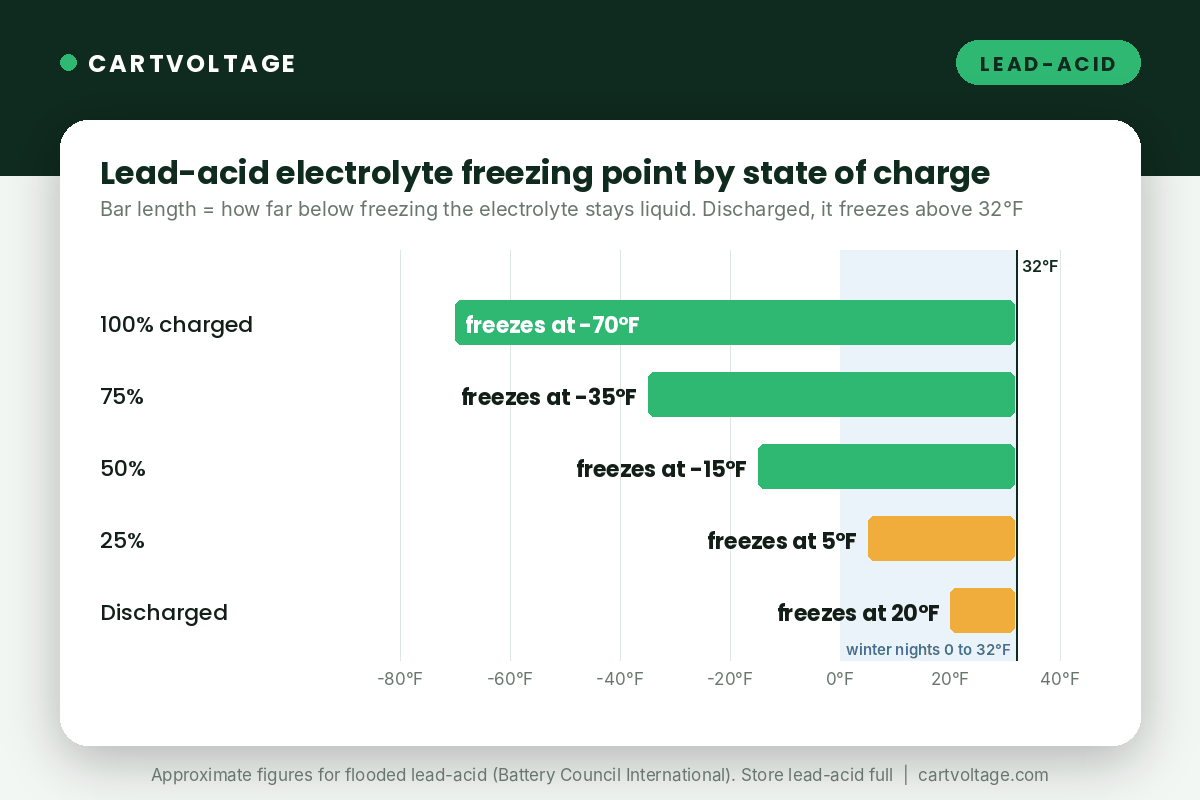
If you haven’t converted yet, the lead-acid routine is the opposite on the first rule and stricter on the schedule. A flooded battery must be stored full, because the electrolyte in a discharged battery is mostly water and freezes like water. Battery Council International’s freezing figures make the point: at full charge the electrolyte freezes around -70°F, at half charge around -15°F, and fully discharged it can freeze at about 20°F, which is an ordinary January night in most of the country. A frozen lead-acid battery usually cracks its case or buckles its plates and is scrap.
- Charge to 100%, let the batteries rest, then check and top up every cell with distilled water to the fill line. Never tap water. Levels and timing are in how to water golf cart batteries.
- Clean the tops and terminals. A film of acid and dirt across the top of a battery is a slow leak between the posts. Baking soda and water, rinse, dry, then terminal protector spray.
- Disconnect or maintain. Either pull the main negative and recharge every 30 to 60 days, or connect a maintainer made for golf cart packs (36V or 48V float, not an automotive 12V unit). Vatrer’s lead-acid guidance is a check every 30 to 60 days, keeping a 48V set above 50.4V.
- Ventilate. Lead-acid gives off hydrogen while charging, so no sealed closets and no charging under a tarp.
- Never charge a frozen battery. Bring it above 41°F first, and if it was discharged when it froze, expect it to be dead anyway.
The Rest of the Cart (Both Battery Types)
- Tires. Inflate to the maximum pressure on the sidewall, usually 20 to 22 psi on standard golf tires and 25 to 30 psi on street tires. Carts that sit for months at normal pressure develop flat spots that thump for the first few miles in spring, and sometimes permanently. Jack stands under the frame avoid it entirely.
- Parking brake off, wheels chocked. A brake left applied for five months stretches the cable and can bond the pads to the drums. Chock both rear wheels instead.
- Tow/Run and key. Club Car and EZGO RXV carts have a Tow/Run switch under the seat; set it to Tow so the controller sleeps and regen is disabled. Remove the key. On an ICON or Evolution, follow the manual’s storage procedure, since the onboard charger and controller stay partly awake on some models.
- 12V accessories. If the cart has a separate 12V battery for lights or a stereo, it needs its own maintainer or a disconnect; it will not survive the winter on its own.
- Rodents. Mice chew wiring harnesses and nest in battery bays. Remove anything edible, put steel wool in the openings around the frame, and use peppermint oil or dryer sheets in the bay. Check in your two-month visits.
- Cover. A breathable cart cover keeps dust and droppings off. A plastic tarp traps moisture against the metal and the battery terminals; don’t use one indoors.
- Charger. Unplug any charger that isn’t doing a job over winter. A lightning surge through a charger left on the wall is a common spring repair.
Five Winter Mistakes That Cost Owners a Battery
- Storing lithium at 100% “to be safe”. Safe for lead-acid, the most damaging storage state for lithium, and worse in a heated garage.
- Storing lithium at 10% and forgetting it. The BMS cutoff is not a floor; the cells keep dropping below it. By spring the pack may be unrecoverable.
- Charging on the first warm afternoon. The air is 50°F, the pack is still 28°F inside. Give it a day.
- Leaving the old lead-acid maintainer on a lithium pack. The float voltage keeps the BMS in and out of protection all winter.
- Not isolating the cart’s electronics. A disconnected charger does nothing about a controller or tracker that draws current 24 hours a day. The main negative, the Tow switch or the pack’s own switch is what isolates it.
Lithium vs Lead-Acid Winter Storage, Side by Side
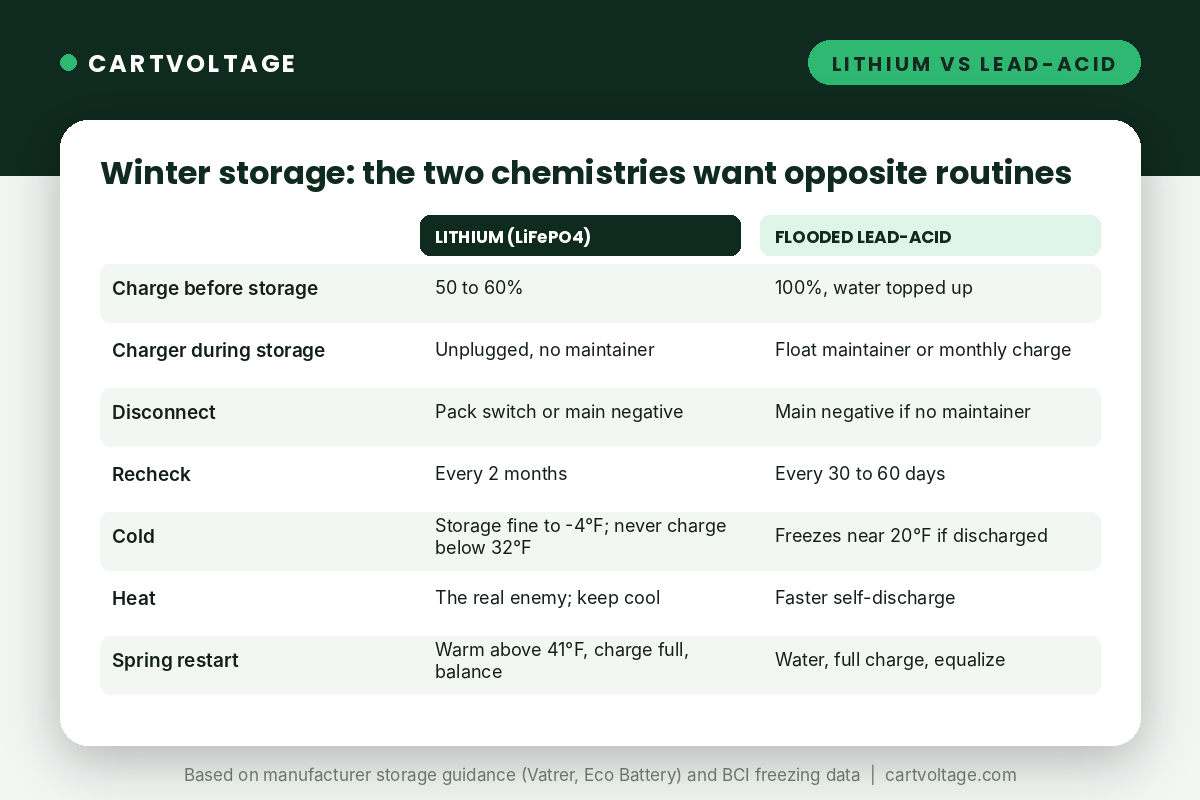
| Step | Lithium (LiFePO4) | Flooded lead-acid |
|---|---|---|
| Charge level before storage | 50 to 60% (52.0 to 52.8V on 48V) | 100% (above 50.4V on 48V, recharged as needed) |
| Charger during storage | Unplugged; no maintainer | Golf cart float maintainer, or monthly charge |
| Disconnect | Yes: pack switch or main negative | Yes if not on a maintainer |
| Recheck interval | Every 2 months | Every 30 to 60 days, water and voltage |
| Cold | Storage fine to about -4°F; never charge below 32°F | Freezes near 20°F if discharged; keep full |
| Heat | The real enemy; keep it cool and shaded | Speeds up self-discharge; more frequent checks |
| Spring restart | Warm above 41°F, charge to 100%, let the BMS balance | Water, full charge, equalize if the charger has the mode |
Frequently Asked Questions
Can lithium golf cart batteries freeze?
Not in the way lead-acid does. There is no water-based electrolyte to turn to ice, and LiFePO4 packs are rated for storage well below 0°F. Cold reduces available range while the pack is cold and blocks charging below 32°F, but it does not damage a pack that is sitting.
Should I leave my lithium golf cart plugged in all winter?
No. The charger either does nothing or keeps the pack at 100%, which is the state that ages it fastest. Store at 50 to 60% with the charger unplugged and the pack switched off.
Is an unheated garage or shed OK for winter storage?
For lithium at 50 to 60%, yes, down to about -4°F, as long as you never charge it there while it is below freezing. For lead-acid, yes if the set is kept fully charged; a discharged set in an unheated shed is the one that freezes. Outdoors or under a carport, a breathable cover keeps the weather off (see golf cart enclosures and covers), but the battery steps above still apply.
How long can a lithium golf cart battery sit unused?
Switched off and at 50 to 60%, six months is routine and a year is possible, losing a few percent a month. Connected to a cart whose electronics stay awake, it can be flat in two to three months, so the disconnect is the whole game.
Do lithium golf cart batteries need a trickle charger?
No, and a lead-acid trickle or float charger should never be connected to one. A lithium pack is stored by isolating it, not by feeding it.
What voltage should a lithium golf cart battery be for storage?
About 52.0 to 52.8V rested on a 48V (16-cell) pack, 39.0 to 39.6V on a 36V (12-cell) pack, and 71.5 to 72.6V on a 72V 22-cell pack. The app’s percentage is easier to read and good enough; aim for the 50 to 60% band.
Next Steps
If the pack won’t take a charge in spring, start with the won’t-charge guide, which walks through the BMS lockout and cold-charge blocks in order. If you are storing a lead-acid set for the last time, the all-voltage lithium buyer’s guide and the charger compatibility guide are where the conversion starts.