Golf Cart Battery Voltage Chart: 36V, 48V and 72V, Lithium and Lead-Acid
CartVoltage is reader-supported. If you buy through links on this page we may earn a commission at no extra cost to you. As an Amazon Associate we earn from qualifying purchases. Details
A voltmeter is the cheapest diagnostic tool a golf cart owner has, but the number only means something if you know what it should read. A “48V” cart is almost never at 48V: a full lead-acid pack rests near 51V and a full lithium pack near 54V, and the two chemistries fall in completely different ways as they discharge. The charts below give resting voltage by state of charge for single batteries and for 36V, 48V and 72V packs, in both chemistries, plus charging voltages and how to take a reading you can trust.
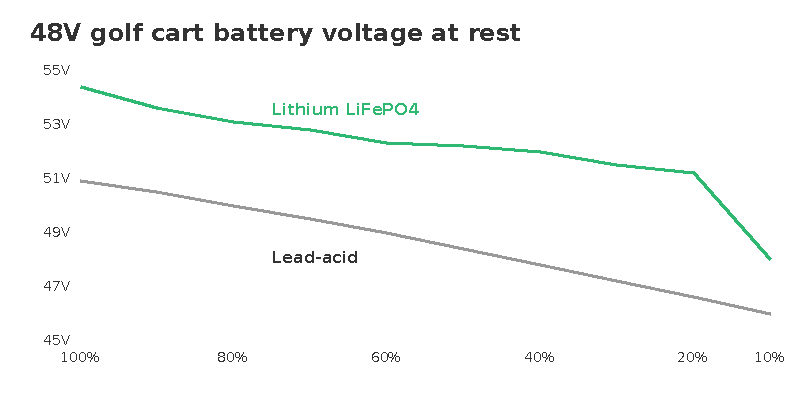
48V Golf Cart Battery Voltage Chart
| State of charge | 48V lead-acid (six 8V) | 48V lithium (16S LiFePO4) |
|---|---|---|
| 100% | 50.9V | 54.4V |
| 90% | 50.5V | 53.6V |
| 80% | 50.0V | 53.1V |
| 70% | 49.5V | 52.8V |
| 60% | 49.0V | 52.3V |
| 50% | 48.4V | 52.2V |
| 40% | 47.8V | 52.0V |
| 30% | 47.2V | 51.5V |
| 20% | 46.6V | 51.2V |
| 10% | 46.0V | 48.0V |
Notice how little the lithium column moves between 70% and 30%: about 1.3V across 40% of the charge. That is why a lithium pack’s voltage is a poor fuel gauge in the middle of its range, and why the factory meter on a converted cart misbehaves (why the meter reads wrong). For lithium, the pack’s Bluetooth app or a shunt-based meter is far more accurate than voltage.
36V and 72V Golf Cart Battery Voltage Charts
| State of charge | 36V lead-acid (six 6V) | 36V lithium (12S) | 72V lithium (24S) |
|---|---|---|---|
| 100% | 38.2V | 40.8V | 81.6V |
| 80% | 37.5V | 39.8V | 79.7V |
| 60% | 36.7V | 39.2V | 78.5V |
| 50% | 36.3V | 39.1V | 78.2V |
| 40% | 35.9V | 39.0V | 78.0V |
| 20% | 35.0V | 38.4V | 76.8V |
| 10% | 34.5V | 36.0V | 72.0V |
Single 6V, 8V and 12V Battery Voltage Chart
On a lead-acid cart, testing each battery separately finds the weak one that drags the whole pack down. A battery that reads well below its neighbors after a full charge and rest is usually the problem; the full test and fixes are in golf cart batteries not holding a charge.
| State of charge | 6V | 8V | 12V |
|---|---|---|---|
| 100% | 6.37V | 8.49V | 12.73V |
| 80% | 6.25V | 8.33V | 12.50V |
| 60% | 6.12V | 8.16V | 12.24V |
| 50% | 6.05V | 8.07V | 12.10V |
| 40% | 5.98V | 7.97V | 11.96V |
| 20% | 5.83V | 7.77V | 11.66V |
What Voltage Should a Golf Cart Battery Charge To?
Readings taken on the charger, or right after it shuts off, are higher than the resting figures above. A 48V lithium pack charges to at most 58.4V (3.65V per cell), and many chargers stop a little lower; a 36V lithium pack tops out at 43.8V. A 48V lead-acid pack finishes its absorption stage at roughly 56 to 59V, based on Trojan’s 2.35 to 2.45V per cell. Lithium and lead-acid need different chargers for exactly this reason (charger compatibility, lead-acid charger on lithium).
How Do You Check Golf Cart Battery Voltage Correctly?
- Let it rest. Lead-acid needs several hours off the charger and off the road, ideally overnight, before its voltage settles. Lithium settles faster, but give it at least an hour.
- Set a digital multimeter to DC volts on a range above the pack voltage.
- Measure the whole pack across the main positive and main negative terminals, then, on lead-acid, each battery on its own.
- Compare with the chart, allowing for temperature: cold batteries read lower.
A voltage that is fine at rest but collapses when you drive points to a weak lead-acid battery, a bad cable or, on lithium, a BMS hitting its current limit (BMS cutoff). Range that drops over time is covered in why a lithium cart loses range. For probe placement, the under-load test and which meter to buy, see how to test golf cart batteries with a multimeter.
Frequently Asked Questions
What should a fully charged 48V golf cart battery read?
About 50.9V at rest for a lead-acid pack of six 8V batteries, and about 54.4V at rest for a 48V (51.2V nominal) lithium pack. Readings right off the charger are higher.
What voltage is too low for a 48V golf cart?
For lead-acid, try not to go below about 48.4V at rest, which is half charge; deeper discharges shorten battery life. A lithium pack below about 51V at rest is near empty, and its BMS will shut it off before the cells are harmed.
What should a fully charged 36V golf cart read?
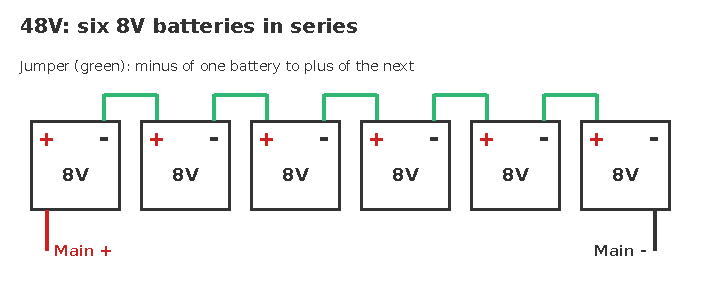
About 38.2V at rest for six 6V lead-acid batteries, and about 40.8V for a 36V (38.4V nominal) lithium pack. If the pack reads about half that, check the jumpers against the golf cart battery wiring diagram.
Why does my lithium battery read the same voltage all day?
That is normal. LiFePO4 holds a nearly flat voltage from about 80% down to 20%, so voltage alone can’t tell 70% from 30%. Use the pack’s app or a shunt monitor; see the best lithium battery meters for golf carts.
Next Steps
If your cart is still on lead-acid, compare the cost with is lithium worth it; if it is 36V or 48V and you are unsure which pack fits, start with 36V vs 48V and the battery size chart.