Golf Cart Battery Wiring Diagram: 36V and 48V Series Configurations
CartVoltage is reader-supported. If you buy through links on this page we may earn a commission at no extra cost to you. As an Amazon Associate we earn from qualifying purchases. Details
Every lead-acid golf cart pack is wired the same basic way: the batteries are connected in series, so their voltages add up to the cart’s system voltage. What changes from cart to cart is how many batteries there are and what voltage each one is. Get one jumper wrong when replacing batteries and the cart won’t move, a battery overheats, or the voltmeter reads half what it should. This guide shows the common 36V and 48V layouts, the safe order to connect cables, and how to confirm the wiring before you drive.
Golf Cart Battery Configurations by Voltage
| Cart voltage | Batteries | Jumpers | Full pack at rest |
|---|---|---|---|
| 36V | Six 6V | 5 | About 38.2V |
| 48V | Six 8V | 5 | About 50.9V |
| 48V | Four 12V | 3 | About 50.9V |
| 72V | Six 12V | 5 | About 76.4V |
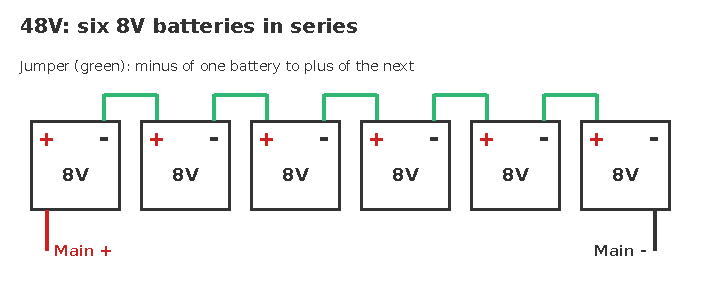
Older 36V carts such as many EZGO TXT and Club Car DS models typically use six 6V batteries. Most modern carts are 48V, built with either six 8V or four 12V batteries depending on make and year. Don’t go by the model name alone: count the batteries and read the voltage printed on one of them, then multiply. Six batteries marked 8V means a 48V cart (36V vs 48V).
How Do You Wire Golf Cart Batteries in Series?
- Make it safe. Key off, Tow/Run switch to Tow, remove rings and watches, wear gloves and eye protection. Take a photo of the existing wiring before you remove anything.
- Disconnect the main negative first, then the main positive, then the jumpers.
- Set the batteries in place so each jumper can reach from one battery’s negative to the next battery’s positive without stretching.
- Fit the jumpers: negative of battery 1 to positive of battery 2, negative of 2 to positive of 3, and so on to the last battery. That leaves one free positive on the first battery and one free negative on the last.
- Connect the main positive cable to the free positive terminal.
- Connect the main negative last, to the free negative terminal. A small spark here is normal as the controller’s capacitors charge.
- Tighten every terminal to the battery maker’s torque and cover them with terminal protector. Loose terminals overheat and melt posts.
Accessories such as lights and a radio should never be tapped off one or two batteries in the string; that drains those batteries faster and unbalances the pack. Use a 48V to 12V reducer instead (voltage reducer guide, and our picks in best 48V to 12V voltage reducers).
How Do You Check the Wiring With a Voltmeter?
- Across the whole pack (main positive to main negative): about 38V on a charged 36V cart, about 51V on a 48V cart. Reading about half that usually means a jumper is reversed or missing.
- Across each battery: about 6.3V, 8.5V or 12.7V when charged. One battery far lower than the rest is weak (not holding a charge).
- Feel for heat after a short drive. A warm terminal or cable points to a loose or corroded connection.
What Cable Size Do Golf Cart Battery Jumpers Use?
Many stock carts use 6 AWG jumpers, and 4 AWG is a common upgrade that runs cooler and helps on hills or with a higher-current controller. Whatever gauge you use, keep all the jumpers the same gauge and the same quality, with sealed, crimped ends. If you are converting to lithium or adding a performance controller, size the main cables and fuse for the pack as shown in lithium wiring basics. For gauge by controller, lug sizes and the kits worth buying, see golf cart battery cables and gauge.
How Is a Lithium Golf Cart Battery Wired?
A lithium conversion replaces the whole string with one pack: the cells are already connected in series inside it, so there are no jumpers. The cart’s main positive and main negative go to the pack’s two terminals, ideally through a fuse sized for the pack. The old jumpers come out, the tray gets a hold-down bracket, and the old batteries go to a recycler (conversion guide, hold-down bracket, old battery disposal).
Frequently Asked Questions
Are golf cart batteries wired in series or parallel?
In series, so the voltages add up. Parallel wiring would keep the voltage of a single battery and the cart would not run. Parallel connections are used only to add a second, identical lithium pack for range (adding a second battery).
What happens if golf cart batteries are wired wrong?
A reversed jumper subtracts a battery’s voltage instead of adding it, so the pack reads low and the cart may not move. A jumper that shorts one battery can overheat it and damage the terminals. If the cart won’t go after battery work, recheck every jumper against your photo (cart won’t move), then confirm each battery and joint with a meter (how to test golf cart batteries with a multimeter).
Which cable do I disconnect first?
The main negative, with the cart in Tow. Reconnect it last.
Can I mix old and new batteries in a golf cart?
It is best not to. In a series string the weakest battery limits the whole pack, so a new battery among old ones is quickly dragged down. Replace the full set, or switch to a single lithium pack.