Golf Cart Battery Not Holding a Charge? Causes, Tests and Fixes
CartVoltage is reader-supported. If you buy through links on this page we may earn a commission at no extra cost to you. As an Amazon Associate we earn from qualifying purchases. Details
A cart that used to do two rounds and now struggles through one is the classic sign of batteries that no longer hold a charge. With lead-acid, the cause is usually one tired battery dragging down the whole string, sulfation from being left discharged, low water, or a charger that stops short. Some of these can be fixed in an afternoon; others mean the pack is at the end of its life. This guide shows how to tell which, using a voltmeter and, for flooded batteries, a hydrometer.
Why Won’t My Golf Cart Batteries Hold a Charge?
- Age. Flooded lead-acid golf cart batteries typically last about 4 to 6 years with good care, less with heat, deep discharges and missed watering.
- Sulfation. Batteries left partly or fully discharged, especially over winter, grow sulfate crystals that permanently reduce capacity. This is why lead-acid should be charged after every use.
- Low water. Exposed plates are damaged quickly. Check levels regularly and top up with distilled water after charging.
- Loose or corroded connections. They waste energy as heat and make the pack look weaker than it is.
- Charging problems. A charger that shuts off early, a wrong charger, or unplugging before the charge finishes leaves the pack undercharged every day (how long a charge should take).
- One weak battery. The string is only as strong as its weakest member; when that battery runs out, the cart slows for all of them.
How Do You Test Golf Cart Batteries?
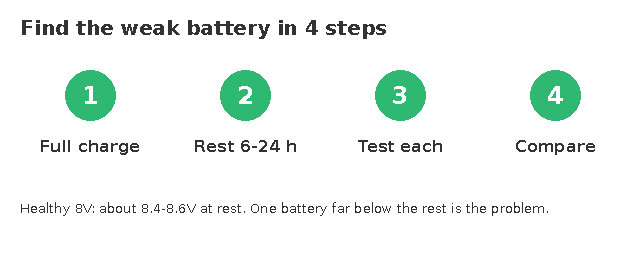
- Fully charge the pack and let the charger finish on its own.
- Let it rest with no charging and no driving for at least 6 hours, ideally 24, as Trojan recommends for an accurate open-circuit reading.
- Measure each battery with a digital voltmeter. A healthy fully charged 8V battery reads about 8.4 to 8.6V, a 6V about 6.3V, and a 12V about 12.7V (full voltage chart).
- Compare. Five batteries near 8.5V and one at 7.6V means you have found the problem battery.
- Check specific gravity (flooded only). A fully charged cell reads about 1.277 on a hydrometer. Trojan treats cells that read low, or differ by more than about 0.015 from the rest, as a sign that the battery needs equalizing.
- Load test if in doubt. A battery that looks fine at rest but drops much faster than the others under load is failing. A golf cart shop or battery dealer can load test the pack.
How Do You Fix Batteries That Won’t Hold a Charge?
- Top up water with distilled water after charging, about 1/8 inch below the bottom of the fill well, never to the cap. Full levels, timing and watering systems are in how to water golf cart batteries.
- Clean and tighten every connection. Baking soda and water removes corrosion; keep it out of the cells.
- Equalize flooded batteries if specific gravity is low or uneven after a full charge, using the charger’s equalize mode and checking gravity hourly until it stops rising. Never equalize sealed AGM or gel batteries.
- Charge after every use and let the charger complete its cycle.
If a battery still reads low after charging and equalizing, or the case is cracked, swollen or leaking, it should be replaced. On an older pack, replacing one battery usually doesn’t last, because the new one is out of step with the tired ones around it; most owners replace the full set. While the batteries are out, check the jumpers too: corroded or undersized cables waste power as heat, and new ones are cheap (golf cart battery cables and gauge).
Is It Time to Switch to Lithium?
When a lead-acid pack is worn out, the choice is a new lead-acid set or a lithium conversion. Lithium costs more up front but removes watering, sulfation and end-of-day fade, weighs 200 to 300 lb less and is rated for thousands of cycles. Run the numbers in is lithium worth it and the cost calculator, and see what to do with the old batteries.
What If It’s a Lithium Battery That Won’t Hold a Charge?
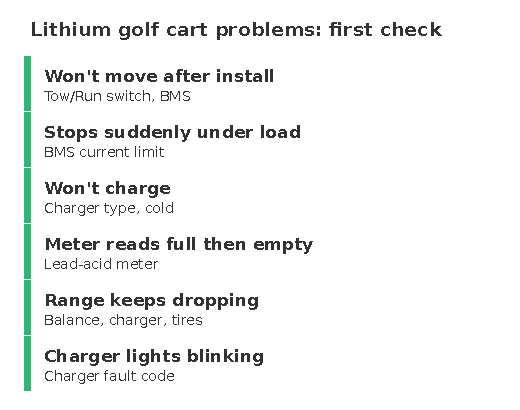
Lithium packs rarely lose capacity quickly. If range has dropped, check the charger is finishing, the cells are balanced (the Bluetooth app shows cell voltages) and nothing is dragging on the cart (lithium losing range). A pack that shuts off early under load is usually the BMS current limit, not lost capacity (BMS cutoff). More in common lithium battery problems.
Frequently Asked Questions
Can I replace just one golf cart battery?
On a young pack, yes. On a pack more than a year or two old, a single new battery is out of balance with the old ones and the problem often returns, so a full set is usually the better buy.
Can sulfated golf cart batteries be restored?
Mild sulfation on flooded batteries can sometimes be reduced by equalizing. Hard, long-standing sulfation usually can’t be reversed, and the battery should be replaced.
Why does my golf cart die quickly after a full charge?
Usually a weak battery whose voltage collapses under load, or a charger that is not really finishing. Test each battery after a rest, then under load, and check every jumper against the golf cart battery wiring diagram. Step-by-step readings and probe placement are in how to test golf cart batteries with a multimeter.
How long do golf cart batteries last?
Flooded lead-acid typically lasts about 4 to 6 years with good care. Lithium packs are rated for thousands of cycles (how long lithium lasts).