48V vs 72V Golf Cart: Speed, Range, Cost and When the Upgrade Makes Sense
CartVoltage is reader-supported. If you buy through links on this page we may earn a commission at no extra cost to you. As an Amazon Associate we earn from qualifying purchases. Details
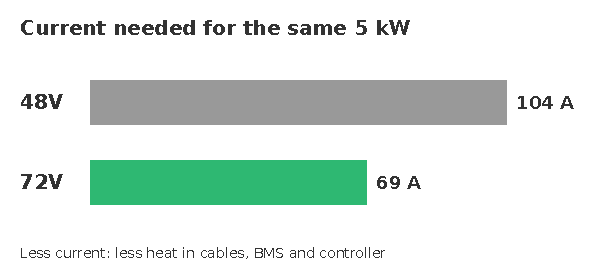
Most EZGO, Club Car and Yamaha carts are 48V from the factory, while 72V is the voltage of choice for lifted builds, many street-legal low-speed vehicles and owners who want more speed and hill power. A 72V system is not simply a bigger battery: it delivers the same power with a third less current, which is why it runs cooler and pulls harder, but every part of the drive system has to be rated for it. This comparison covers speed, range, cost and the parts list, so you can tell whether the upgrade fits your cart.
48V vs 72V Golf Cart Comparison
| 48V | 72V | |
|---|---|---|
| Typical top speed | About 15 to 22 mph | About 25 to 35+ mph (depends on controller, motor, gears) |
| Current for the same power | Higher (about 104A at 5kW) | About a third less (about 69A at 5kW) |
| Hills and lifted carts | Adequate on stock carts; can slow on steep grades | Holds speed better with big tires and heavy loads |
| Range | Set by watt-hours (V × Ah) | Set by watt-hours (V × Ah) |
| Factory carts | Most EZGO, Club Car, Yamaha | Many LSVs and custom builds |
| Conversion work | Drop-in lithium for 48V carts | Controller, solenoid, charger, converter, often motor and cables |
| Battery cost | Lower | Higher for the same capacity in Ah |
Is a 72V Golf Cart Faster Than 48V?
Usually, yes. A DC motor’s speed rises with the voltage it receives, so in theory 72V spins a motor up to 50% faster than 48V. In practice, the controller, motor rating, gear ratio and tires decide the real top speed, and battery makers quote a gain of roughly 25 to 40%. The bigger day-to-day difference is how the cart pulls: on grades, with passengers or on large tires, a 72V cart holds its speed where a 48V cart slows. Note that a lithium battery alone does not raise a cart’s governed top speed (does lithium make a cart faster).
Does a 72V Golf Cart Have More Range?
Not automatically. Range depends on stored energy, which is volts times amp-hours. A 72V 50Ah pack holds 3.6kWh, the same as a 48V 75Ah pack, and a 48V 100Ah pack (4.8kWh) holds more than a 72V 60Ah pack (4.3kWh). Driving a 72V cart at its higher speeds also uses more energy per mile. Compare packs by kWh, then estimate miles with the range calculator.
What Do You Need to Convert a 48V Golf Cart to 72V?
- A 72V-rated controller. This is the deciding part; a 48V controller can fail on 72V. Many upgrades use an aftermarket controller rated for 48 to 72V, programmed for the motor (controller and solenoid).
- A motor that can take it. Many 48V motors tolerate 72V but run hotter and wear faster; check with the motor maker or fit a higher-speed or higher-power motor.
- A 72V-rated solenoid to switch the higher voltage safely.
- A 72V lithium charger matched to the pack; a 48V charger will not work.
- A 72V-input 12V converter for lights, horn and accessories (voltage reducer guide).
- Cables and fusing sized for the controller’s peak current (wiring basics).
- The 72V pack itself, which may not fit a standard tray; measure first. Watch for 70.4V vs 76.8V packs, which need different chargers (72V battery guide).
Controller programming is the part most owners hand to a shop. Never put a 72V pack on a cart whose controller and solenoid are rated only for 48V.
Should You Choose 48V or 72V?
- Stay with 48V for course use, flat or gently rolling neighborhoods, fleet carts and budget conversions. A good 48V lithium pack with enough continuous current covers stock carts well (best 48V batteries).
- Consider 72V for lifted carts on large tires, steep hills, six-seaters, heavy utility work or street use where local rules allow higher speed.
Speed also has a legal side: golf carts on public roads are commonly limited to about 20 mph, and low-speed vehicles to 25 mph, so a faster cart may not be road-legal at full speed. Check local rules first.
Frequently Asked Questions
Can I put a 72V battery in a 48V golf cart?
Not on its own. The controller, solenoid, charger and 12V converter must be rated for 72V, and the motor must be able to handle it. Without those, the higher voltage can destroy the controller.
How fast does a 72V golf cart go?
Battery makers quote roughly 25 to 35 mph or more for 72V builds, but the controller settings, motor, gearing and tire size decide the real number.
Is 72V better than 48V?
For speed, hills and heavy carts, yes. For a stock cart used on a course or in a flat neighborhood, 48V is cheaper, simpler and entirely adequate.
Does 72V use less battery?
It draws less current for the same power, which slightly reduces heat losses, but range still comes down to the pack’s kWh and how fast you drive.