Do You Need a New Controller or Solenoid for a Lithium Golf Cart Battery?
CartVoltage is reader-supported. If you buy through links on this page we may earn a commission at no extra cost to you. As an Amazon Associate we earn from qualifying purchases. Details
Somewhere in every lithium conversion thread someone says “you’ll need a new controller for lithium,” and someone else says they have run a stock controller for three years without a problem. Both are describing real carts. The stock controller and solenoid on a 36V or 48V cart were designed around a lead-acid pack whose voltage swings from 42V to 64V over a day, and a lithium pack sits comfortably inside that window. What changes is not the voltage but the current the cart can now pull, the regen the pack has to accept, and the age of the parts you are keeping. This guide goes through the controller, the solenoid, the onboard computer and the wiring, and says for each one when to keep it and when a change is justified.
Why the Voltage Is Not the Problem
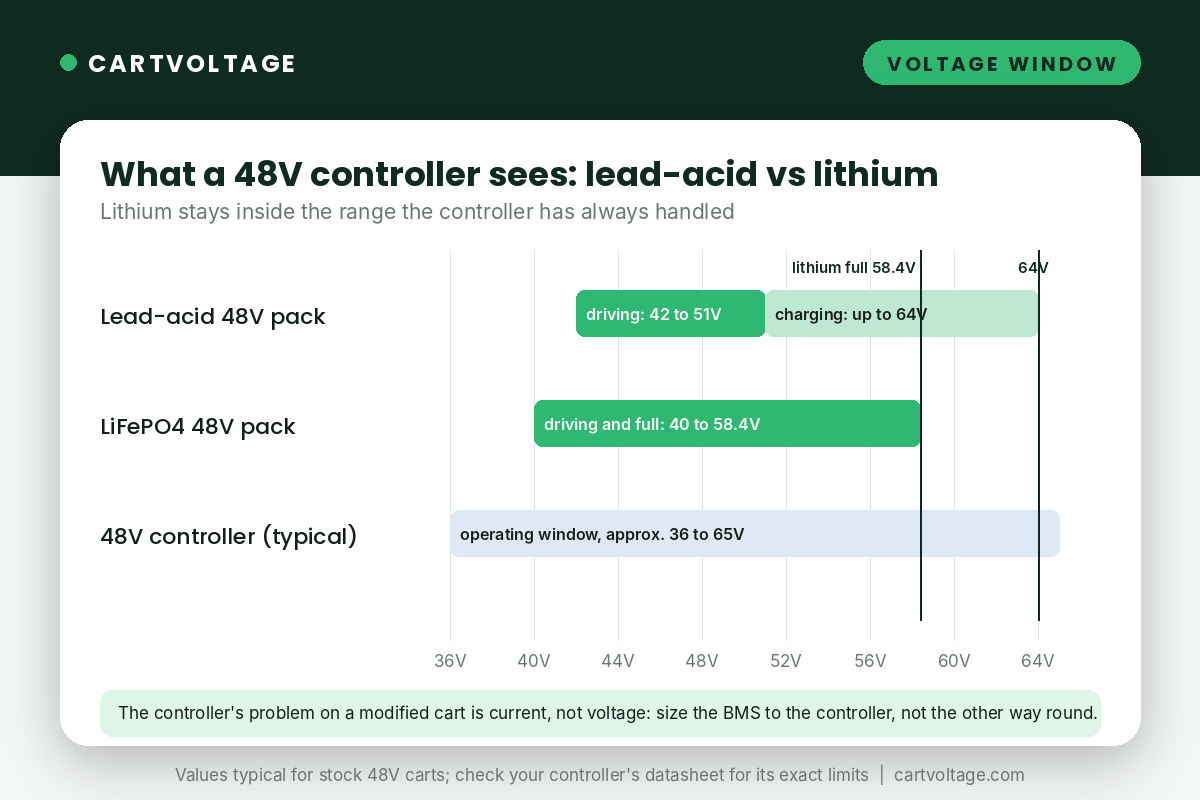
A “48V” lead-acid pack is a 48V pack only on the label. Fully charged and rested it sits at about 51V, it sags into the low 40s climbing, and while the charger is connected and finishing it is pushed to 60V to 64V, with the controller connected the whole time. Every stock 48V controller has lived with that range for years. A 48V LiFePO4 pack rests at 51.2V, is full at 58.4V, and the BMS disconnects it at 40V. Nothing in that range is new to the controller. The same holds for 36V: lead-acid between 32V and 48V on charge, lithium between 30V and 43.8V. The one place lithium’s voltage shows is at the top: because the pack holds 52V to 53V for most of its charge instead of sliding down from 51V, a series-wound cart runs a little faster and a little stronger all day, which owners notice as the cart feeling “new”. That is the motor seeing a steadier voltage, not a problem to fix.
The Controller: Keep It, With Three Exceptions
Stock controllers on the common carts are rated somewhere between 250A and 350A peak: the EZGO TXT PDS controller is a 275A unit, Club Car’s IQ is 250A, the Yamaha G29 Drive uses a 300A Curtis, and the RXV’s AC drive is in the same class. A 200A continuous lithium BMS covers what those controllers pull on a stock cart with margin, because a stock cart on the flat draws 60A to 120A and only touches the controller’s peak for a second or two pulling away or starting a climb. Keep the controller unless one of these applies:
- You are changing voltage. A 36V cart converted to 48V, or any cart going to 72V, needs a controller, solenoid and often a motor rated for the new voltage. That is a performance project with a lithium pack in it, not a lithium conversion; the 36V vs 48V guide covers what it involves.
- You want more than the cart has. A 400A, 500A or 600A controller is the standard way to get torque for a lifted cart on big tires, and lithium’s steady voltage makes the upgrade feel bigger. But the controller upgrade then dictates the battery: a 500A controller on a 200A BMS trips the pack on every hill, which is the first cause in the BMS cutoff guide. Upgrade the controller and the pack’s continuous rating together, as the hills and lifted carts guide explains.
- The controller is already failing. A controller that throws codes, hesitates or overheats on lead-acid will do the same on lithium. The conversion is a sensible moment to replace it, but lithium is not the reason.
One setting is worth a look if the controller is programmable. Navitas controllers have a lithium battery type that fixes the state-of-charge display and the low-voltage behaviour; Curtis controllers set up by a dealer can have their under-voltage cutback moved. Neither is required for the cart to run; both make it behave better at the bottom of the pack, where lithium’s voltage drops quickly and a cutback tuned for lead-acid’s slow slide can trigger late or early.
Regen Braking: the Controller Pushes Current Back
Carts with regenerative braking, which is every EZGO RXV, every Club Car Precedent, Onward and Tempo, and most AC-drive carts, use the motor as a generator on descents and push the current into the pack. A lead-acid pack absorbs it without comment. A lithium pack absorbs it through the BMS’s charge path, and if the pack is at 100% the BMS has to refuse, which is why a regen cart that has just been charged to full can cut out on the first downhill. The controller is not at fault and does not need replacing; the fix is either a pack with a BMS that tolerates regen at full, or the habit of stopping the charge short of 100% when the first mile is downhill. The RXV conversion guide and the Onward and Tempo guide cover the regen carts specifically.
The Solenoid: Keep It If It’s Healthy, Replace It If It’s Old
The solenoid is a relay: a 36V or 48V coil pulls a pair of heavy contacts closed so battery current can reach the controller. Its coil does not care whether the voltage comes from lead-acid or lithium, and its contacts are rated for the stock controller’s current. On a stock cart, keep it. There are two honest reasons to replace it during a conversion. First, age: solenoid contacts pit and burn over years of pulling in under load, and a worn solenoid that drops out under current is the most common cause of a cart that clicks and does not move, which is high on the list in the won’t-move guide. If the cart is more than eight or ten years old and the batteries are out anyway, a new solenoid is cheap insurance. Second, a controller upgrade: a 400A or larger controller needs a heavy-duty solenoid with contacts rated for it, the same as it would with lead-acid.
One detail matters more with lithium. Many carts have a pre-charge resistor across the solenoid contacts, a small resistor that lets the controller’s capacitors charge gently before the contacts close. Club Car IQ and Excel carts and EZGO PDS carts have one from the factory. If the resistor is missing or burnt, the controller’s capacitors charge through the contacts in one surge, which pits the contacts and, with lithium, can trip the BMS’s short-circuit protection. Check that it is there and intact, and pre-charge the controller manually the first time the new pack is connected regardless, as described in the conversion guide.
The Onboard Computer: the One Thing You Must Deal With
Club Car 48V carts from 1995 to about 2014 have an onboard computer that manages lead-acid charging and locks the solenoid while it thinks a charger is connected. A lithium pack has its own BMS and the OBC has no way to talk to it, so on a converted Club Car the OBC either gets bypassed for charging or the cart gets a charger designed to work around it. This is not a controller change; the controller stays. It is a wiring change at the charger receptacle and the OBC’s sense lead, and it is the step that trips up more Club Car conversions than anything else. The Club Car DS and Precedent guide walks through it with the charger that makes it simplest, and the charger compatibility guide explains which chargers need the bypass and which don’t.
Wiring, Fuses and the Rest
- Main cables. The stock 4 AWG or 6 AWG cables that carried lead-acid current carry lithium current just as well; the pack delivers the same amps for the same job. Replace cables that are corroded, stiff or have green crystals at the lugs, which is most cables on a ten-year-old cart, and shorten the run where the single pack sits closer to the controller than six batteries did. New cables should be 4 AWG for a stock controller and 2 AWG for a 400A or larger one (lithium golf cart wiring basics).
- A main fuse or breaker. Most lead-acid carts never had one. Lithium packs can deliver far more current into a short than lead-acid, so an ANL fuse or a resettable breaker on the positive lead, close to the terminal, is the one addition worth making. Size it above the pack’s continuous rating and at or below what the cable can carry: 250A for a 200A pack on 4 AWG, 300A for a 250A pack on 2 AWG. The BMS protects the cells; the fuse protects the cables.
- Voltage reducer. If the cart’s lights, horn or stereo ran from a tap across two lead-acid batteries, that tap is gone. A 48V-to-12V reducer takes its place; the reducer guide covers sizing and wiring.
- Battery meter. The factory meter reads lead-acid voltage and makes no sense on lithium (why, and the fix). Use the pack’s app or a lithium-calibrated meter.
- Tow/Run switch and key. Unchanged, and both should be in Tow and off while the pack is connected.
Keep or Replace, by Part

| Part | Stock cart, same voltage | Replace when |
|---|---|---|
| Controller | Keep | Changing voltage; adding a 400A+ performance controller (then size the BMS to match); already failing |
| Solenoid | Keep if healthy | Over 8 to 10 years old, contacts pitted, drops out under load; or a controller upgrade needs a heavier one |
| Pre-charge resistor | Check it is present and intact | Missing or burnt; add one if the cart never had it |
| Onboard computer (Club Car 1995 to 2014) | Bypass for charging, or use a charger that works around it | Not replaced; bypassed |
| Main cables | Keep if clean and flexible | Corroded, stiff, or too long for the new pack position |
| Main fuse or breaker | Add one, 250A to 300A | Always worth adding; lithium can push far more current into a short |
| Voltage reducer | Add if the cart has 12V accessories | Any cart that tapped 12V off the old batteries |
| Battery meter | Replace or ignore | Lead-acid meters misread lithium; use the app or a lithium meter |
Frequently Asked Questions
Will a lithium battery damage my golf cart controller?
No. A 48V lithium pack tops out at 58.4V, below the 60V to 64V a lead-acid charger has always pushed through the same controller. The controller sees a steadier, slightly higher average voltage and nothing outside its range.
Do I need a new solenoid for a lithium golf cart battery?
Not because of lithium. Replace it if it is old and worn, which on a cart more than eight to ten years old is likely, or if you are also fitting a high-current controller that needs heavier contacts.
Does a lithium golf cart go faster with the stock controller?
A little, on series-wound carts, because the pack holds 52V to 53V through the day instead of sliding down from 51V. Speed-limited carts (most Precedents and RXVs) stay at their programmed limit. The real speed gains come from controller and gearing changes, not the battery.
Do I need to reprogram the controller for lithium?
Not to make the cart run. On programmable controllers, setting a lithium battery type or adjusting the under-voltage cutback improves the state-of-charge display and the behaviour near empty, but a stock cart drives normally without it.
Can I convert a 36V cart to 48V just by fitting a 48V lithium pack?
No. The controller, solenoid and often the motor are rated for 36V, and 48V will shorten their life or fail them outright. A 36V cart gets a 36V lithium pack, which still gives it steadier voltage and more range; a voltage change is a separate project with its own parts list.
Next Steps
The step-by-step conversion guide covers the pre-charge, the cable routing and the fuse. If your cart is a Club Car, read the OBC bypass walkthrough before buying a charger. And if you are planning a controller upgrade at the same time, pick the pack from the hills and lifted carts guide so the BMS can keep up.