
Best Golf Cart Bluetooth Speakers and Soundbars: Portable vs Hardwired, and Powering One on a Lithium Cart
CartVoltage is reader-supported. If you buy through links on this page we may earn a commission at no extra cost to you. As an Amazon Associate we earn from qualifying purchases. Details
A speaker is the accessory most likely to be bought twice. The first purchase is usually a portable Bluetooth speaker strapped to the roof support; the second, a year later, is a hardwired soundbar once the owner is tired of charging the portable and losing it to the weather. Both are reasonable choices, but they ask very different things of the cart’s electrical system, and on a 48V or lithium cart the hardwired route needs a correctly sized reducer and, for clean sound, an isolated one. This guide covers both kinds, with the current figures and wiring details that decide whether the music plays or the lights dim with the bass.
Portable Speaker vs Hardwired Soundbar
| Portable Bluetooth speaker | Hardwired 12V soundbar | |
|---|---|---|
| Power source | Own rechargeable battery | Cart’s 12V circuit via reducer |
| Draw on the cart | None | About 5A typical, up to 17A at full volume (200W RMS) |
| Weather | IP67 models shrug off rain; must be taken in to charge | IP66 or IP67, stays on the cart year-round |
| Volume and bass | Enough for two seats | Enough for a six-seater or a tailgate |
| Theft and loss | Comes off with a strap; easily forgotten | Bolted to the roof supports |
| Install | None | 1 to 2 hours plus reducer wiring |
| Typical price | $60 to $200 | $250 to $500 |
| Not ideal if | You drive at dusk daily and hate charging things | The cart has no reducer yet and you are not ready to add one |
How Much Current Does a Golf Cart Soundbar Draw?
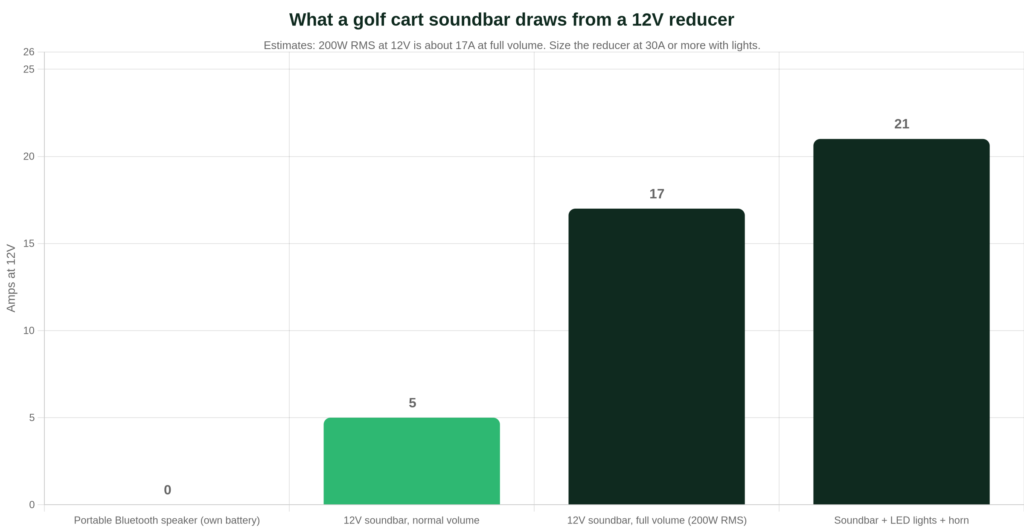
Soundbar boxes quote peak watts (300, 500, even 1,000), which is a marketing figure. The number that matters is RMS, and even that is only reached at full volume with heavy bass. A 200W RMS bar can pull about 17A from 12V for a moment on a bass hit and about 5A at normal volume. Add LED lights and a horn (about 4A) and the peak is just over 20A, which is why a 30A reducer is the sensible minimum for a cart with both, and a 40A unit is worth it with a bigger amplified bar (reducer picks by load). On a lithium pack this is trivial: 20A at 12V is about 5A from a 48V pack.
Our Picks
1. ECOXGEAR SoundExtreme Soundbar: Best Hardwired Value
ECOXGEAR’s SoundExtreme line (18, 26 and 32 inch) is the most common golf cart soundbar for a reason: IP66 sealing, a five-speaker layout in the 18 inch (one tweeter, two mids, two woofers), 300W peak, Bluetooth 5.0 with about 100 ft range, and LED accent lighting, at about $300 for the 18. One detail from owner reports worth knowing: some units shut down above roughly 14.2V input, which is a non-issue on a regulated 12V reducer but a reason not to run one straight off a charging 12V battery.
2. Wet Sounds Stealth 6 Ultra: Best Sound Quality
The Stealth 6 Ultra is the step up: a built-in 200W RMS Class D amplifier driving four 3 inch marine drivers and two 1 inch titanium tweeters, IP67, 40Hz to 20kHz, about 21 inches long and 15 lb, with Bluetooth built in. It costs roughly $400 to $480 and is the bar to buy if the cart is the party. Its 15 lb weight wants solid roof-support clamps, and its amplifier is the reason to size the reducer at 30A or more.
3. Rugged Portable Bluetooth Speaker: Best No-Wiring Option
If you would rather not touch the wiring, buy a portable speaker rated IP67 with 12 hours or more of battery and a strap or clamp mount, and keep it on the charger between rounds. It will never dim the headlights, and it goes to the beach too. Its limits are volume on a six-seater and the daily charging.
Wiring a Soundbar on a 48V or Lithium Cart
- Never tap one battery or the pack for 12V. On lead-acid it unbalances the string; on lithium there is nothing to tap. Use a reducer with an input ceiling above 58.4V (reducer guide).
- Size the reducer for everything at once: soundbar peak plus lights plus horn, then 25% more. 30A for most carts, 40A for a big amplified bar.
- Fuse the soundbar’s positive lead close to the reducer with the fuse the maker specifies (typically 10 to 20A), and run the negative back to the reducer’s output negative, not to the frame.
- Key-switch the reducer so the bar cannot drain the pack while parked; most soundbars have a small standby draw.
- Mount on the roof supports with the included clamps, cable tucked inside the support tube or along it with zip ties, away from the pedal area.
Why Does My Golf Cart Speaker Whine, and How Do I Fix It?
A rising whine that follows motor speed is a ground loop: the controller’s switching noise rides on the shared negative of a non-isolated reducer and into the amplifier. The cures, cheapest first: run the soundbar’s negative straight to the reducer’s output negative rather than the frame; add an inline ground loop isolator on the audio or power lead; or fit an isolated reducer such as the Victron Orion-Tr, whose separate input and output grounds remove the path entirely (isolated reducer pick). Lithium carts are not immune; the controller, not the battery, makes the noise.
Frequently Asked Questions
Can I run a 12V soundbar on a 48V golf cart?
Yes, through a 48V to 12V reducer rated for at least the soundbar’s peak draw plus your lights. Never connect a 12V soundbar across part of the pack.
Will a soundbar drain my lithium battery?
While playing, a 200W bar at normal volume costs the pack roughly 1 to 2A at 48V, a small fraction of what driving uses. Key-switch the reducer so nothing draws while parked.
What size reducer do I need for a golf cart soundbar?
30A covers a 200W RMS bar plus LED lights and a horn with headroom; choose 40A for larger amplified bars or a second amplifier.
Is IP66 or IP67 better for a golf cart speaker?
IP66 resists powerful water jets; IP67 survives brief immersion. For a roof-mounted bar in rain and pressure washing, either is fine; IP67 matters more for a portable that may end up in the lake.