Best Golf Cart Accessories: The Upgrades Worth Buying, in the Order to Buy Them
CartVoltage is reader-supported. If you buy through links on this page we may earn a commission at no extra cost to you. As an Amazon Associate we earn from qualifying purchases. Details
Golf cart accessory lists tend to be forty items long and useless, because they never say which upgrades change how the cart is used and which are decoration. This one is shorter and ranked. It separates the accessories that need no power and fit any cart from the powered upgrades that share one 12V circuit, gives the current each one draws, and puts them in the order that experienced owners actually buy them: the things that make the cart safer and more useful first, the things that make it louder last.
Tier 1: No Power Needed, Fits Any Cart
| Accessory | Why it earns its place | What to look for | Typical price |
|---|---|---|---|
| Side mirrors and rear-view mirror | The cheapest safety upgrade; required for street use in most places | Folding side mirrors that clamp to the roof struts; a wide panoramic rear mirror | $20 to $50 |
| Storage cover or driving enclosure | Keeps seats, dash and terminals dry; see our enclosure guide | Buy by roof length, 600D fabric, wind straps | $40 to $350 |
| Cup holders and dash organizer | Stops phones and drinks ending up under the pedals | Strut-clamp holders with a rubber liner; dash trays with a non-slip base | $15 to $40 |
| Seat covers | Protect vinyl from sun cracking and make a hot seat usable | Breathable mesh for hot climates, waterproof for wet ones, sized to the seat width | $25 to $80 |
| Rear cargo box or utility bed | Turns a cart into a yard and errand vehicle | Bolts to the rear seat or bag-well mounts; check the load rating | $80 to $250 |
| Rear seat kit | Two more riders; the biggest change to how a cart is used | Model-specific kit with a fold-down deck; check it fits your lift height and roof | $250 to $500 |
Not for every cart: a rear seat kit adds 60 to 90 lb behind the axle and two riders on top of it, which is exactly the load that makes a tired lead-acid pack crawl up hills. If a rear seat is in the plan, budget for the battery too (how weight changes the cart).
Tier 2: Powered Accessories, and What They Draw
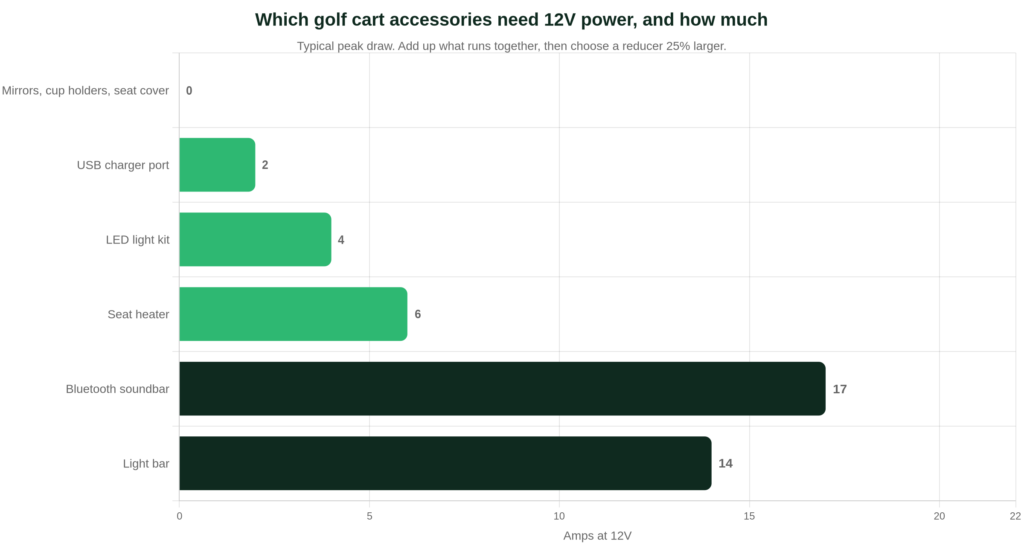
| Accessory | 12V draw | Guide | Not ideal if |
|---|---|---|---|
| Lithium battery meter | Under 1A | Best lithium battery meters | Your pack already has a Bluetooth app you check |
| USB charging port | About 2A | Any dual-port 12V USB socket with a rubber cap; wire it key-switched | You never carry a phone on the cart |
| LED light kit | About 2 to 4A | Best LED light kits | The cart never drives at dusk |
| Seat heater pad | About 4 to 6A | 12V heated seat pads with a two-level switch | Warm climate; a seat cover does more |
| Fan | About 3 to 5A | Clamp-on 12V fans for hot climates | Cool climate |
| Light bar | About 8 to 15A | Only with a 40A or larger reducer | Street-driven cart; many places prohibit them on roads |
| Bluetooth soundbar | About 5A typical, up to 17A | Best speakers and soundbars | No reducer yet; a portable speaker is simpler |
The One Part Every Powered Accessory Depends On
On a 36V, 48V or lithium cart, none of the Tier 2 items can connect to the pack directly. Tapping one lead-acid battery for 12V unbalances the string and shortens its life; a lithium pack has no 12V to tap at all. The right source is a 48V to 12V reducer with an input ceiling above 58.4V, wired through the key switch and fused. Add up the peak draws of everything that could run at once, add 25%, and buy that size: lights, USB and a meter fit a 20A reducer; add a soundbar and 30A is the sensible minimum; a light bar or seat heaters on top call for 40A (reducer guide, reducer picks). On a lithium pack the whole set is a small load: 20A at 12V is about 5A from the 48V side.
A Sensible Buying Order
- Mirrors. Day one, whatever the cart.
- Cover or enclosure, depending on whether the cart sits outside or drives in weather.
- Reducer, if the cart is 36V, 48V or lithium and anything powered is coming.
- Battery meter on a lithium cart, or a multimeter on a lead-acid one.
- LED light kit, street-legal if the cart leaves the property.
- USB port, cup holders, seat covers: the small daily-use items.
- Rear seat or cargo box, whichever matches how the cart is used.
- Soundbar, last, once the reducer and wiring are in place to feed it cleanly.
Lift kits and tires are a separate decision with their own consequences for speed, torque and the battery; they have their own guide (lift kits and tire sizes).
Frequently Asked Questions
What accessories do I need to make a golf cart street legal?
Commonly headlights, taillights, brake lights, turn signals, a horn, mirrors, a windshield and sometimes seat belts and a slow-moving-vehicle sign. Requirements vary by state and community, so check locally before buying.
Can I add 12V accessories to a lithium golf cart?
Yes, through a 48V to 12V reducer. Never tap the lithium pack’s cells; it unbalances the pack and can void the warranty.
Will accessories drain my golf cart battery?
While driving, a typical accessory set is a few amps from a 48V pack, a small share of what the motor uses. Wire the reducer through the key switch so nothing draws while parked.
Which golf cart accessories fit all carts?
Strut-clamp mirrors, cup holders, covers sized by roof length, seat covers sized by seat width and most USB ports. Light kits, rear seats and lift kits are model-specific.