
Best DC Clamp Meter for Golf Cart Batteries: Measure Amp Draw, Charger Output and Parasitic Drain
Disclosure: CartVoltage earns a commission from qualifying purchases made through links on this page, at no extra cost to you. Specifications come from manufacturer and retailer pages, which are named where they are used.
A multimeter tells you the voltage of a golf cart battery. It cannot tell you how hard the battery is working. For that you need amps, and a golf cart moves far more current than a multimeter’s 10A socket can carry. A DC clamp meter reads that current from outside the cable, with nothing disconnected. The mistake most buyers make is picking up a clamp meter that only reads AC, which is useless on a battery cable.
Why Does a Golf Cart Need a DC Clamp Meter?
Clamp meters come in two kinds. An AC-only clamp uses a simple coil that responds to alternating current. A battery supplies direct current, which that coil cannot sense. A DC clamp has a Hall effect sensor in the jaw that measures the steady magnetic field around the cable. The product name or spec sheet must say DC amps or “AC/DC current”. If it only says “AC current” plus “DC voltage”, the DC part refers to the test leads, not the clamp.
| Question | Multimeter | DC clamp meter |
|---|---|---|
| Is the pack charged? | Yes (voltage) | Yes, most have voltage leads too |
| How many amps is the motor pulling? | No, limited to about 10A | Yes |
| Is the charger putting out its rated amps? | No | Yes |
| Is something draining the pack while parked? | Only by breaking the circuit | Yes, on a low range |
| Which battery is weak? | Yes | Yes, with the leads |
If you only want voltage checks, a multimeter is enough and costs less. See best multimeter for golf cart batteries.
How Many Amps Does a Golf Cart Draw?
The range you need depends on what you plan to measure. The currents on one cart span more than three orders of magnitude, from a fraction of an amp when parked to hundreds of amps on a hill.
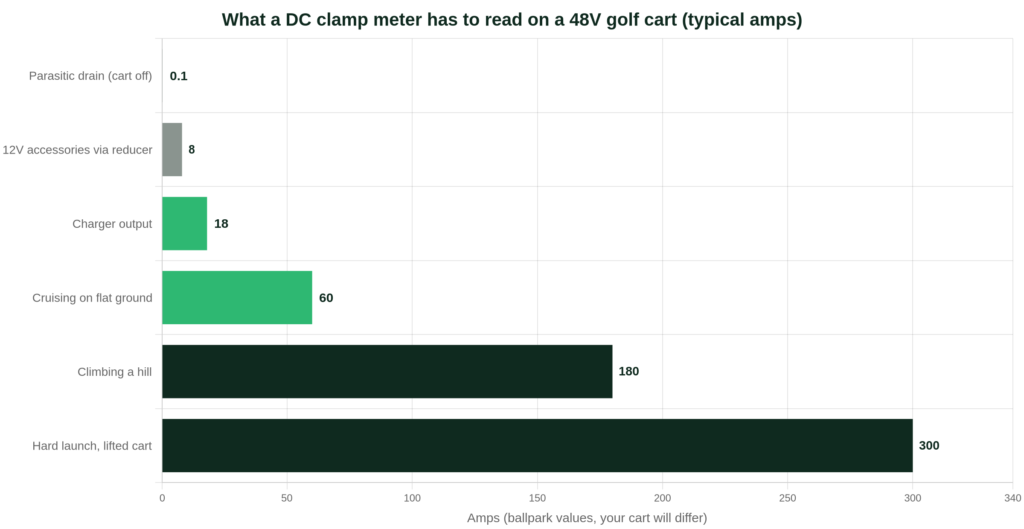
| What you measure | Typical current | Range and resolution you want |
|---|---|---|
| Parasitic drain with the cart off | 0.02 to 0.3A | 2A or 20A range, 0.001 to 0.01A steps |
| 12V accessories through a reducer | 2 to 15A | 20A or 40A range |
| Charger output | 13 to 25A | 40A or 100A range |
| Cruising on flat ground | 40 to 80A | 100A or 400A range |
| Hills, heavy load, hard launch | 150 to 300A or more | 400A range or higher |
That spread is the reason no single cheap meter is perfect. A 400A meter usually steps in 0.01A at best, which is coarse for a 0.05A drain. A 100A meter with 0.001A steps is excellent for drain but goes over range the moment you climb a hill.
What Is the Best DC Clamp Meter for a Golf Cart?
| Meter | DC current | Jaw opening | Safety rating | Best for |
|---|---|---|---|---|
| Klein Tools CL390 | 400A AC/DC | 1.6 in (41 mm) | CAT III 600V | Motor and controller current, general use |
| UNI-T UT210E | 100A AC/DC (2A, 20A, 100A ranges) | 17 mm | CAT II 600V, CAT III 300V | Parasitic drain, charger output, accessories |
| Fluke 325 | 400A AC/DC (40A, 400A ranges) | 30 mm | CAT III 600V, CAT IV 300V | Daily professional use |
Best overall: Klein Tools CL390
Top pick: Klein Tools CL390
400A AC/DC true RMS clamp meter with 600V AC/DC voltage, Rel/Zero button, temperature probe input and a 4000-count display.
Check price on AmazonKlein’s product page lists 400A AC/DC current, 600V AC and DC voltage, a 1.6 inch jaw, CAT III 600V, a Rel/Zero function, a DC polarity indicator, Max/Min, and temperature from -40°F to 1,832°F with a K-type thermocouple. It is built to survive a 6.6 ft drop.
For a golf cart, three of those matter. The 400A range covers hill and launch current on most stock and mildly upgraded carts. The 1.6 inch jaw closes easily around 2 AWG and even doubled cables. Max/Min lets you clamp the cable, drive a loop, and read the peak afterwards without watching the display. The temperature input is a bonus for checking a hot terminal.
Not ideal if: your main job is hunting a small parasitic drain. A 4000-count display resolves 0.01A at best, so a 0.03A drain shows as two or three counts. It is also not enough for a high-output build with a 500A or larger controller, where peaks can pass 400A.
Best for parasitic drain and chargers: UNI-T UT210E
UNI-T’s data sheet lists three DC current ranges (2A, 20A and 100A), 1mA resolution, an accuracy of 2% plus 3 counts, a 2000-count display and a 17 mm jaw. The meter is rated CAT II 600V and CAT III 300V. It is small, low priced, and one of the few budget clamps that can see milliamps of DC.
On a golf cart that makes it the right tool for three jobs: finding what drains the pack in storage, checking that a charger delivers its rated 13 to 25A, and measuring what lights, a stereo or a voltage reducer really draw. An independent teardown review by Mark Hennessy notes that the 2A range is very sensitive to stray magnetic fields, so you must press Zero with the jaw in position next to the cable before each reading.
Not ideal if: you want motor current. It tops out at 100A, and a cart on a hill will exceed that. The 17 mm jaw fits a single 4 AWG or 2 AWG cable but is tight on thick welding-type insulation and will not go around two cables together. The lower safety rating is fine for a 48V cart but makes it a poor choice for household mains work.
See the UNI-T UT210E on Amazon
Professional pick: Fluke 325
The Fluke 325 measures AC and DC current to 400A on 40A and 400A ranges, with a stated DC accuracy of 2% plus 5 digits. It reads 600V AC and DC, has a 30 mm jaw, measures temperature with the included probe, and carries CAT III 600V and CAT IV 300V ratings with a 2-year warranty, as listed by Tester.co.uk.
Not ideal if: you service one cart a few times a year. Its measurements are no more useful on a golf cart than the Klein’s, and it costs considerably more. Pay for it if the meter will be used every week or will also be used on mains equipment.
How Do You Use a DC Clamp Meter on a Golf Cart?
- Select DC amps. On many meters the dial position is shared and a button switches between AC and DC.
- Zero the meter. Close the empty jaw, hold it near where you will measure, and press Zero or Rel. A DC clamp drifts with temperature and nearby magnetic fields, so repeat this before every reading.
- Clamp one cable only. Put the jaw around a single main cable, for example the pack’s main negative. If you clamp positive and negative together, the two currents cancel and the meter reads zero.
- Center the cable and close the jaw fully. A gap in the jaw gives a wrong reading.
- Note the sign. A minus sign only means the current flows the other way through the jaw. It is useful: discharge and charge show opposite signs.
Safety comes first. Do not hold a meter while driving. Secure it and use Max/Min, or have a passenger read it. Keep the metal test lead tips away from battery terminals when you are only using the clamp, and remove rings and watches around a battery pack.
Five Tests You Can Run
1. Parasitic drain while parked
Key off, charger unplugged, clamp on the main negative, lowest range. A small draw adds up. At 0.10A the pack loses 0.10 x 24 x 30 = 72Ah in a month. On a 170Ah lead-acid pack that is over 40% gone in four weeks, with nobody driving. If you find a drain, switch to Tow and pull accessory fuses one at a time until the reading drops. For storage, see the best golf cart battery maintainer.
2. Charger output
Clamp one of the charger’s DC leads, or the main negative while charging. Early in the charge on a low pack, a healthy charger should deliver close to its rated amps. Near the end, the current tapers to a few amps, which is normal. A 15A charger that never shows more than 6A on a half-empty pack has a problem. More on this in the best golf cart battery charger guide.
3. Running current and real power
Amps times pack voltage is power. A steady 60A on a 51V lithium pack is 60 x 51 = 3,060 watts, about 3 kW. That also gives a rough runtime: a 105Ah battery at an average of 60A lasts about 105 / 60 = 1.75 hours of continuous driving. Compare it with our golf cart battery range guide.
4. Peak current against the BMS rating
Set Max, then drive your steepest hill with a normal load. If the peak sits close to your lithium battery’s continuous rating, you have found why the cart cuts out. A 200A battery management system (BMS) with a cart that pulls 220A for a long climb will trip. See golf cart lithium BMS cutoff and batteries for hills and lifted carts.
5. Finding a bad cable or connection
This test needs both functions at once: the clamp for amps and the leads for voltage across one cable, end to end, under load. Resistance is volts divided by amps. Example: 0.090V across a cable carrying 150A is 0.090 / 150 = 0.0006 ohms, and it wastes 0.090 x 150 = 13.5 watts as heat. A cable that shows several times the drop of its neighbors at the same current is corroded or undersized. See golf cart battery cable gauge.
The same method works on the solenoid: measure the voltage across its two large terminals under load. Our golf cart solenoid guide explains what the reading means and when to replace it.
What Do the Readings Mean?
| Reading | Likely meaning | Next step |
|---|---|---|
| 0.00A on a cable you know is carrying current | AC mode selected, AC-only meter, or both cables in the jaw | Switch to DC and clamp one cable |
| A steady small reading with nothing connected | Meter not zeroed | Press Zero and measure again |
| Parked drain above about 0.1A | An accessory, reducer or controller is staying awake | Use Tow mode and pull fuses to find it |
| Cruising current much higher than before on the same route | Dragging brakes, low tire pressure, or a bearing | Check the cart mechanically before blaming the battery |
| Peak current near the BMS limit | Battery is undersized for the cart | Reduce load or move to a higher-current battery |
| Charger current far below its rating on a low pack | Charger fault, bad plug contact, or wrong profile | Check the plug pins, then the charger |
Who Should Skip a Clamp Meter?
| Your situation | Better choice |
|---|---|
| You only check state of charge | A multimeter or a battery meter on the dash |
| You have a lithium battery with a Bluetooth app | The app already shows live amps. See lithium battery Bluetooth app |
| You want amps on display all the time | A shunt-based battery monitor. See best lithium battery meter |
| You are not comfortable working near a live battery pack | A golf cart shop can run these tests in minutes |
Frequently Asked Questions
Can a regular clamp meter measure DC amps?
Only if it is an AC/DC model with a Hall effect sensor. Many low-cost clamp meters measure AC current only. They still have DC voltage through the leads, which is why the packaging can be confusing. Look for “DC current” or “AC/DC amps” in the specs.
How many amps should a clamp meter read for a golf cart?
400A DC covers motor current on most stock and mildly upgraded carts. Choose 600A or more if you run a 500A or larger controller. If you only want to check chargers, accessories and parasitic drain, 100A with fine resolution is enough.
Where do I clamp to measure golf cart amp draw?
Around the pack’s main negative or main positive cable, one cable only, anywhere along its length. Every amp the cart uses passes through those two cables.
Why does my clamp meter show amps when nothing is on?
DC clamps have an offset that changes with temperature, jaw position and nearby magnetic fields. Press Zero with the jaw closed near the measuring point. If a reading remains after zeroing and clamping, it is a real parasitic draw.
Is a clamp meter accurate enough for small drains?
A meter with 1mA resolution, such as the UT210E, can find drains of a few hundredths of an amp when zeroed carefully. A 400A meter with 0.01A steps can confirm a large drain but is not precise below about 0.05A. For exact milliamp figures, a multimeter in series on its mA range is more accurate, provided the draw stays under the meter’s fuse rating.
Quick picks
Make sure the specs say DC current, then choose the range for the job.
Sources: Klein Tools product page for the CL390; UNI-T UT210E data sheet; Mark Hennessy’s independent UT210E review; Tester.co.uk listing for the Fluke 325. Current figures for golf carts are typical ballpark values and the worked examples are calculations, not measurements of a specific cart.
More gear for your cart: best golf cart accessories.



2 Comments