
Best Golf Cart Battery Charger for Lead-Acid (36V and 48V): Picks by Plug, Amp Size and the Club Car OBC Catch
Disclosure: CartVoltage earns a commission from qualifying purchases made through links on this page, at no extra cost to you. Specifications come from manufacturer data sheets and manuals, which are named where they are used.
Most charger shopping goes wrong in the first minute. People search by cart brand, buy the first charger with the right voltage, and then find that the plug does not fit, the charger never switches on, or the batteries are still gassing eight hours later. A lead-acid golf cart charger has to match three things at once: pack voltage, the receptacle on your cart, and the size of your batteries. This guide covers all three, with the numbers.
Running lithium instead? This page is the wrong one. Go to our best lithium golf cart charger guide, because the voltage targets and charge stages are different.
Which Charger Does Your Golf Cart Need?
Find your cart in the table below first. The plug decides which chargers will physically connect, so it narrows the list more than any other spec.
| Cart | Pack voltage | Charge plug | Watch out for |
|---|---|---|---|
| EZGO TXT 36V (Powerwise) | 36V | Powerwise “D” plug | Not the same as the 48V TXT plug |
| EZGO TXT 48V, 2010 to 2013 | 48V | Notched rectangular | Easy to confuse with the later triangle plug |
| EZGO RXV (2008 and later), TXT 48V (2014 and later) | 48V | 3-pin triangle | Check the model year on the serial plate |
| Club Car DS and Precedent, 1995 and later | 48V | Round 3-pin | On-board computer (OBC) on carts up to about 2014 |
| Yamaha G29 Drive and Drive2 | 48V | 3-pin “clover” | Different from older Yamaha plugs |
| Yamaha G19 and G22 | 48V | 2-pin | Confirm against your receptacle |
| Yamaha G16 and earlier | 36V | Crowfoot | Shared with many older 36V carts |
Not sure which plug you have? Our golf cart charger plug types guide shows how to identify each one. If you are unsure of pack voltage, count the fill caps on one battery, multiply by 2, then multiply by the number of batteries. Six batteries with three caps each is 36V. Six batteries with four caps each is 48V.
How Many Amps Should a Golf Cart Charger Have?
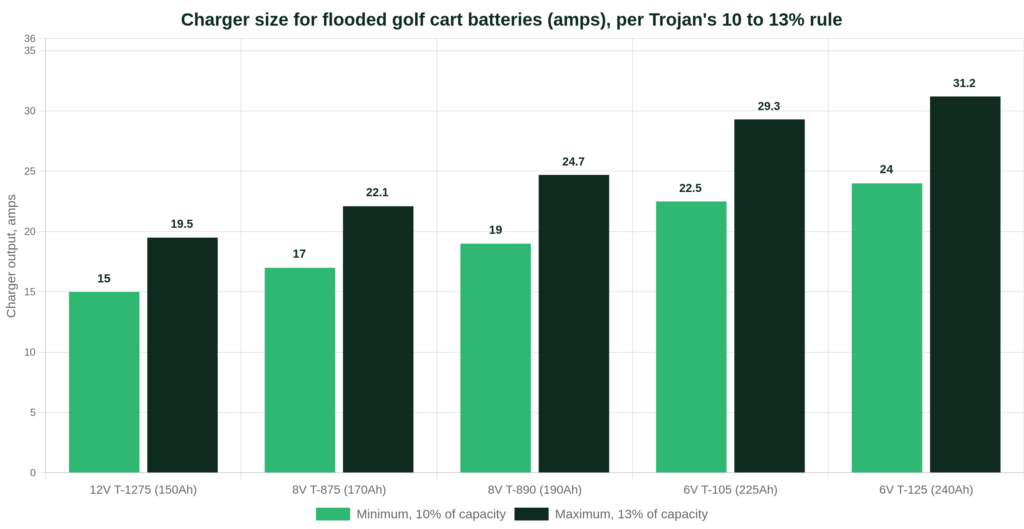
Trojan’s user guide for flooded deep-cycle batteries sets the bulk charge current at 10 to 13% of the 20-hour capacity (C20). That gives a clear window for each common battery. The chart shows it.
| Battery (typical pack) | Capacity (C20) | Charger window, 10 to 13% | Good match |
|---|---|---|---|
| 12V T-1275 (four in a 48V cart) | 150Ah | 15 to 19.5A | 15A or 18A |
| 8V T-875 (six in a 48V cart) | 170Ah | 17 to 22.1A | 18A or 22A |
| 8V T-890 (six in a 48V cart) | 190Ah | 19 to 24.7A | 22A |
| 6V T-105 (six in a 36V cart, eight in a 48V cart) | 225Ah | 22.5 to 29.3A | 25A |
| 6V T-125 | 240Ah | 24 to 31.2A | 25A |
What if the charger is smaller than the window? It still works, just slower. A 13.5A or 15A charger on 170Ah batteries finishes overnight without trouble. The risk only appears when a small charger meets a deeply drained pack and its safety timer ends the charge before the batteries are full. Do that night after night and the plates sulfate. If you often drain the pack below 50%, stay inside the window.
What if the charger is bigger? Above about 13% the batteries heat up and gas harder, which uses more water. Bigger is not better here.
What Voltage Should the Charger Reach?
A good lead-acid charger runs in stages and each stage has a voltage target. Trojan publishes these per cell for flooded batteries at 77°F. Multiplied out for a full pack (18 cells at 36V, 24 cells at 48V), they look like this:
| Stage | Per cell | 36V pack | 48V pack | What it does |
|---|---|---|---|---|
| Absorption | 2.35 to 2.45V | 42.3 to 44.1V | 56.4 to 58.8V | Finishes the charge after the bulk stage |
| Float | 2.25V | 40.5V | 54.0V | Holds a full pack without overcharging |
| Equalize | 2.70V | 48.6V | 64.8V | Controlled overcharge that balances the cells |
Two details from the same guide matter when you compare chargers. First, the targets move with temperature, by about 2.8 millivolts per cell for every degree Fahrenheit away from 77°F. On a 48V pack in a 47°F garage that is 24 cells x 30 degrees x 0.0028V, or about 2V higher. A charger with temperature compensation makes that correction for you. Second, Trojan recommends equalizing only when needed: when specific gravity falls below 1.235 or the cells differ by more than 0.030. AGM and gel batteries use different settings and should not be equalized like this, so pick the matching profile if your charger offers one.
What Is the Best Golf Cart Battery Charger?
| Charger | Voltage | Output | Battery profiles | Best for |
|---|---|---|---|---|
| Lester Summit Series II 1050W | 24, 36 and 48V | 25A at 36V, 22A at 48V | Flooded, AGM, gel, lithium | Larger batteries and owners who want one charger for life |
| Lester Summit Series II 650W | 24, 36 and 48V | 18A at 36V, 13.5A at 48V | Flooded, AGM, gel, lithium | Overnight charging with the same features at a lower price |
| FORM 48V 15A (Club Car round 3-pin) | 48V | 15A | Lead-acid and LiFePO4, selectable | Budget 48V Club Car charging |
| FORM 48V 15A (Yamaha Drive 3-pin) | 48V | 15A | Lead-acid and LiFePO4, selectable | Budget Yamaha G29 and Drive2 charging |
| FORM 48V 15A on-board (ring terminals) | 48V | 15A | Lead-acid and LiFePO4, selectable | Mounting the charger in the cart |
Best overall: Lester Summit Series II 1050W
Top pick: Lester Summit Series II 1050W
One charger for 24V, 36V and 48V packs. 25A at 36V and 22A at 48V, profiles for flooded, AGM, gel and lithium, Bluetooth app, IP66 sealed case.
Check price on AmazonLester’s data sheet lists 25A at 24V, 25A at 36V and 22A at 48V from the 1050W model. Compare that with the sizing table above: 22A sits right at the top of the window for 170Ah 8V batteries, and 25A at 36V lands inside the window for 225Ah 6V batteries. Few chargers in this class fit both common packs that well.
- Input: 100 to 240V AC, under 12A, so it runs on a normal household outlet.
- Case: IP66 and NEMA 4, about 13.2 x 7.2 x 4.2 inches and 10.2 lb.
- Efficiency: above 91%, according to the data sheet.
- App: Lester’s ChargerConnect app shows charge status and history, starts and stops a charge, runs an equalize cycle and changes the battery profile.
- Low-voltage start: the minimum start-up voltage is 10V DC, which helps with packs that have sat for months.
- Warranty: 4 years, as listed by Golf Cart Garage.
Not ideal if: you have one healthy cart and only need a basic overnight charge, since it costs several times more than a budget unit. Also, the charger is sold with different cord sets, so confirm that the listing includes the plug for your cart before you order.
Best value: Lester Summit Series II 650W
The 650W model has the same profiles, app and sealed case, with 18A at 36V and 13.5A at 48V. On a 36V cart with T-105 batteries, 18A is a little under the 22.5A minimum, so expect a longer charge (see the time table below). On a 48V cart, 13.5A is on the small side for 170Ah batteries. It suits carts that are used lightly and plugged in every night.
Not ideal if: the cart works all day, runs on hills, or often comes back below half charge. Get the 1050W.
See the Lester Summit Series II 650W on Amazon
Best budget 48V charger: FORM 48V 15A
FORM’s 48V 15A chargers have a selectable profile for lead-acid and LiFePO4, and come in versions for the main 48V plugs. At 15A they match 150Ah 12V batteries exactly and run a little under the window for 170Ah 8V batteries, which means a longer but normal overnight charge. Check that the profile is set to lead-acid before the first charge.
FORM 48V 15A chargers, by plug
Not ideal if: you own a Club Car with a working OBC (read the OBC section below first), you have 36V batteries, or your pack is 225Ah or larger.
EZGO 36V and 48V chargers
For EZGO, the plug matters most because there are three of them. Use the links below to see chargers for each plug, then filter by the specs in this guide: lead-acid profile, 15A or more, automatic shut-off and a stated absorption voltage.
- 36V chargers with the EZGO Powerwise D plug
- 48V chargers for the EZGO TXT notched plug (2010 to 2013)
- 48V chargers for the EZGO RXV 3-pin triangle plug
Charger fine, plug damaged? On an EZGO RXV the plug handle often fails before the charger does. If the pins are burnt or the handle is cracked, a replacement 48V 3-pin triangle plug handle for the EZGO RXV (2008 and later) costs far less than a new charger. Unplug the charger from the wall before you work on it, and match each wire to the same pin position as the old plug.
What Is the Club Car OBC Catch?
Club Car carts with the PowerDrive system, built from 1995 to about 2014, have an on-board computer in the cart. The original charger has no brain of its own. The OBC decides when charging starts and stops. Plug in many aftermarket chargers and nothing happens, or the charge ends at the wrong time, because the cart and the charger are both trying to be in control.
There are two ways through it:
- Buy a charger built to handle it. Golf Cart Garage lists the Lester Summit Series II as working on Club Car carts with or without a working OBC.
- Bypass the OBC. Lester’s bypass kit (part 17-283) is sold for PowerDrive carts from 1995 to 2013/14. Buggies Unlimited describes it as required for aftermarket chargers such as the Summit II, DPI Accusense and Delta-Q. It does not fit 36V carts made before 1995 or the ERIC charging system on 2014 and later carts.
One warning before you install a bypass: the same listing states that the original PowerDrive charger will no longer work once the kit is in. Treat the bypass as a one-way move to a modern charger. If you are not comfortable working on the cart’s wiring, have a golf cart shop fit it.
See the OBC bypass kit for 48V Club Car on Amazon. This listing is for carts with the 6-pin Deutsch-style OBC connector and is described as fitting 1995 to 2014 models, so check the connector on your cart before you order.
How Long Will Each Charger Take?
Lead-acid batteries need about 25% more amp-hours put back than were taken out, because some of the charge is lost as heat and gassing. So the estimate is: amp-hours used x 1.25, divided by charger amps. The table assumes the pack is at 50% when you plug in.
| Battery | 13.5A | 15A | 18A | 22A | 25A |
|---|---|---|---|---|---|
| T-1275 (150Ah) | 6.9 h | 6.2 h | 5.2 h | 4.3 h | 3.8 h |
| T-875 (170Ah) | 7.9 h | 7.1 h | 5.9 h | 4.8 h | 4.2 h |
| T-105 (225Ah) | 10.4 h | 9.4 h | 7.8 h | 6.4 h | 5.6 h |
Worked example for the T-875 on an 18A charger: 170Ah x 50% = 85Ah used. 85 x 1.25 = 106Ah to return. 106 / 18 = 5.9 hours. Real times run longer, because the current tapers during the absorption stage, so add an hour or two. For more cases, see how long it takes to charge a golf cart.
How Much Does a Charge Cost?
Take the same 48V pack of 170Ah batteries at 50%. The energy used is 85Ah x 48V = 4.08 kWh. Lead-acid returns roughly 80% of the energy put into it, and the charger itself is about 91% efficient, so the wall supplies about 4.08 / 0.80 / 0.91 = 5.6 kWh. At $0.17 per kWh that is about $0.95 per charge. These are estimates. Your electricity rate and battery age will move the number, and older batteries waste more.
Is It the Charger or the Batteries?
Before you spend money on a charger, check that the charger is the problem. A multimeter across the whole pack answers most of it.
| What you see | Likely cause | What to do |
|---|---|---|
| Charger does not switch on, pack reads very low (for example under 30V on a 48V cart) | Pack voltage is below the charger’s start threshold | Charge batteries one at a time with a 6V, 8V or 12V charger to bring the pack up, then retry |
| Charger does not switch on, pack voltage is normal | Blown fuse, bad receptacle, OBC issue on Club Car, or a failed charger | Check the fuse and plug pins, then test with a known good charger |
| Charger runs but pack never reaches the absorption voltage in the table above | One or more weak batteries, or a charger that is too small | Measure each battery under charge and look for one that reads lower than the rest |
| Charger finishes, but range is short the next day | Batteries, not the charger | Test specific gravity or load test each battery |
| Batteries use a lot of water and run hot | Overcharging: wrong profile or a charger that does not shut off | Check the profile setting, then replace the charger |
More help: golf cart battery not holding charge, the golf cart battery voltage chart, and the lead-acid section of our charger blinking and error codes guide. A multimeter for golf cart batteries costs far less than a charger you did not need.
Who Should Skip a New Lead-Acid Charger?
| Your situation | Better move |
|---|---|
| Batteries are 5 or more years old and range is fading | Test the batteries first. A new charger will not fix worn plates |
| You plan to convert to lithium within a year | Buy a charger with both profiles (Lester Summit II or FORM), or wait and read is a lithium conversion worth it |
| You already switched to lithium | Do not reuse a lead-acid only charger. See lead-acid charger on a lithium battery |
| The original charger works and only the plug or cord is damaged | Replace the cord set or plug instead of the whole charger |
Charging Habits That Make Lead-Acid Batteries Last
- Charge after every use. Trojan’s guide says to recharge after each outing of 30 minutes or more.
- Stay above 20%. The same guide advises not to discharge beyond 80% depth.
- Let the charge finish. Unplugging early on a regular basis leaves the pack undercharged, which is the most common cause of early battery failure.
- Water after charging, not before. Top up with distilled water once the charge is complete, unless the plates are exposed. A battery watering system makes this a two-minute job.
- Check specific gravity now and then. A fully charged Trojan flooded cell reads about 1.277.
- Ventilate. Flooded batteries release hydrogen while charging. Charge in an open or well-aired space, away from sparks and flames.
- Plan for winter. A stored pack needs to stay charged. See how to winterize a golf cart.
Storing the cart for months? A charger refills a pack, but a maintainer is what keeps it full through winter. See the best golf cart battery maintainer for 36V and 48V carts.
Frequently Asked Questions
Can I use a 48V charger on a 36V golf cart?
No. A 48V charger pushes a 36V pack far past its safe voltage, which overheats the batteries and boils off the electrolyte. The reverse does not work either: a 36V charger cannot fill a 48V pack. The only exception is a multi-voltage charger, such as the Lester Summit Series II, set to the correct voltage.
Can I leave a golf cart charger plugged in all the time?
With a modern automatic charger, yes. It ends the charge, then either drops to a float voltage (about 54V on a 48V pack) or restarts when the pack falls. With an old transformer charger that has no automatic shut-off, no. Check your charger’s manual to see which type you have.
Why does my charger not turn on when I plug it in?
The most common reason is a pack that is too low for the charger to detect. Most chargers need to see a minimum voltage before they start. Other causes are a blown fuse, worn plug pins and, on Club Car, the OBC. The troubleshooting table above walks through each one.
Is a 15 amp charger enough for a 48V golf cart?
For overnight charging, yes. A 15A charger refills 170Ah batteries from 50% in about 7 to 9 hours. It is the right size for 150Ah 12V batteries and slightly small for 170Ah and 190Ah 8V batteries. Carts that are used twice a day or drained deeply do better with 18 to 22A.
Can one charger work for lead-acid now and lithium later?
Yes, if it has a selectable profile. The Lester Summit Series II and the FORM chargers in this guide offer both. You must change the profile when you change the batteries. Before you convert, read our lithium charger compatibility guide, because the lithium battery maker’s charge voltage has to match the charger’s lithium setting.
How often should I equalize golf cart batteries?
Only when the batteries need it. Trojan’s guidance for flooded batteries is to equalize when specific gravity is below 1.235 or when cells vary by more than 0.030, and not more often than about every 30 days. Never equalize AGM or gel batteries with a flooded profile.
Quick picks
Match the voltage, match the plug, and size the amps to 10 to 13% of battery capacity.
Sources: Lester Electrical Summit Series II data sheet; Trojan Battery user’s guide for flooded deep-cycle batteries; Golf Cart Garage and Buggies Unlimited product listings for the Summit Series II and the Lester OBC bypass kit 17-283. Charge time and cost figures are calculated estimates. Check your charger’s manual and your battery maker’s settings before changing a charge profile.
More gear for your cart: best golf cart accessories.




5 Comments