
Best Golf Cart Battery Maintainer for Winter Storage (36V and 48V)
Disclosure: CartVoltage earns a commission from qualifying purchases made through links on this page, at no extra cost to you. Specifications come from manufacturer and retailer pages, which are named where they are used.
Golf cart batteries rarely die on the course. They die in the garage between November and March. A lead-acid pack loses charge while it sits, a half-charged pack sulfates, and a deeply discharged one can freeze and crack. A battery maintainer is the low-cost fix, but only for the right cart. Some owners need one, some already own one without knowing it, and lithium owners should not buy one at all.
Do You Need a Battery Maintainer for a Golf Cart?
| Your situation | Need a maintainer? | Why |
|---|---|---|
| Lead-acid cart stored 2 months or more, old charger with no float mode | Yes | The pack will self-discharge and nothing tops it up |
| Lead-acid cart, modern automatic charger with float or storage mode | Usually no | Leaving that charger plugged in does the same job. Check the manual |
| Lead-acid cart stored where there is no power outlet | No (it cannot run) | Fully charge, disconnect the pack, and recharge on a schedule instead |
| Cart used every week all year | No | Regular charging keeps the pack full |
| Lithium (LiFePO4) cart | No | Self-discharge is very low and float charging is not recommended by most makers |
How Fast Do Golf Cart Batteries Lose Charge in Storage?
Trojan’s deep-cycle storage guide gives measured numbers for its T-105 battery. Specific gravity (the measure of charge in a flooded cell) drops by about 0.0015 per week at 42°F, 0.005 per week at 75°F and 0.0075 per week at 86°F. The same guide says to give a boost charge once specific gravity has fallen by 0.040. Divide one by the other and you get the storage time before a top-up is due.
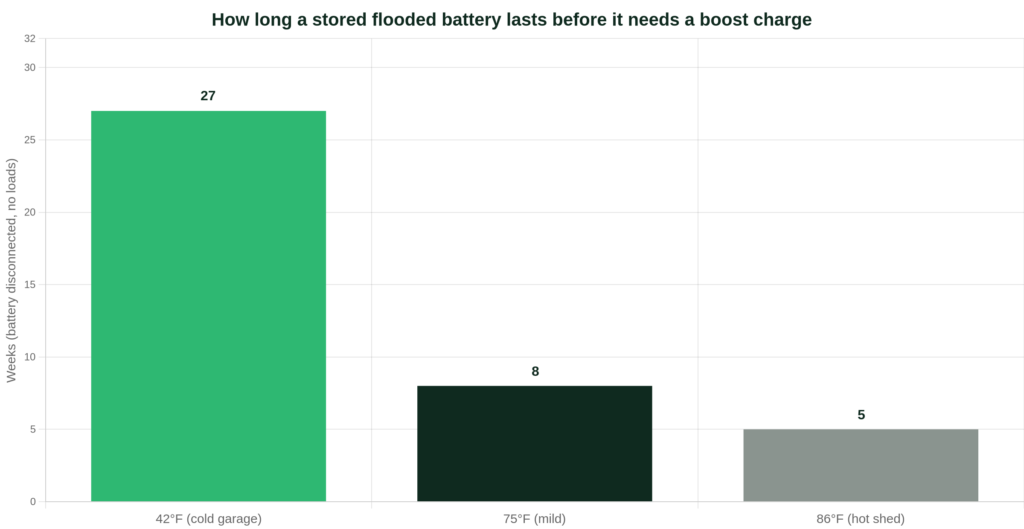
Worked example at 75°F: 0.040 / 0.005 = 8 weeks. At 42°F: 0.040 / 0.0015 = about 27 weeks. So a cold garage is kind to a full battery, and a hot shed is not.
There is a catch. Those figures are for a battery sitting on its own. In a cart, the controller, the on-board computer on older Club Cars, a voltage reducer, a battery meter or a GPS unit can pull a small current around the clock. With those loads connected, a pack can go flat in a few weeks. That is why owners who “only left it for the winter” find a dead pack in spring. Put the cart in Tow mode (if it has a Run/Tow switch) and either disconnect the pack or use a maintainer.
Can Golf Cart Batteries Freeze?
Yes, and the freezing point depends on how charged they are. As a battery discharges, its electrolyte becomes closer to plain water. Trojan’s storage guide lists these values:
| State of charge | Specific gravity | Freezing point |
|---|---|---|
| 100% | 1.280 | -92°F |
| 85% | 1.250 | -62°F |
| 62% | 1.200 | -16°F |
| 40% | 1.150 | +5°F |
| 20% | 1.100 | +19°F |
A full battery is safe in any winter. A battery at 20% can freeze on an ordinary cold night at 19°F. Frozen electrolyte expands, cracks the case and ruins the battery. Keeping the pack full is the whole point of a maintainer in a cold climate.
What Is the Difference Between a Charger and a Maintainer?
A charger refills a used pack at 13 to 25 amps. A maintainer holds an already full pack at a float voltage, with only 1 to 3 amps available. Float for flooded lead-acid is about 2.25V per cell, which is 40.5V for a 36V pack and 54.0V for a 48V pack.
The low current is why a maintainer cannot replace a charger. Take a 48V cart with 170Ah batteries at 50%. It needs about 85Ah x 1.25 = 106Ah put back. On a 3A maintainer that is 106 / 3 = 35 hours or more, against about 6 hours on an 18A charger. Always charge the pack fully with the normal charger first, then connect the maintainer. If you need a charger, see our best golf cart battery charger guide.
What Is the Best Golf Cart Battery Maintainer?
| Product | Output | Battery types | Stand-out feature | Best for |
|---|---|---|---|---|
| BatteryMINDer 483CEC1 | 48V, 3A | Flooded, AGM, gel (selectable) | Temperature sensor and pulse desulfation | Long winter storage of a 48V lead-acid cart |
| Battery Tender PowerPlus 48V | 48V, 15A | Flooded, AGM, gel and LiFePO4 (switch) | Full charger plus float maintenance, IP68 | Owners who need a new charger and a maintainer in one |
| Basic 48V float maintainer (clip-on) | 48V, about 2.5A | Lead-acid | Small, simple, low price | Budget storage where a full feature set is not needed |
| 36V maintainer | 36V, 2 to 3A | Lead-acid | Matches six 6V batteries | Older 36V EZGO, Club Car and Yamaha carts |
Best dedicated maintainer: BatteryMINDer 483CEC1 (48V, 3A)
Top pick: BatteryMINDer 483CEC1
48V, 3A charger, maintainer and desulfator. Selectable lead-acid battery type, temperature sensor included, 5-year warranty.
Check price on AmazonBattery Mart’s listing for the 483CEC1 shows 48V at 3A, a 100 to 240V AC input, and a battery type selector that covers flooded, AGM and gel. It comes with a temperature sensor that adjusts the charge voltage as the garage gets colder or warmer, a 2-foot ring terminal lead with a 15A fuse, and a quick connector. The warranty is 5 years.
The temperature sensor is the reason it tops this list. Float voltage should rise as temperature falls. A maintainer without compensation undercharges in a cold garage and overcharges in a hot one. The unit also sends high-frequency pulses that the maker says dissolve sulfate. Treat that as a bonus for keeping healthy batteries healthy. It will not bring back a pack that is already worn out.
Not ideal if: you have a 36V cart, a lithium battery, or you wanted clip-on leads. Battery clips are not listed in the box, so plan to fit the ring terminals to the pack’s main positive and main negative posts.
Best charger and maintainer in one: Battery Tender PowerPlus 48V 15A
Battery Tender’s own page lists the PowerPlus 48V at 15A with a chemistry switch for lead-acid (flooded, AGM, gel) and LiFePO4. It runs four stages: a start-up check, bulk, absorption and float, and the page says float maintenance can run indefinitely. The case is rated IP68, it weighs 9.3 lb, it is built for permanent mounting in the cart, and it ships with ring terminal cables and a 40A fuse. The warranty is 2 years.
Battery Tender rates it for 48V packs from 40Ah to 200Ah. That covers 150Ah 12V batteries and 170Ah or 190Ah 8V batteries. A 48V pack of eight 225Ah T-105 batteries is above the stated range.
Not ideal if: your present charger works well (a small maintainer costs less) or your pack is larger than 200Ah. Two buying notes from the Amazon listing: ring terminals are included but cart plug adapters are sold separately, and the same listing offers a 36V 18A version (model 022-2013-DL-WH) for 36V carts, so pick the model that matches your pack voltage.
See the Battery Tender PowerPlus 48V on Amazon
Budget option: basic 48V float maintainer
Simple clip-on 48V maintainers are sold by golf cart parts stores and on Amazon. A typical one, as listed by Golf Cart Tire Supply, gives up to 2.5A while maintaining and 1A or less at float, suits 10 to 300Ah lead-acid batteries, has reverse polarity and short circuit protection, and weighs under 2 lb. You give up temperature compensation and a battery type selector.
Not ideal if: the cart is stored in a place with big temperature swings, or you have AGM or gel batteries that need their own float setting.
One option on Amazon is the Schauer SBC0348MTR 48V 3A smart battery maintainer, listed with an automatic float mode. Or compare other 48V golf cart battery maintainers on Amazon.
For 36V carts
A 36V cart needs a 36V maintainer. Look for the same three things: a float stage around 40.5V, automatic operation, and leads that reach the pack’s main positive and negative. Never put a 48V unit on a 36V pack.
One option on Amazon is the Schauer SBC0336MTR 36V 3A smart battery maintainer, listed with an automatic float mode and compatibility with flooded lead-acid, AGM and gel batteries. Check the listed float voltage against your pack before you order.
Can You Use a 12V Battery Tender on a Golf Cart?
Not across the pack. A 12V maintainer cannot charge a 36V or 48V series string. It only works on one 12V battery, or on two 6V batteries wired in series, at a time. Some owners move a 12V unit around the pack. It is slow, easy to connect wrongly, and it leaves the batteries at different charge levels. On a cart with 8V batteries it does not work at all, because no pair adds up to 12V. A pack-voltage maintainer is the right tool.
How Do You Set Up a Maintainer for Winter?
- Clean the battery tops and terminals. Dirt and acid film create a leakage path that drains the pack.
- Check the water. Plates must be covered before charging. Top up to the correct level after charging, using distilled water.
- Charge fully with the normal charger. Let it finish on its own.
- Switch the cart to Tow and turn off accessories. Disconnect anything wired straight to the pack that you do not need.
- Connect the maintainer to the pack’s main positive and main negative, red to positive first. Select the right battery type.
- Plug it in and check the indicator after a day. It should show float or maintain.
- Look at it once a month. Check the indicator and the water level. A maintainer is automatic, but outlets trip and plugs get knocked out.
Flooded batteries give off hydrogen while charging, so keep the storage area ventilated and away from flames and sparks. For the rest of the storage routine (tires, cleaning, covers), see how to winterize a golf cart.
What If There Is No Power Where the Cart Is Stored?
Then use the schedule method. Charge the pack fully, switch to Tow, and disconnect the main negative cable so nothing can drain it. Check the voltage with a multimeter every 4 to 6 weeks, after the pack has rested. Trojan’s guide says to boost charge when a battery falls below these open-circuit readings:
| Measure | Recharge when below |
|---|---|
| One 6V battery | 6.2V |
| One 12V battery | 12.4V |
| 36V pack (same level per cell) | 37.2V |
| 48V pack (same level per cell) | 49.6V |
The pack figures are the 6V value multiplied out: 6.2V is 2.067V per cell, times 18 cells for 36V and 24 cells for 48V. A multimeter for golf cart batteries is all you need, and the voltage chart shows what each reading means.
How Do You Read the Results in Spring?
| What you find | What it means | What to do |
|---|---|---|
| Maintainer on float, water level normal | Storage went well | Run a normal charge cycle, then drive |
| Water level low in every cell | Float voltage too high for the temperature, or wrong battery type selected | Top up, check the setting, consider a unit with temperature compensation |
| One battery lower than the rest | A weak battery, not a maintainer fault | Test that battery on its own |
| Maintainer light off, pack low | Power was lost during storage | Recharge at once. If the charger will not start, see battery not holding charge |
| Cracked or bulged case | The battery froze while discharged | Replace it. Do not charge a frozen or cracked battery |
Do Lithium Golf Cart Batteries Need a Maintainer?
No. LiFePO4 batteries lose very little charge in storage and do not sulfate, and most makers advise against holding them on a float charge for months. The usual advice is to store the battery partly charged, switch it off or disconnect it, and check it every few months. Follow your battery maker’s manual for the exact level. Cold matters in a different way for lithium: the battery must not be charged below freezing. See lithium golf cart batteries in cold weather.
Frequently Asked Questions
Can I leave my golf cart charger plugged in all winter instead?
If it is a modern automatic charger with a float or storage mode, yes, and the manual will say so. If it is an older charger that only shuts off on a timer, or a Club Car system that depends on the on-board computer, check the manual first. Some of those restart on a schedule and some do not.
How many amps should a golf cart battery maintainer have?
Between 1 and 3 amps at pack voltage is enough to hold a full pack. More current does not help with maintenance. It only matters if you want the same unit to recharge the cart after use, which needs 13 amps or more.
How much electricity does a maintainer use?
Very little. Even at a full 1A of float on a 48V pack, the draw is about 54 watts, or roughly 39 kWh a month, which is under $7 at $0.17 per kWh. Real float current on a healthy pack is usually well below 1A, so the true cost is lower.
Will a maintainer fix dead golf cart batteries?
No. A maintainer keeps good batteries good. A pack that has sat flat for months has hard sulfate on its plates, and a small float current will not reverse that. Test the batteries before you spend money.
Should I disconnect the batteries for winter if I use a maintainer?
You do not have to. Switch the cart to Tow and turn off accessories, then connect the maintainer to the complete pack. Disconnecting is for storage without a maintainer.
Quick picks
Charge fully first, match the pack voltage, and let the maintainer hold float until spring.
Sources: Trojan Battery deep-cycle battery storage guide (standing loss, boost-charge thresholds and freezing points); Battery Mart listing for the BatteryMINDer 483CEC1; Battery Tender product page for the PowerPlus 48V 15A; Golf Cart Tire Supply listing for a 48V clip-on maintainer. Storage times and running costs are calculated estimates. Follow your battery and charger manuals.
More gear for your cart: best golf cart accessories.




4 Comments