

Best Golf Cart Solenoid (36V and 48V): How to Test It, Size It and Replace It
Disclosure: CartVoltage earns a commission from qualifying purchases made through links on this page, at no extra cost to you. Specifications come from manufacturer data sheets and dealer service guides, which are named where they are used.
You press the pedal, hear a click, and the cart does not move. Or there is no click at all. Either way, the solenoid gets blamed first, and it is replaced far more often than it needs to be. A solenoid is a simple part, and three multimeter readings will tell you whether it is the fault or just the messenger. This guide shows those tests, then helps you pick the right replacement.
What Does a Golf Cart Solenoid Do?
A solenoid is a heavy switch worked by a small electromagnet. It is also called a contactor. It has two circuits:
- The coil circuit (two small terminals). When you turn the key and press the pedal, a small current flows through the coil. On a 48V continuous-duty solenoid of the White-Rodgers 586 type, the coil is 336 ohms, so it draws only 48 / 336 = 0.14 amps.
- The power circuit (two large terminals). The energized coil pulls a plunger that bridges two heavy contacts. Those contacts carry the full motor current, which can be 200 amps or more.
So a 0.14A signal controls a 200A circuit. Every pedal press opens and closes that switch, which is why it wears out.
What Are the Symptoms of a Bad Golf Cart Solenoid?
| Symptom | Most likely cause | Is it the solenoid? |
|---|---|---|
| One click, cart does not move | Burnt or pitted contacts, or a fault after the solenoid (controller, motor, cable) | Maybe. Run test 2 below |
| No click at all | No signal reaching the coil (key switch, pedal microswitch, Tow switch, controller), or an open coil | Often not. Run test 1 below |
| Rapid clicking or chattering | Pack voltage collapsing under load | Usually the batteries or a loose cable |
| Cart keeps moving or has power with the pedal released | Contacts welded shut | Yes. Replace it and find out why it welded |
| Works cold, cuts out when hot, body too hot to touch | High resistance across worn contacts | Yes. Run test 3 below |
| Loss of top speed or hill power, nothing else wrong | Voltage drop across contacts or cables | Possibly. Run test 3 below |
How Do You Test a Golf Cart Solenoid?
You need a multimeter set to DC volts. Safety first: raise the drive wheels off the ground on stands so the cart cannot move, remove rings and watches, and keep tools from bridging terminals. A 48V pack can weld a wrench. The method below follows the service approach published by Buggies Unlimited. Always check the wiring diagram for your make, model and year.
Test 1: Is the coil getting a signal?
Put the meter leads on the two small terminals. Key on, in forward, Run mode, press the pedal.
- Pack voltage present and the solenoid clicks: the coil circuit is good. Go to test 2.
- Pack voltage present, no click: the coil has failed. Replace the solenoid.
- No voltage, no click: the solenoid is not the problem. The signal is being lost before it arrives. Check the key switch, the pedal microswitch, the Run/Tow switch and the controller output.
Test 2: Are the contacts passing power?
Put the black lead on the pack’s main negative and the red lead on the large terminal that feeds the controller (the motor side). Press the pedal so the solenoid clicks.
- Full pack voltage: the contacts are closing. The solenoid is good and the fault is further on: controller, motor, cables, or the throttle sensor.
- Low or no voltage after the click: the contacts are burnt. Replace the solenoid.
- Full pack voltage with the key off and pedal released: the contacts are welded shut. Replace the solenoid.
One trap: if your cart has a resistor across the two large terminals, a small voltage will show on the motor side even with the solenoid open, because the resistor passes a trickle. That is normal. Buggies Unlimited’s guide suggests lifting one end of the resistor and taping it while you test, so that it cannot hide a bad contact.
Test 3: How much voltage do the contacts lose under load?
This is the test that finds a tired solenoid that still clicks. Put one meter lead on each large terminal, with the wheels raised and a helper holding the pedal, or better, on a real drive with the meter secured and set to Max. A closed switch should read almost nothing. A reading above about 0.5V under load means the contacts are worn, a figure also used by Golf Cart Stuff in its owner’s guide.
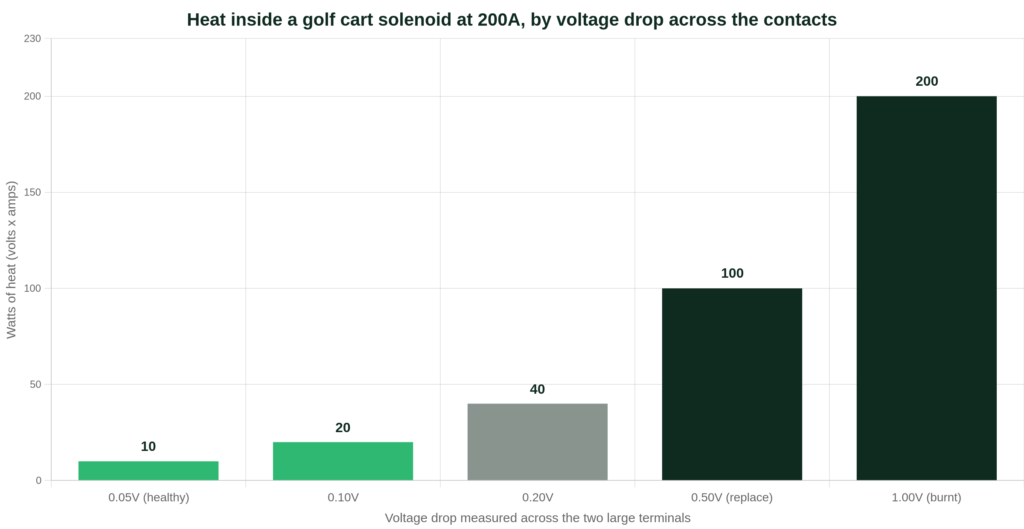
The reason is simple arithmetic. Heat in the contacts equals the voltage drop times the current. At 200A, a 0.05V drop is 10 watts, which a solenoid sheds easily. A 0.5V drop is 100 watts, about the heat of an old incandescent light bulb, inside a sealed part the size of a fist. That heat pits the contacts further, the drop rises, and the solenoid fails. If you want the current figure as well, a DC clamp meter reads it from the cable.
How Do You Choose the Right Solenoid?
| Spec | What to match | Why it matters |
|---|---|---|
| Coil voltage | Your pack voltage: 36V or 48V | A 36V coil on 48V overheats. A 48V coil on 36V may not pull in firmly |
| Duty | Continuous duty | The coil stays energized the whole time you drive. Starter-type intermittent solenoids burn out |
| Contact rating | At or above your controller’s current limit | Undersized contacts overheat and weld |
| Terminals | 4 terminals on most electric carts (2 large, 2 small) | Must match your wiring |
| Resistor and diode | Reuse or replace what your cart had | They protect the contacts and the controller |
For reference, the White-Rodgers 586 series data sheet, the design that most stock golf cart solenoids copy, lists 200A continuous and 600A inrush on the normally open contacts, a rated electrical life of 50,000 cycles at 200A, and an operating range of -40°F to 149°F. At 100 pedal presses a day, 50,000 cycles is 500 days of use, which is why a solenoid on a busy cart is a wear item.
Do you need a heavy-duty 400A solenoid?
| Your cart | Solenoid to buy |
|---|---|
| Stock controller (about 250 to 300A), flat ground | Standard 200A continuous |
| Stock controller, steep hills, rear seat or lifted | Standard works. Heavy-duty lasts longer |
| Upgraded controller of 400A or more | Heavy-duty 400A continuous |
| High-speed motor or a lithium battery with a 300A or larger BMS and an upgraded controller | Heavy-duty 400A continuous |
A lithium battery on its own does not require a new solenoid. The controller sets the current, not the battery. We cover that question in do you need a new controller or solenoid for lithium.
What Is the Best Golf Cart Solenoid?
| Solenoid | Voltage | Type | Best for |
|---|---|---|---|
| 10L0L 48V 4-terminal (586 series type) | 48V | Standard, 4 terminal | Stock 48V EZGO, Club Car and Yamaha carts |
| Heavy-duty 48V 400A solenoid | 48V | 400A continuous, 1,000A peak as listed | Upgraded controllers and hard use |
| 10L0L 36V 4-terminal (70 series type) | 36V | Standard, continuous duty | 36V EZGO carts |
| Club Car DS 36V 4-terminal | 36V | Standard | Club Car DS 1976 to 1998 |
Best standard 48V solenoid: 10L0L 48V 4-terminal
Top pick for stock 48V carts: 10L0L 48V 4-terminal solenoid
A 586-series type replacement listed for EZGO (73231G01), Club Car (101883601) and Yamaha (JR1-H1950-00).
Check price on AmazonThis is the like-for-like replacement for most 48V carts on a stock controller. The listing cross-references the three common original part numbers, so one part covers a 48V EZGO, a Club Car and a Yamaha. Compare the part number stamped on your old solenoid with the listing before you order, and count the terminals.
Not ideal if: you have a 36V cart, an upgraded 400A or larger controller, or a Club Car model that needs a solenoid with a specific built-in resistor. In that last case buy the version listed for your exact model.
Best heavy-duty: 48V 400A continuous solenoid
For an upgraded controller, the usual step up is a solenoid listed at 400A continuous with a 1,000A peak, twice the continuous rating of the standard part. Larger contacts run cooler at the same current, so they last longer on hills and with heavy loads.
Not ideal if: your cart is stock and used on flat ground. You would be paying for capacity the controller will never use. Heavy-duty solenoids are also physically larger, so check the mounting space, and many need their own resistor and diode fitted.
See the 48V heavy-duty 400A solenoid on Amazon
Best for 36V carts
A 36V cart needs a 36V coil. For EZGO, the 10L0L 70-series type solenoid is listed as a 4-terminal, continuous-duty replacement for original numbers 27855-G01 and 27855-G02. For an older Club Car DS (1976 to 1998), buy the solenoid listed for that model, because the mounting and terminals differ.
- 10L0L 36V solenoid for EZGO on Amazon
- 36V 4-terminal solenoid for Club Car DS (1976 to 1998) on Amazon
What Are the Resistor and Diode on a Solenoid For?
Many carts have two small parts attached to the solenoid. Both get thrown away by mistake during a replacement.
- Pre-charge resistor (across the two large terminals). The controller contains large capacitors. If they are empty when the solenoid closes, a huge inrush current arcs across the contacts. The resistor lets the capacitors fill slowly first. Buggies Unlimited gives 250 ohms as the usual value. At 48V that passes at most 48 / 250 = 0.19 amps, and dissipates at most 48 x 48 / 250 = 9.2 watts for the moment before the capacitors fill.
- Diode (across the two small terminals). When the coil switches off, its collapsing magnetic field produces a voltage spike. The diode absorbs it and protects the controller and switches. It is polarity sensitive: the banded end goes to the positive coil terminal. Fitted backwards, it shorts the coil signal and can blow a fuse or damage the controller.
Not every cart has both. Fit the new solenoid with exactly what the old one had, in the same positions. If either part looks burnt or cracked, replace it too.
See a golf cart solenoid resistor and diode set on Amazon
How Do You Replace a Golf Cart Solenoid?
- Switch to Tow and turn the key off. On carts with a Run/Tow switch, always switch to Tow before disconnecting the batteries.
- Disconnect the pack. Remove the main negative cable first and keep it away from the post.
- Photograph the wiring. Take clear photos of all four terminals, the resistor and the diode before you remove anything.
- Label and remove the wires, then unbolt the old solenoid.
- Mount the new solenoid and move the resistor and diode across in the same positions and the same polarity.
- Reconnect the wires and tighten correctly. The White-Rodgers 586 data sheet gives a maximum of 60 in-lb on the large terminals and 12 to 18 in-lb on the small coil terminals. Hold the lower nut with a second wrench so the stud does not turn inside the housing.
- Reconnect the pack, main negative last, switch to Run, and test with the wheels raised.
Over-tightening is the most common way a new solenoid is ruined. A stud that turns breaks the internal connection. Loose terminals are the second: a loose lug heats up and looks exactly like a failing solenoid. Clean the cable lugs while you are there, and see our battery cable guide if they are corroded.
Who Should Not Buy a Solenoid Yet?
| Your situation | Check this first |
|---|---|
| Rapid clicking and the cart barely moves | Battery voltage under load. See the voltage chart and battery not holding charge |
| No click and no voltage at the small terminals | Key switch, pedal microswitch, Tow switch and controller |
| Cart died right after a lithium conversion | The BMS may have shut off. See golf cart won’t move after lithium conversion |
| Solenoid clicks and shows full voltage on the motor side | Controller, motor or throttle sensor. The solenoid is working |
Frequently Asked Questions
Can I use a 36V solenoid on a 48V golf cart?
No. The coil is wound for its voltage. A 36V continuous-duty coil of the 586 type is 189 ohms, so on 48V it would draw 48 / 189 = 0.25A instead of 0.19A and run at about 12 watts instead of 7, which overheats it. Match the coil voltage to the pack.
How long does a golf cart solenoid last?
There is no fixed interval. It depends on how many times it switches and how much current it carries. The 586 series is rated for 50,000 electrical cycles at 200A. A lightly used cart may never wear one out, while a cart on stop-and-go duty on hills can need one every few years.
Can I bypass a solenoid to test it?
We do not recommend it. Bridging the two large terminals with a tool creates a heavy arc at pack voltage and can make the cart lurch. The voltage tests above tell you the same thing without the risk.
Why does my new solenoid click but the cart still will not move?
Because the solenoid was not the fault. If the motor side shows full pack voltage after the click, look at the controller, the motor, the throttle sensor and the cables. Also check that the diode is not fitted backwards and that both large cables are on the correct terminals.
Is a hot solenoid normal?
Warm is normal, because the coil alone gives off about 7 watts the whole time you drive. Too hot to hold is not. That points to worn contacts or a loose terminal, and test 3 will confirm it.
Quick picks
Test first. Then match coil voltage, continuous duty and contact rating.
Sources: White-Rodgers (Emerson) Type 586 DC contactor spec sheet for coil resistance, contact ratings, life and torque; Buggies Unlimited service guide on solenoid testing and the 250 ohm resistor; Golf Cart Stuff owner’s guide for the 0.5V voltage-drop threshold. Product details are as stated in the Amazon listings. Heat and current figures are calculations. Follow the wiring diagram for your cart, and have a golf cart shop do the work if you are not comfortable around a live battery pack.
More gear for your cart: best golf cart accessories.



One Comment