Lithium Golf Cart Battery Losing Range? 7 Causes, in the Order to Check Them
CartVoltage is reader-supported. If you buy through links on this page we may earn a commission at no extra cost to you. As an Amazon Associate we earn from qualifying purchases. Details
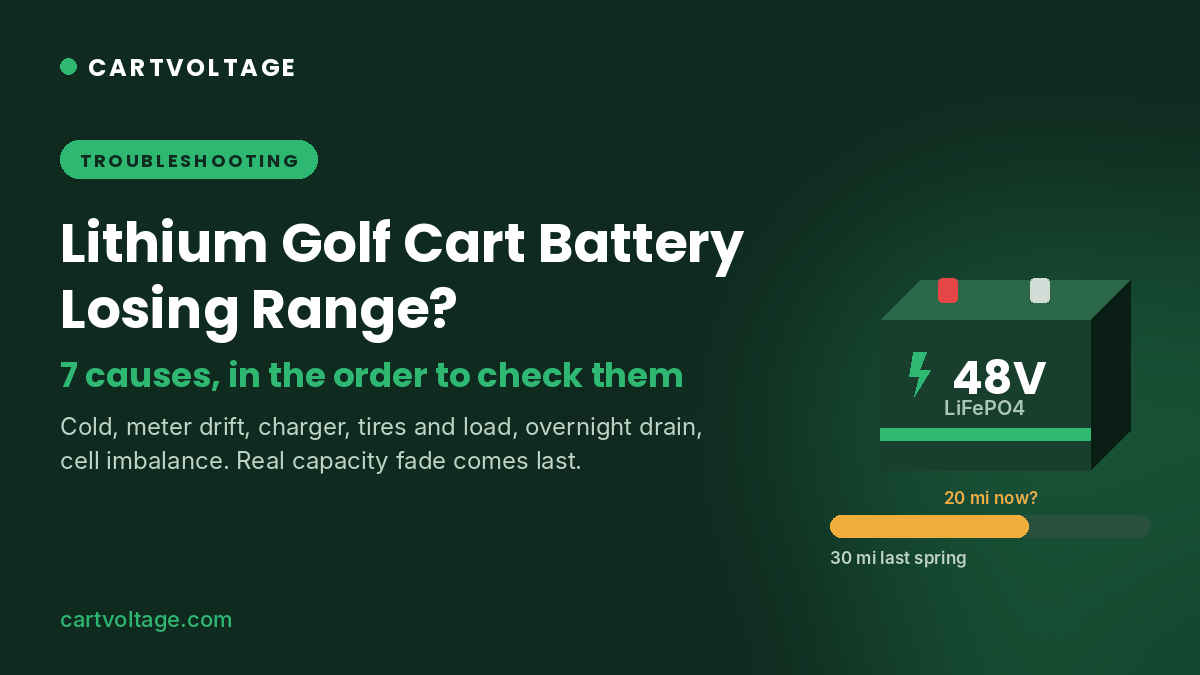
“My lithium battery used to do 30 miles and now it barely does 20” is one of the most common complaints on golf cart forums, and in most of those threads the battery turns out to be fine. The range went somewhere else: into cold cells, into tires that lost pressure over the summer, into a charger that quietly stopped reaching full, or into a state-of-charge meter that drifted and now tells you to stop at what is really 35%. Real capacity loss is the last thing on this list for a reason. Here are the seven causes, in the order they are most likely, with the five-minute check for each.
First, Measure It Properly
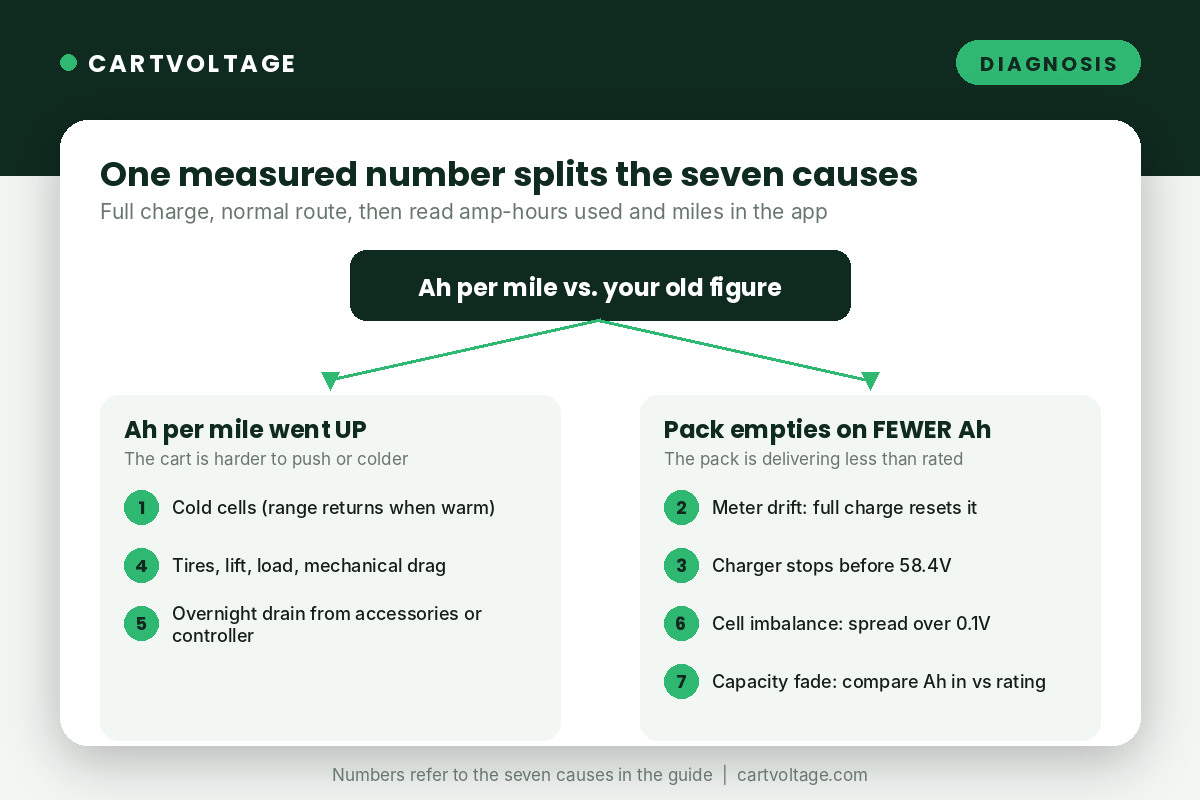
“It feels like less range” is not a measurement, and the factory dash meter on a lead-acid cart cannot read a lithium pack at all. Before chasing a cause, get one clean number. Charge the pack to 100% and leave it on the charger an extra hour. Drive your normal route. Then open the battery app and read the amp-hours used, or the percentage used, and note the miles. A 48V 105Ah pack doing 10 miles on 35Ah is using 3.5Ah per mile, which is normal for a stock cart; if the same cart now uses 5Ah per mile, something is loading it harder (causes 1, 4 and 5). If it still uses 3.5Ah per mile but the pack reaches empty after 60Ah instead of 95Ah, the pack is delivering less than it should (causes 2, 3, 6 and 7). That split is the whole diagnosis.
Cause 1: Cold Cells
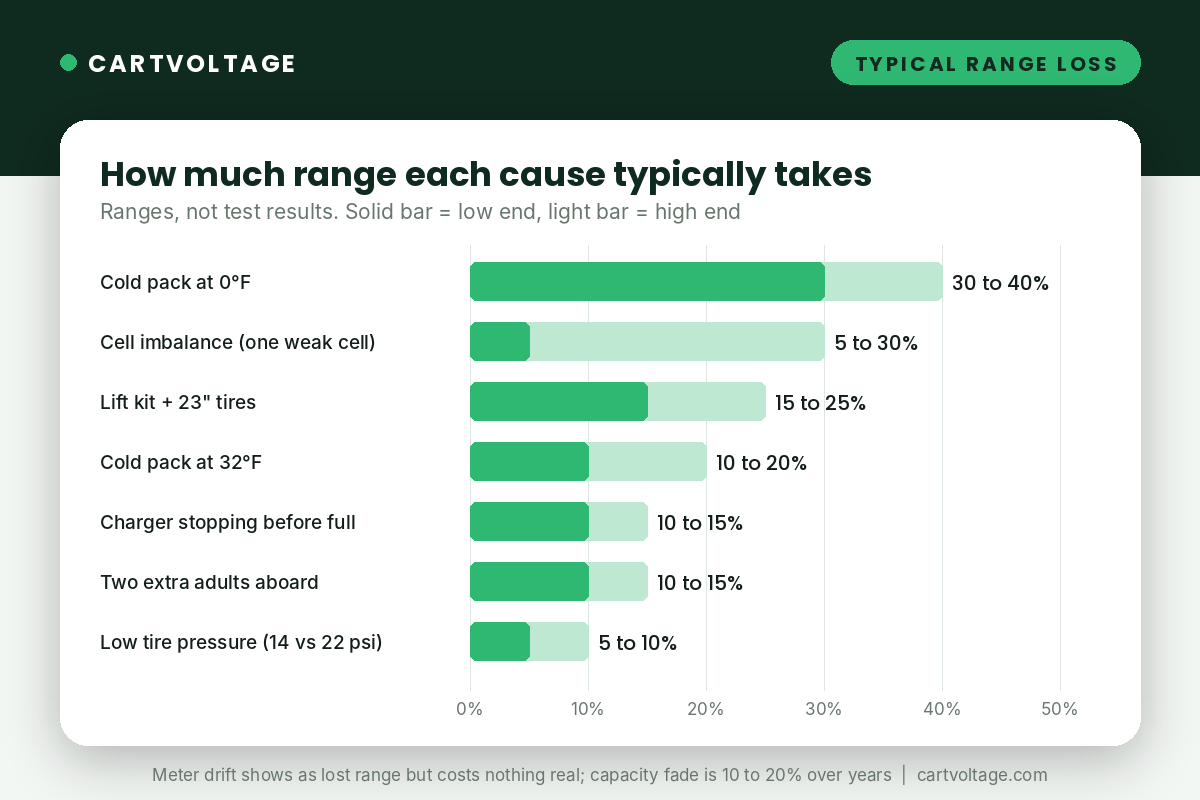
LiFePO4 does not lose capacity in the cold, but it hides it. Below about 50°F the cells’ internal resistance rises, voltage sags harder under load, and the BMS or the controller reaches its low-voltage limit with energy still in the pack. Expect 10 to 20% less range at freezing and 30 to 40% less around 0°F, with the range coming back as the pack warms. The pattern is the giveaway: range is fine by afternoon and poor first thing in the morning, and it tracks the weather rather than the calendar. Nothing is wrong with the battery; the fix is to drive it gently for the first mile, park it somewhere warmer, and never charge it below 32°F, which is a different and permanent problem covered in the cold weather guide.
Cause 2: The Meter Has Drifted
The Bluetooth app does not measure how much energy is in the pack. It counts amps in and amps out and keeps a running total, and it resets that total to 100% only when the pack reaches full charge. If the cart has been charged to 80 or 90% for a few weeks, the count drifts, and a pack that reads 20% may have 35% left or 10%. Owners who stop driving when the app says 20% then see “less range” that is entirely in the meter. The reset is simple: charge to 100%, leave it on the charger an hour past the point the charger says done, and let the pack rest. Then do the measured drive above. If range is back, it was the meter. A lead-acid dash meter is worse: it reads voltage, lithium’s voltage barely moves between 90% and 20%, so it shows full for most of the day and then drops to empty in the last few miles. Replace it with a lithium-calibrated meter if the pack has no app; the 48V comparison lists the packs with built-in monitors. Why the factory gauge is worse still: battery meter reads wrong after lithium. Where to find cell voltages, cycle count and the charge limit in the app: lithium golf cart battery Bluetooth app.
Cause 3: The Charger Stops Before Full
A 48V LiFePO4 pack is full at 58.4V (3.65V per cell), a 36V pack at 43.8V. A charger that terminates lower than that, which is common with chargers still on a lead-acid or an “AGM” profile, or with a cheap lithium charger that is out of calibration, leaves the top 10 to 15% unfilled every night. The day starts at 88%, the app may even say 100% because it reset early, and the cart runs out sooner. Check it directly: after the charger says done, read the pack voltage in the app or with a meter. Under 58.0V on a 48V pack, or a charge that finishes in half the time it used to, means the charger is stopping short. The other version of this fault is a charger that trips on a protection error part-way through because one cell reaches 3.65V early, which is cause 6. The charger compatibility guide covers the profiles, lead-acid charger on a lithium battery explains why the old profile stops short, and the charge time calculator tells you how long a full charge should take.
Cause 4: The Cart Got Harder to Push
This is the group most owners never consider because nothing about it says “battery”. Tire pressure drops a few psi a month; a cart on 14 psi instead of 22 psi uses noticeably more energy per mile. A lift kit and 23″ tires raise rolling resistance and gearing load enough to take 15 to 25% off the range of the same pack. A rear seat with two more adults, a cooler and a cargo box are weight the pack has to move. A speed upgrade or a controller change raises current draw more than it raises speed. And mechanical drag is the quiet one: a dragging brake shoe, a seized rear bearing or a parking brake cable that no longer releases fully will cut range the way a hill does. Jack up the rear, spin each wheel by hand, and listen; a wheel that stops in half a turn is costing you miles. If the measured number showed more amp-hours per mile, start here before anything electrical. The range calculator shows how much each of these takes off a stock figure, and the hills and lifted carts guide explains why the pack’s BMS rating matters once the cart is modified.
Cause 5: Something Is Draining It Overnight
If the app reads 70% when you park and 60% the next morning, the pack is not losing range on the road; it is losing it in the garage. The usual suspects are a 48V-to-12V reducer feeding accessories that never switch off (a stereo with memory, LED strips with a controller, a GPS tracker, a dash camera), a controller that stays awake because the key switch or Tow/Run switch isn’t isolating it (EZGO RXV and ICON carts are known for parked draw), or a light switch left on. Measure it: note the percentage at night and in the morning for three nights. A healthy pack with the cart switched off loses nothing you can see. To find the culprit, pull the reducer’s fuse for a night, then the accessory fuses one at a time. The reducer guide covers wiring accessories through the key switch so they sleep when the cart does.
Cause 6: Cell Imbalance
A 48V pack is 16 cells in series, and the pack is only as big as its weakest cell. If one cell sits 0.1V higher than the rest, it reaches 3.65V first and the BMS stops the charge with the other fifteen not yet full. On the way down, the same cell, or a different weak one, hits 2.5V first and the BMS cuts the pack off with energy still in the rest. The result is a pack that behaves like a 70Ah battery while reading 105Ah on the label. Open the app and look at the individual cell voltages after a full charge and an hour of rest: a spread under 0.05V is normal, 0.05 to 0.1V wants a few full charges with the pack left on the charger an extra hour or two so the BMS can balance, and more than 0.1V that does not close after three or four of those cycles is a cell that is aging faster than its neighbours. That is a warranty conversation; the fine print by brand is in how long lithium golf cart batteries last. Imbalance is also the most common reason a cart cuts out on a hill with the meter showing 40%, which is covered in golf cart lithium BMS cutoff explained and why a cart stops after conversion.
Cause 7: Real Capacity Fade
The one owners fear first and should check last. A LiFePO4 pack does lose capacity, slowly, through calendar aging and use, and the industry defines end of life as 80% of the original rating. The measurement is the amp-hour count on a full charge: if the app or the charger shows 84Ah going into a pack that used to take 100Ah from the same starting point, the pack has faded about 16%. On a pack under three years old that figure is far more likely to be imbalance or a charger fault than aging; on a pack that spent summers at 100% in a Florida garage, aging is plausible at year five or six. Either way, fade is gradual: a pack that lost 30% of its range over one month did not age, it hit one of the six causes above.
Symptom to Cause, at a Glance
| What you notice | Most likely cause | Five-minute check |
|---|---|---|
| Range is poor in the morning, fine by afternoon, tracks the weather | 1. Cold cells | Compare a cold-morning run with a warm-afternoon run on the same route |
| App drops to 20% early; range returns after a full charge | 2. Meter drift | Charge to 100%, extra hour on the charger, rest, re-test |
| Charger finishes faster than it used to; voltage under 58V after “done” | 3. Charger stopping short | Read pack voltage right after the charger shuts off |
| More amp-hours per mile on the same route; new tires, lift, seat or speed change | 4. Tires, load, drag | Tire pressure; jack up and spin the rear wheels |
| Percentage drops overnight with the cart parked | 5. Parasitic drain | Note % at night and in the morning for three nights; pull the reducer fuse |
| Charger trips part-way; cart cuts out on hills at 40%; cell spread over 0.1V | 6. Cell imbalance | Cell voltages in the app after a full charge and an hour’s rest |
| Fewer amp-hours accepted on a full charge, slowly, over years | 7. Capacity fade | Compare Ah in on a full charge against the rated figure |
The Order to Work Through It
- Tire pressure and a wheel spin. Free, two minutes, and it catches the cause that embarrasses the most people.
- Full charge, extra hour, rest, then the measured drive. This resets the meter (cause 2), confirms whether the charger reaches 58.4V (cause 3), and gives you the amp-hours-per-mile figure that splits everything else.
- Three nights of parked readings. If the number moves overnight, it is cause 5 and nothing else matters until it is fixed.
- Cell voltages in the app. Spread over 0.1V after a rested full charge is cause 6.
- Weather. If the loss follows the thermometer, it is cause 1 and it will reverse itself.
- Only then, amp-hours in on a full charge versus the rating. That is the capacity fade test, and the warranty claim starts from that number.
Frequently Asked Questions
Why does my lithium golf cart battery die so fast all of a sudden?
Sudden is the clue. Capacity fade is slow; a sudden drop is cold weather, a drifted meter, a charger that stopped reaching full, a new drain on the pack, or a cell that has gone out of balance. Work through the list above in order and the cause is usually found in the first two steps.
Why does my golf cart lose power going uphill with charge left?
Voltage sag. Under a heavy load the pack voltage dips, and a cold pack, an imbalanced pack or a BMS rated below what the cart is pulling will dip far enough to trip the BMS or the controller’s low-voltage limit even at 40% charge. Check cell spread first, then the BMS continuous rating against the cart; lifted carts and hills want 250A or more.
Does a lithium golf cart battery lose range in cold weather permanently?
No. Cold hides capacity and the range returns when the pack warms. Charging below 32°F is the thing that causes permanent loss, so keep the two apart in your head: cold driving is fine, cold charging is not.
How do I know if my golf cart battery has actually lost capacity?
Measure the amp-hours the pack accepts on a full charge from a known starting point, or the amp-hours it delivers from 100% to the BMS cutoff, and compare with the rated figure. Below 80% of rated is the industry end-of-life line. Anything measured in “miles” or “it feels like” is not a capacity test.
Can a second battery in parallel fix lost range?
It can add range, but it is the wrong first move if the cause is one of the six fixable ones, and a second pack in parallel with an imbalanced or faded one creates new problems. Diagnose first, then decide whether you need more capacity or just the capacity you already paid for. If it is more capacity, adding a second lithium golf cart battery in parallel covers matching and wiring.
Next Steps
If the pack won’t charge at all, that is a different list: the won’t-charge guide. If the cart stops dead rather than losing range gradually, see golf cart won’t move after lithium conversion. And if the measured number says the pack really is fading, how long lithium golf cart batteries last explains what to expect from the warranty. Every other symptom is covered in common lithium golf cart battery problems.