

Best Golf Cart Heater: Propane vs 48V Electric vs Heated Seats (and What Each Costs Your Battery)
Disclosure: CartVoltage earns a commission from qualifying purchases made through links on this page, at no extra cost to you. Specifications come from manufacturer pages and product listings, which are named where they are used.
A golf cart is a hard thing to heat. It has no engine heat to borrow, no insulation and, most of the time, no doors. That is why the three kinds of golf cart heater are so different from each other, and why the wrong one disappoints. One burns propane and throws real heat. One runs from the 48V pack and takes some of your range in exchange. One only warms the seat, and for many people that is enough.
Which Type of Golf Cart Heater Is Best?
| Type | Heat output | Power source | Effect on range | Best for |
|---|---|---|---|---|
| Propane cup-holder heater | About 1,170W (4,000 BTU) | 1 lb propane cylinder | None | Cold mornings, open or partly open carts |
| 48V electric heater | 400W | The cart’s battery pack | About 7% of a 105Ah lithium pack per hour | Enclosed carts, short trips, no fuel to carry |
| 12V heated seat pad | Typically 30 to 60W | 12V through a voltage reducer | Very small | Efficient warmth in any cart |
| USB heated seat cover | Typically 10 to 18W per port | USB port or power bank | Negligible | Mild climates, no wiring |
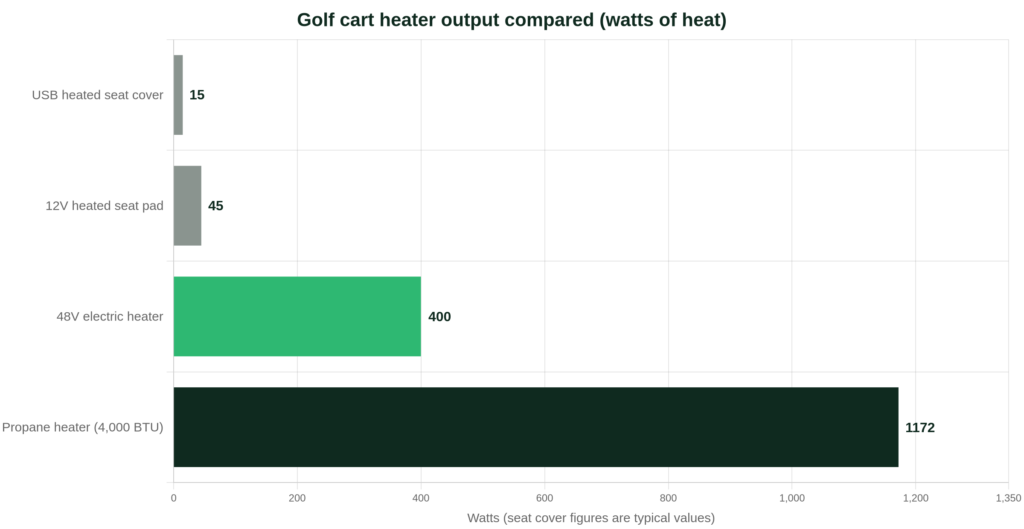
The chart explains most buyer disappointment. A propane heater gives roughly three times the heat of a 48V electric heater and about 25 times that of a heated seat pad. But heat output is not the whole story. A seat pad puts its small output straight into your body, while a space heater in an open cart warms air that blows away.
How Much Battery Does an Electric Golf Cart Heater Use?
This is the question that matters on an electric cart, so here is the arithmetic. A 400W heater on a 51.2V lithium pack draws 400 / 51.2 = 7.8 amps. In one hour it uses 0.4 kWh.
| Battery | Usable energy | 1 hour of 400W heat | 4-hour round |
|---|---|---|---|
| 48V 105Ah lithium | About 5.4 kWh | 7% | About 30% |
| 48V 150Ah lithium | About 7.7 kWh | 5% | About 21% |
| 48V lead-acid, six 170Ah 8V batteries (used to 50%) | About 4.1 kWh | 10% | About 39% |
Worked example for the 105Ah pack: 105Ah x 51.2V = 5.38 kWh. Four hours of heat is 4 x 0.4 = 1.6 kWh, and 1.6 / 5.38 = 30%. If your normal round uses 40% of the battery, running the heater the whole time takes you to 70%. That is fine. If you normally come home at 20% left, it is not. Check your margin in our golf cart battery range guide.
For comparison, a 45W heated seat pad over the same four hours uses 0.18 kWh, about 3% of the 105Ah pack. That is one tenth of the electric heater’s cost for the warmth you feel most.
What Is the Best Golf Cart Heater?
Best for heat: Mr. Heater MH4GC propane golf cart heater
Top pick for warmth: Mr. Heater MH4GC
4,000 BTU radiant propane heater with a cup-holder adapter, low-oxygen shut-off and a tip-over switch. Uses no battery power.
Check price on AmazonMr. Heater’s product page lists the MH4GC at 4,000 BTU of radiant heat from a 1 lb propane cylinder, with push-button piezo ignition, an oxygen depletion sensor that shuts the heater off in low oxygen, and a 90-degree tip-over switch designed not to trip on bumpy cart paths. It has a wind-resistant burner and an adapter that fits most golf cart cup holders. The warranty is 1 year.
Run time is easy to estimate. A 1 lb cylinder holds about 21,600 BTU of energy, so 21,600 / 4,000 = about 5.4 hours, enough for a full round. Radiant heat also suits a golf cart, because it warms people and surfaces directly instead of the moving air.
Not ideal if: your cart is fully enclosed and you plan to keep it zipped shut, your course or community bans open-flame devices, or you do not want to carry and store propane cylinders. Mr. Heater labels it for outdoor use only. Read the safety section below before buying.
Best electric: 48V 400W golf cart heater
Several brands now sell 400W heaters built to run directly from a 48V golf cart pack, with a carbon fiber heating element, an adjustable mount for a cup holder or dash, and an inline fuse. There is no fuel, no flame and no fumes. You wire it once and switch it on.
At 400W it is a personal heater, not a cabin heater. Point it at your hands or legs. Inside a zipped enclosure it will take the edge off. In an open cart on a windy day you will feel it only when it is aimed at you.
Not ideal if: your cart is 36V (a 48V heater on 36V gives only about 56% of its rated heat, and the listing may not allow it), your battery has little range to spare, or your cart has no enclosure and you play in real cold.
See a 48V 400W golf cart heater on Amazon
Most efficient: heated golf cart seat cover
A heated seat cover straps over the bench and warms you by contact. There are two kinds. Covers with a 12V plug give the most heat and need a 12V supply from a voltage reducer. USB-powered covers give less heat but run from any USB port or a power bank, so they need no wiring at all.
Not ideal if: cold hands and face are your problem, since a seat cover does nothing for them. Also check the fit. Universal covers suit standard two-person benches, while some covers are cut for one model only.
- Universal heated golf cart seat cover with 4 heat zones and 3 heat levels (USB, Type-C and 12V plug) on Amazon
- Heated golf cart seat covers kit with 3-speed heating on Amazon (check the listing for the cart models it fits)
Is a Propane Heater Safe in a Golf Cart?
It can be used safely, but only with ventilation. These points are not optional:
- Never run it in a sealed enclosure. Burning propane uses oxygen and can produce carbon monoxide. Keep at least one side panel or the rear open so fresh air flows through.
- The oxygen sensor is a backup, not permission. It reacts to low oxygen. It is not a carbon monoxide alarm.
- Outdoor use only. That is the manufacturer’s rating. Never run it in a garage, shed or cart barn.
- Keep it clear of vinyl and fabric. Enclosure panels, towels and bag covers can melt or burn if they touch the grille.
- Turn it off before fuelling, covering or parking the cart, and store cylinders upright, away from the battery compartment and the charger.
- Flooded lead-acid batteries release hydrogen while charging. Never use any flame heater in a cart that is on charge.
If any of that sounds like too much to manage, choose the electric heater or heated seats.
How Do You Wire an Electric Golf Cart Heater?
| Heater | Connect to | Current | Watch out for |
|---|---|---|---|
| 48V 400W heater | The full pack: main positive and main negative, through the supplied fuse | About 8A | Never tap part of a lead-acid pack. A switch or key-switched relay stops it running while parked |
| 12V heated seat pad | The 12V output of a voltage reducer | About 3 to 5A at 12V | Add it to your other 12V loads and stay under the reducer’s rating |
| USB seat cover | A USB port or power bank | Up to about 3A at 5V | Low-power ports give weak heat |
Tapping 12V from two batteries of a lead-acid pack is the classic mistake. Those two batteries end up discharged more than the rest, and the pack goes out of balance. Use a reducer. See best 48V to 12V voltage reducer. If you are unsure what your accessories draw, a DC clamp meter will tell you.
Does an Enclosure Matter More Than the Heater?
Yes. In an open cart moving at 12 to 15 mph, the air around you is replaced constantly, so most of a space heater’s output is carried away. An enclosure stops the wind and traps the warm air, which means a small heater can do more for comfort inside an enclosure than a large one can in an open cart. If you play through winter, buy the enclosure first. See our golf cart enclosure guide.
| Your setup | Best choice |
|---|---|
| Open cart, cold and windy | Propane heater plus heated seat cover |
| Enclosed cart, lithium battery with range to spare | 48V electric heater |
| Enclosed cart, lead-acid battery near its range limit | Heated seat cover, or propane with a panel open |
| Mild winters, short trips | Heated seat cover only |
| Community that bans open flame | 48V electric heater or heated seats |
Does Cold Weather Itself Cut Golf Cart Range?
It does, before any heater is switched on. Batteries deliver less energy when cold, and a lithium battery must not be charged below freezing. Plan for both effects together on a winter round. Our guides on lithium golf cart batteries in cold weather and how to winterize a golf cart cover the details. If the cart will sit for weeks between winter rounds, a battery maintainer keeps a lead-acid pack ready.
Frequently Asked Questions
Can I use a 12V car heater in a golf cart?
You can, but it rarely pays. A 150W plug-in car heater draws 12.5 amps at 12V, which uses most of a small voltage reducer’s capacity, and it gives less than half the heat of a 400W 48V unit. A 48V heater wired to the pack is the better electric choice.
How long does a 1 lb propane cylinder last in a golf cart heater?
About 5 to 5.5 hours on a 4,000 BTU heater, based on roughly 21,600 BTU in a 1 lb cylinder. Cold weather lowers cylinder pressure, so expect a little less on very cold days.
Will an electric heater damage my golf cart battery?
No. An 8 amp load is small next to the 50 to 200 amps the motor draws. It simply uses energy, which shortens range. The only risks are wiring it without a fuse, tapping part of a lead-acid pack, or leaving it on while parked.
Can I run a household space heater from a golf cart?
Not sensibly. A 1,500W household heater would need an inverter and would draw about 30 amps from a 48V pack, emptying a 105Ah lithium battery in roughly three and a half hours with the cart standing still.
What is the cheapest way to stay warm in a golf cart?
A windshield, an enclosure or even a single wind-side panel, plus a heated seat cover. Stopping the wind costs no energy at all, and the seat cover uses about 3% of a 105Ah battery over four hours.
Quick picks
Stop the wind first, then choose heat by how much battery you can spare.
Sources: Mr. Heater product page for the MH4GC (F242010); Amazon listings for the 48V 400W heater and heated seat covers. Battery percentages, run times and current figures are calculations from the stated wattage and capacity. Seat cover wattages are typical values. Follow the manufacturer’s instructions for any heater, and check your course or community rules on propane.
More gear for your cart: best golf cart accessories.


One Comment