Golf Cart Battery Cables: What Gauge, Which Kit, and When to Upgrade
CartVoltage is reader-supported. If you buy through links on this page we may earn a commission at no extra cost to you. As an Amazon Associate we earn from qualifying purchases. Details
Battery cables are the least glamorous part of a golf cart and the cause of a surprising share of its problems: a warm terminal, a cart that bogs on hills, a melted post, or a lithium BMS that trips under load because a corroded jumper is dropping voltage. Cables also get replaced at the two moments owners are already working on the pack, a new lead-acid set or a lithium conversion. This guide covers the gauge your cart needs, what to look for in a cable kit, and the sizes and torque to get right.
What Gauge Battery Cable Does a Golf Cart Need?
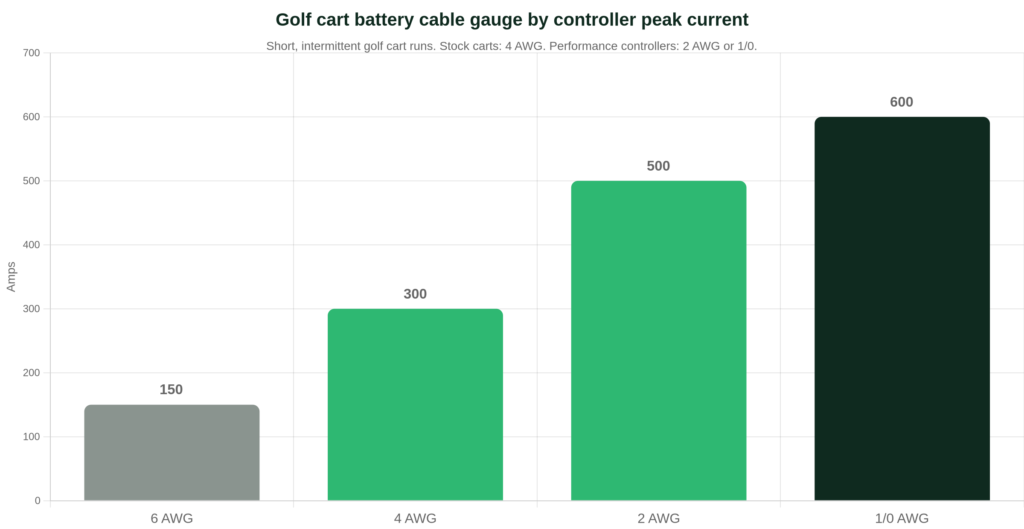
| Cable gauge | Suits | Notes |
|---|---|---|
| 6 AWG | Many factory jumpers; stock controllers up to about 150A peak | Fine when new; the first to run warm as it ages |
| 4 AWG | Stock and mildly upgraded carts, up to about 300A peak | The standard upgrade; cooler, less voltage drop on hills |
| 2 AWG | 400 to 500A performance controllers, lifted carts | Needed with a 250A continuous lithium pack and a big controller |
| 1/0 AWG | 600A controllers | Also upsize the solenoid and fuse |
Continuous-duty wire tables rate 4 AWG around 70 to 95A and 2 AWG around 115 to 130A, but a golf cart draws its peak current for seconds at a time over cables a foot long, so the industry sizes cables by the controller’s peak rating as above. If you are unsure, go one size larger; the cost is a few dollars and the cables run cooler.
What to Look for in a Golf Cart Battery Cable Kit
- Pure copper, not CCA. Copper-clad aluminum cable of the same gauge carries less current and corrodes at the lugs. Listings that don’t say “pure copper” or “OFC” usually aren’t.
- Fine-strand, flexible insulation. Welding-style cable with 105°C insulation bends around tight battery layouts without stressing the lugs.
- Tinned, crimped lugs with heat-shrink. Most golf cart posts take 5/16 inch lugs; some use 3/8 inch. Check your terminals before ordering, and avoid soldered-only lugs, which crack under vibration.
- The right lengths. Standard jumpers run about 11 to 13 inches and controller links 13 to 15 inches; some Club Car layouts need a 17 inch controller-to-pack cable. Kits sold by cart model (EZGO TXT, RXV, Club Car DS, Precedent, Yamaha) take the guesswork out.
- Enough cables. A six-battery pack needs five jumpers plus the main positive and negative, and often one or two controller and solenoid links.
Cable Kits Worth Buying
4 AWG Pure Copper Kit: Best for Stock Carts
For a lead-acid cart with a stock controller, a model-specific 4 AWG pure copper kit with tinned 5/16 inch lugs is the sensible replacement for tired factory jumpers. It drops in with the new battery set and runs cooler than the 6 AWG it replaces.
2 AWG Kit: Best for Performance Controllers and Lithium
If the cart has, or will get, a 400 to 500A controller, or a high-output lithium pack feeding a lifted cart on big tires, step up to 2 AWG for the main cables and any remaining links. Match the solenoid and fuse to the controller as well.
Which Cables Does a Lithium Conversion Need?
A lithium pack has its cells connected inside, so the five jumpers come out and only the main positive and main negative remain, plus the short links to the solenoid and controller. Size those for the pack’s continuous rating and the controller’s peak: 4 AWG for a 200A pack on a stock cart, 2 AWG for a 250A pack or a performance controller, with a fuse just above the pack’s continuous rating. Most lithium kits include main cables; check their gauge and lug size against your cart before relying on them (wiring basics, battery wiring diagram).
How to Replace Golf Cart Battery Cables
- Tow/Run to Tow, key off, photograph the layout.
- Disconnect the main negative first, then the main positive, then the jumpers.
- Clean the posts with a terminal brush; neutralize any acid with baking soda and water.
- Fit the new jumpers negative-to-positive down the string, then the main positive, then the main negative last.
- Torque to the battery maker’s figure. Lead-acid posts are commonly specified around 8 to 10 ft-lb by cable makers, and lithium terminals lower (Vatrer, for example, quotes 5 to 7 ft-lb); over-tightening cracks posts.
- Coat terminals with protector spray and recheck tightness after the first week.
Frequently Asked Questions
Do thicker battery cables make a golf cart faster?
Not faster at the top end, but they reduce voltage drop under load, so a cart with worn 6 AWG cables often pulls harder on hills after a 4 AWG upgrade (what really changes speed).
Can I use welding cable for golf cart batteries?
Yes. Fine-strand pure copper welding cable is what most quality kits are made from. Use proper crimped lugs and heat-shrink.
Why is one battery cable hot?
A loose or corroded connection, or a cable too small for the current. Clean and retorque first; if it still runs hot, replace the cable and check the whole set (other signs of a weak pack).
What size lugs do golf cart batteries use?
Most take 5/16 inch lugs; some batteries and controllers use 3/8 inch. Measure the stud or bolt before ordering.