Best Golf Cart Lithium Battery Conversion Kits (48V and 36V): What’s Actually in the Box
CartVoltage is reader-supported. If you buy through links on this page we may earn a commission at no extra cost to you. As an Amazon Associate we earn from qualifying purchases. Details
A lithium conversion kit is a battery sold with the charger, cables, mounting hardware and usually a monitor in the same box, matched to work together. For a first conversion it removes the two mistakes people make most: buying a charger with the wrong plug, and discovering the pack needs cables the old batteries didn’t. The catch is that “kit” means different things to different sellers. Some include a 25A charger, brackets and a touchscreen; some include an 18A charger and nothing else. This guide compares the kits owners buy most on Amazon by what’s actually in the box, and says which cart each suits. Specs are from manufacturer listings; we don’t run a test lab.
Quick Picks
- Best 48V kit overall: DC HOUSE 48V 100Ah: metal case, 18A charger, touch monitor, Bluetooth
- Best 48V kit for lifted carts and hills: Cloudenergy 48V 105Ah in the charger bundle: 250A BMS where the others stop at 200A
- Best 48V budget kit: LOSSIGY 48V 100Ah: charger and monitor at the low end of the price range
- Best 48V kit with certification: Vatrer 48V 105Ah with charger: UL 2271 listed pack, sold with a matched charger and cart-specific plug options
- Best 36V kit: DC HOUSE 36V 100Ah: metal case, 25A charger, monitor
- Best 36V budget kit: LOSSIGY 36V 100Ah: 25A charger included, Amazon’s Choice in the category
What a Good Kit Includes
Before the table, the checklist. A kit earns its name if it includes:
- A lithium charger matched to the pack’s voltage (58.4V for 48V packs, 43.8V for 36V), with a plug option for your cart or ring terminals you can adapt. 18A is the common size; 20 to 25A charges a 100Ah pack in around four to five hours instead of six. The old lead-acid charger is not a substitute: why a lead-acid charger fails on lithium.
- Main cables long enough to reach the cart’s leads from wherever the single pack sits in a tray built for four to eight batteries.
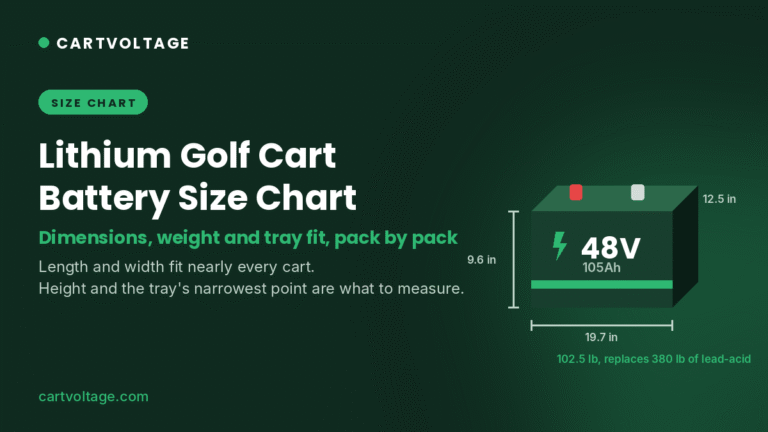
- Mounting hardware: a bracket, strap or spacers. Fewer kits include this than you’d expect; it’s the most common missing item. Pack footprints against each tray are in the size chart.
- A way to read state of charge: a touch monitor, an external display, or at least a Bluetooth app. The cart’s factory gauge will be wrong with lithium (why, and the fix).
What no kit includes: a voltage reducer for lights and accessories. If your cart has them, budget for the Pro Chaser 30A separately; our reducer guide explains why. Kits don’t include a controller because you don’t need one: why a lithium swap keeps the stock controller and solenoid.
48V Conversion Kits Compared
| Kit | Capacity | BMS continuous | Charger in box | Approx. charge time (empty to full) | Monitor | Case | Hardware in box (per listing) | Certification noted | Price |
|---|---|---|---|---|---|---|---|---|---|
| DC HOUSE 48V 100Ah | 100Ah | 200A | 18A | ~6 h | Touch monitor + app | Metal | Cables; check listing for bracket | Not stated | Check on Amazon |
| Cloudenergy 48V 105Ah (bundle) | 105Ah | 250A | 20A | ~5.8 h | Touch monitor + app | Plastic | Cables, port plug, retention strap | Not stated | Check on Amazon |
| LOSSIGY 48V 100Ah | 100Ah | 200A | Included (amps vary by listing) | ~6 h at 18A | Monitor + app | Plastic | Cables | Not stated | Check on Amazon |
| Vatrer 48V 105Ah (with charger) | 105Ah | 200A | 20A on kit listings | ~5.8 h | App; monitor on some bundles | Plastic | Brackets and cables on cart-specific kits | UL 2271 | Check on Amazon |
| OGRPHY 48V 105Ah | 105Ah | 200A | 18A | ~6.4 h | Touch monitor + app | Plastic | Cables | Not stated | Check on Amazon |
| ELEFAST 48V 100Ah | 100Ah | 200A | Included | ~6 h | App | Plastic | Cables | Not stated | Check on Amazon |
From manufacturer Amazon listings as of September 2026. Kit contents change between listing variants (with charger / without, plug type); confirm what’s in the box on the exact listing before ordering. Charge times assume a fully depleted pack and add roughly 10% for the finishing stage.
36V Conversion Kits Compared
| Kit | Capacity | BMS continuous | Charger in box | Approx. charge time | Monitor | Case | Hardware in box (per listing) | Price |
|---|---|---|---|---|---|---|---|---|
| DC HOUSE 36V 100Ah | 100Ah | 200A | 25A | ~4.4 h | Monitor + app | Metal | Cables | Check on Amazon |
| LOSSIGY 36V 100Ah | 100Ah | 200A | 25A | ~4.4 h | App | Plastic | Cables | Check on Amazon |
| OGRPHY 36V 100Ah | 100Ah | 200A | 25A | ~4.4 h | Touch monitor + app | Plastic | Cables | See 36V comparison |
| Cloudenergy 36V (250A) | ~105Ah | 250A | 20A | ~5.8 h | Touch monitor + app | Plastic | Cables, port plug, retention strap | Check on Amazon |
| Vatrer 36V 105Ah (with charger) | 105Ah | 200A | Included on kit listings | ~5.8 h at 20A | App | Plastic | Varies by listing | Check on Amazon |
How to Choose: Four Questions
1. Does the kit offer your cart’s charger plug?
This is the whole point of buying a kit, and it’s where kits differ most. Vatrer’s cart-specific listings (EZGO TXT, RXV, Club Car, Yamaha, ICON) ship the charger with the right plug. Several other kits ship a charger with ring terminals or a generic connector, which works but means you either mount the charger under the seat and wire it directly, or buy an adapter to the cart’s receptacle. Neither is hard; just know which you’re getting. Plug shapes by make and year are in golf cart charger plug types, and voltage and profile rules in the charger compatibility guide.
2. Is 200A enough, or do you need 250A?
For a stock two or four-seater on mostly flat ground, 200A continuous is fine and every kit above has it. For a lifted cart on big tires, a six-seater, hilly terrain, or an AC-drive cart with a high-amp controller (ICON, EZGO RXV, Onward HP), the extra 50A in the Cloudenergy bundles is the difference between climbing a long grade and the BMS cutting out halfway up (what a BMS cutoff looks like). It’s worth more than an extra 5Ah. The full case for 250A is in best lithium battery for hills and lifted carts.
3. Metal or plastic case?
Plastic (ABS) is lighter and fine in a golf cart tray. Metal takes knocks better and sheds heat a little faster, which matters on utility carts, farm carts and anything that bounces down a trail. DC HOUSE is the metal-case option at both voltages.
4. Do you want a certification?
UL 2271 is the light-EV battery safety standard, and among Amazon kits only the Vatrer 48V 105Ah carries it. It doesn’t change performance; it means an independent lab checked the BMS protections and abuse tolerance. If the cart lives in an attached garage or you’d rather not rely on the manufacturer’s own word, it’s the one to pick.
The Kits in Detail
DC HOUSE 48V 100Ah Kit
The most complete box at its price: metal case, 18A charger, a touch monitor that reads true state of charge, and Bluetooth. Several owners on deal forums note it’s the same pack sold under a sister brand, and that tallies with the metal-case design. What’s not in the box is a cart-specific plug; the charger connects with ring terminals, so plan to mount it under the seat or add an adapter.
Best for: first conversions, utility carts, anyone who wants the monitor and the metal case.
Watch for: hold-down hardware; check the listing and budget a strap if it’s not included.
Cloudenergy 48V 105Ah Bundle
The only kit here with a 250A continuous BMS, and one of the few that ships mounting hardware: a retention strap and a port plug alongside the 20A charger and touch monitor. That combination makes it the default for lifted carts, six-seaters and hilly properties, where the extra current headroom matters more than anything else on the spec sheet.
Best for: lifted carts, big tires, hills, AC-drive carts.
Watch for: no UL listing; confirm the bundle variant includes the charger.
LOSSIGY 48V 100Ah Kit
One of the longest-running lithium golf cart listings on Amazon and among the most reviewed. Standard 200A BMS, charger and monitor in the box, plastic case. LOSSIGY runs several near-identical listings with slightly different bundles and charger amperages; read the “what’s in the box” section on the exact one you’re buying.
Best for: stock carts on a budget.
Watch for: multiple listings; charger amps vary.
Vatrer 48V 105Ah with Charger
Vatrer sells the same UL 2271 listed pack bare and in kits, and the kits are the ones to look at here: cart-specific listings for EZGO, Club Car, Yamaha and ICON ship a 20A charger with the matching plug, plus brackets and cables sized for that cart. It costs more than the generic kits, and in return the plug problem simply doesn’t arise.
Best for: anyone who wants the certification, or a plug-matched charger without adapters.
Watch for: make sure you’re on the “with charger” listing for your cart, not the bare pack. Full review of the pack, its variants and datasheet: Vatrer 48V 105Ah review.
OGRPHY 48V 105Ah Kit
Effectively a 105Ah answer to the DC HOUSE kit: 18A charger, touch monitor and app, 200A BMS, plastic case. If you want the extra 5Ah and the monitor without paying for a metal case, this is the comparison to make.
ELEFAST 48V 100Ah Kit
A no-frills kit, usually the lowest priced in this group: 200A BMS, Bluetooth, charger in the box, plastic case, no monitor. Sensible for a stock cart where the app is enough.
DC HOUSE 36V 100Ah Kit
The 36V version of the metal-case kit, and it ships a 25A charger, which on a 36V system is a real advantage: a 100Ah pack refills in about four and a half hours. Monitor and Bluetooth included. For a 1994 to 2009 EZGO TXT or a pre-1995 Club Car DS it’s the one-box answer.
LOSSIGY 36V 100Ah Kit
Amazon’s Choice in the 36V category at the time of writing, with a 25A charger, 200A BMS and 1000A peak. Plastic case, app rather than a touch monitor. The budget pick for a stock 36V cart.
Cloudenergy 36V 250A Bundle
The 36V pack with a 250A BMS, plus 20A charger, touch monitor, port plug and a retention strap. A 36V system draws more current than a 48V one for the same power, so the extra BMS headroom matters even more here on a lifted or hard-worked cart.
Kit vs Buying Separately
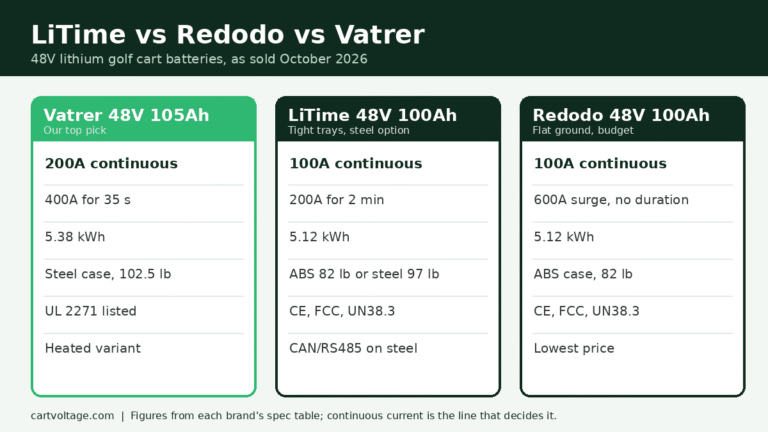
Buying separately? See best lithium golf cart chargers for charger picks by plug. For the bare pack, LiTime vs Redodo vs Vatrer compares three of the biggest Amazon brands.
| Kit | Pack + charger bought separately | |
|---|---|---|
| Cost | Usually $50 to $150 less than the parts | Higher, but you choose each part |
| Plug match | Only if the kit offers cart-specific plugs | You pick a charger with your exact plug |
| Charger quality | Adequate; sometimes the weakest part of the kit | Can pick a higher-amp or better-built unit |
| Best when | First conversion, stock cart, want one purchase | Unusual plug, want 25 to 30A charging, or already own a lithium charger |
Frequently Asked Questions
What comes in a golf cart lithium conversion kit?
At minimum the battery and a matched lithium charger. Better kits add main cables, a monitor or app, and mounting hardware. None include a voltage reducer for lights.
Will the kit’s charger plug into my cart?
Only if the kit offers your cart’s plug. Cart-specific kits do; generic kits ship ring terminals or a generic connector, which you mount under the seat or adapt. Match by photo, not by name.
Is a 100Ah kit enough for my cart?
For a stock 2 to 4 seat cart doing under 15 miles a day, yes. Lifted carts, six-seaters and 20-mile days want 150Ah, which is sold as a bare pack more often than as a kit. Run your cart through the range calculator, or see 100Ah vs 105Ah vs 150Ah range.
Can I install a conversion kit myself?
Most owners do, in one to two hours with hand tools. The general sequence is in how to convert a golf cart to lithium; cart-specific steps, including the Club Car OBC bypass, are in our guides for EZGO TXT, EZGO RXV, Club Car DS and Precedent, and Yamaha.
Do I need a 36V or 48V kit?
Count the batteries under the seat: six 6V batteries means 36V; six 8V or four 12V means 48V. A 48V kit cannot go into a 36V cart without replacing the controller and motor. More in 36V vs 48V golf cart.
What is the best 48V golf cart lithium battery conversion kit?
For a stock 48V cart, the DC HOUSE 48V 100Ah kit: metal case, 18A charger, touch monitor and Bluetooth in one box. For lifted carts, six-seaters and hills, the Cloudenergy 48V 105Ah bundle with its 250A BMS. For a UL 2271 listed pack and a charger with your cart’s exact plug, the Vatrer 48V 105Ah cart-specific kit.
What is the best 36V golf cart lithium battery conversion kit?
The DC HOUSE 36V 100Ah kit, whose 25A charger refills the pack in about four and a half hours. The LOSSIGY 36V 100Ah kit is the budget pick, and the Cloudenergy 36V 250A bundle suits lifted or hard-worked 36V carts. More 36V options in best 36V lithium golf cart batteries.
Next Steps
Confirm fitment and plug type in the fitment guide, or if you’d rather choose the pack and charger separately, see Best 48V Lithium Golf Cart Battery, Best 36V and the charger guide.

2 Comments