Golf Cart Won’t Move After Lithium Conversion: 9 Causes in Order, With a 2-Minute Multimeter Test
CartVoltage is reader-supported. If you buy through links on this page we may earn a commission at no extra cost to you. As an Amazon Associate we earn from qualifying purchases. Details
The lithium pack is in, the cables are tight, you turn the key and press the pedal, and nothing happens. Or the cart moves ten feet and dies. Or it drives fine on the flat and quits on the first hill. All three feel like a bad battery; almost none of them are. This guide works through the causes in the order they actually occur, from a switch left in the wrong position to the one case where a controller is genuinely damaged, with a quick multimeter test that tells you which side of the cart the problem is on.
First: Which of These Is It?
| What happens | Start with |
|---|---|
| Completely dead: no lights, no solenoid click, no dash | Causes 1, 2, 3 |
| Dash lights up, no click when you press the pedal | Causes 4, 5, 6 |
| Solenoid clicks, cart doesn’t move | Causes 3, 7, 9 |
| Moves, then cuts out under acceleration or on hills, then recovers | Cause 8 |
| Moved fine for weeks, now dead after sitting | Cause 2 (low-voltage cutoff) |
| Club Car: dash flashes or cart refuses to run after a failed charge | Cause 6 |
| EZGO RXV or ICON: dead with the brake locked | Cause 2, then the parked-draw note |
The Two-Minute Multimeter Test
Before pulling anything apart, three voltage readings split the problem in half. Set the meter to DC volts, Run/Tow switch in RUN, key on. If you are new to the meter, how to test golf cart batteries with a multimeter covers probe placement and which meter to buy.
- Across the pack terminals. A 48V pack should read 50 to 54V; a 36V pack 37 to 41V. Zero means the BMS is asleep or tripped (Cause 2). Well below the range means the pack is nearly empty.
- Across the solenoid’s big input terminal and the pack negative. Should match reading 1. If it’s zero, the problem is between the pack and the solenoid: a main cable, the Run/Tow switch, or a fuse (Causes 1, 3).
- Across the solenoid’s big output terminal and pack negative, with the pedal pressed. If it stays at zero while the solenoid clicks, the solenoid contacts have failed (Cause 5). If there’s no click at all, the controller isn’t being told to engage (Causes 4, 6). If voltage appears here and the cart still won’t move, the fault is downstream: controller, motor, or a locked brake (Causes 7, 9).
Cause 1: Run/Tow Switch in Tow
You put it in TOW to do the swap and forgot. Every EZGO, Club Car and Yamaha built since the late 1990s has one, usually under the seat; ICON and Evolution call it the maintenance switch. In TOW the controller is disconnected and the cart is dead by design. Flip it to RUN. This is the most common cause on this list, and it’s embarrassing, and everyone has done it.
Cause 2: The BMS Is Asleep or in Low-Voltage Cutoff
A new pack often ships in storage mode with the output disconnected; a pack that’s been run flat, or drained by a cart that stays awake when parked, disconnects itself at its low-voltage limit. Either way the terminals read 0V and the cart is dead. Wake it: press the pack’s power button, connect the charger for a minute, or use the app. If it was low-voltage cutoff, charge it fully before driving. Every other cutoff the BMS can make, and the reset for each: golf cart lithium BMS cutoff explained.
RXV and ICON owners: these carts keep the controller and electromagnetic brake circuit powered in RUN with the key off. Parked for weeks at a low state of charge, the pack can reach cutoff, and the brake locks. Wake the pack, charge, and switch to TOW for storage in future. Details in the RXV guide and ICON guide; the storage routine itself is in how to winterize a golf cart.
Cause 3: Main Cable Loose, on the Wrong Terminal, or Not Reaching
Three versions of the same problem. A ring terminal that’s on the stud but not tightened will carry enough current to light the dash and none to move the cart. A main lead that was routed to where the old battery’s terminal was, rather than to the new pack’s terminal, is connected to nothing. And on carts converted from six or eight batteries to one pack, the factory main leads sometimes aren’t long enough to reach the pack’s terminals cleanly, and get stretched onto the edge of a stud.
Run/Tow to TOW, then check both main leads: correct terminal, full contact, torqued to the pack maker’s spec. If a lead is short, buy a longer 2 or 4 gauge cable rather than stretching it. Check the pack’s negative lead reaches the controller’s B- and the positive reaches the solenoid, as they did before.
Cause 4: Controller Not Waking (Key Switch, Precharge, Fuse)
Dash lights up, pedal does nothing, no click. The controller powers on through the key switch via a small-gauge wire, often through a fuse and a precharge resistor. If that circuit was disturbed during the swap (a spade connector pulled off, a fuse blown by a momentary short while moving cables), the controller never wakes even though the pack is fine. Follow the thin wire from the key switch toward the controller and solenoid; check every connector and the fuse in that line. On carts where a 12V accessory tap was removed with the lead-acid pack, confirm the key-switch circuit wasn’t sharing it.
Cause 5: Solenoid Failed
The solenoid is a heavy relay; when it clicks, contacts inside close to send pack power to the controller. Contacts burn over years and a conversion is often when they finally quit, because the pack is disconnected and reconnected several times. The multimeter test catches it: click, but no voltage on the output side. A replacement is inexpensive and matched to voltage (36V or 48V) and coil type; check the part number on the old one. When a solenoid is worth replacing during a conversion.
Cause 6: Club Car OBC Lockout
On 1995 to 2013 Club Car DS and Precedent carts, the On-Board Computer can lock the cart out after it sees what it thinks is a failed or interrupted charge, which is exactly what happens when the factory charger is plugged into a lithium pack before the OBC is bypassed. Symptom: dash flashes or the cart refuses to run, even though the pack reads full. Disconnect the pack’s main negative for five minutes to reset the OBC, then complete the bypass so it doesn’t happen again. Full wiring in the Club Car guide.
Cause 7: Electromagnetic Brake Locked
EZGO RXV, ICON, Evolution and some Yamaha Drive2 carts use a motor brake that releases electrically. If the brake circuit didn’t get power, the cart tries to move and can’t; you may hear the motor hum. The usual cause after a conversion is the brake wire or its connector disturbed at the motor, or the pack’s low-voltage cutoff (Cause 2) having left the brake engaged. Check the connector at the motor end, then cycle Run/Tow (TOW releases the brake on most of these carts, which is also the way to push the cart if you need to).
Cause 8: Cuts Out Under Load, Then Recovers
The cart drives, then stumbles or dies for a second when you floor it or climb, then comes back. That’s the BMS opening because the controller asked for more current than the pack’s continuous rating, for longer than the burst window. A 200A pack on a lifted cart with a 400A controller does this on every hill. Two fixes: a pack with a higher continuous rating (250A or more), or a second identical pack in parallel, which doubles the available current. Turning the controller’s current limit down works too, at the cost of performance. Which packs carry 250A, and how to run two in parallel, is in Best Lithium Golf Cart Battery for Hills and Lifted Carts. Losing range rather than stopping dead? Start here. Cart dies and then comes back on its own? That is the BMS: golf cart lithium BMS cutoff explained.
Why this happens, from a pack engineer: Engineer’s Note on continuous vs peak current.
Cause 9: Reversed Polarity Damaged the Controller
The rare, expensive one. If the main leads were connected backwards even briefly, the controller’s input protection may have failed. Symptoms: voltage reaches the controller, the solenoid clicks, nothing moves, and the controller may be warm or show a fault code on carts that have one. Before condemning it, confirm the motor: on series carts, a jumper test at the motor terminals with the pack will spin it; on AC carts, leave that to a technician. A damaged controller is a replacement, not a repair, and it’s the reason every guide on this site says main negative off first and on last, and photograph the wiring before you start.
Also Check: Throttle and Pedal Sensors
Club Car’s MCOR and EZGO’s inductive throttle sensor live near the pedal and get knocked during a conversion when the floor mat or access panel comes up. A cart that does everything except respond to the pedal, on a cart that responded before the swap, has usually had a throttle connector pulled. Reseat it before buying parts.
Quick Sequence
- Run/Tow in RUN? (Cause 1)
- Pack terminals read normal voltage? If 0V, wake the BMS (Cause 2)
- Voltage at solenoid input? If not, main leads and fuse (Cause 3)
- Solenoid clicks? If not, key-switch circuit and precharge (Cause 4); if yes but no output, solenoid (Cause 5)
- Club Car flashing or locked out? Reset and bypass the OBC (Cause 6)
- Motor hums but won’t turn? Brake circuit (Cause 7)
- Drives then cuts out on hills? BMS rating (Cause 8)
- Everything above passes? Throttle sensor, then controller (Cause 9)
Frequently Asked Questions
Why does my golf cart click but not move after installing lithium?
The solenoid is engaging but power isn’t reaching the motor. Most often a main lead on the output side is loose or short, the solenoid contacts have failed, or an electromagnetic brake is still locked. The multimeter test above tells you which.
Why does my cart stop on hills with a lithium battery?
The BMS is protecting itself: the controller is drawing more than the pack’s continuous rating for longer than its burst window. A 250A pack, a second pack in parallel, or a lower controller current limit fixes it.
Does a lithium battery need a different solenoid?
No. The solenoid cares about voltage, not chemistry. A 48V solenoid works with a 48V lithium pack. If yours failed during the conversion, it was on its way out already. If the cart stopped after replacing lead-acid batteries instead, check the jumpers against the golf cart battery wiring diagram.
My cart worked for a month, now it’s dead. Is the lithium battery bad?
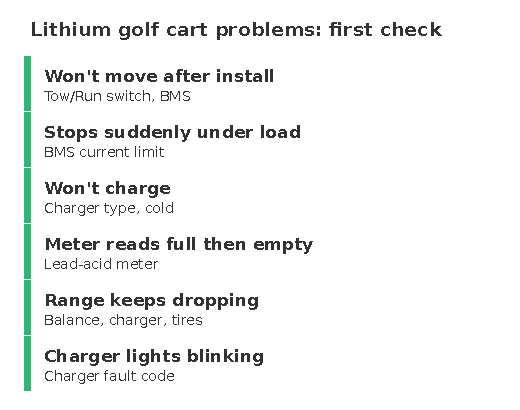
Almost certainly not. It’s low-voltage cutoff after sitting, especially on RXV and ICON carts that draw power while parked. Wake the BMS, charge fully, and use TOW for storage. For other symptoms, see common lithium golf cart battery problems.
Can I test the motor without the controller?
On a series (DC) cart, yes: jumping the motor terminals directly from the pack will spin it. On AC carts (RXV, ICON, Onward HP, Drive2 AC) the motor needs the controller to run at all; leave those to a technician with a diagnostic tool.
Next Steps
Charging problems rather than driving problems? Lithium Golf Cart Battery Won’t Charge: 9 Causes in Order. Need to confirm the install was right? The cart-specific guides for EZGO TXT, Club Car and Yamaha show the wiring step by step.



3 Comments