How Long Do Lithium Golf Cart Batteries Last?
CartVoltage is reader-supported. If you buy through links on this page we may earn a commission at no extra cost to you. As an Amazon Associate we earn from qualifying purchases. Details
Every lithium golf cart battery listing leads with a cycle number: 4,000 cycles, 6,000 cycles, sometimes 15,000. Those numbers are not lies, but they answer a question nobody asked. A golf cart does not wear a battery out by cycling it; it wears it out by sitting in a hot garage, fully charged, for the eleven months a year it is not being driven hard. This guide explains what the ratings mean, how long the packs last in practice, what the long warranties actually promise, and the handful of habits that decide whether you get 8 years or 15.
The Numbers at a Glance
| Question | Lithium (LiFePO4) | Flooded lead-acid |
|---|---|---|
| Rated cycle life (manufacturer) | 3,000 to 6,000 cycles to 80% capacity | Roughly 1,000 to 1,200 cycles at 50% depth of discharge (Trojan T-105 class) |
| Realistic life in a golf cart | 10 to 15 years | 3 to 6 years with watering and equalizing; 2 to 3 if neglected |
| What usually ends it | Calendar aging: heat and time at high charge | Sulfation, water loss, plate shedding |
| Warranty length (typical) | 5 years (most Amazon brands) to 8, 10 or 11 years (Eco, Vatrer, Dakota) | 12 to 18 months, often prorated |
| “End of life” definition | 80% of original capacity; the pack still works after that | Fails to hold charge or holds very little |
What “4,000 Cycles” Actually Means
A cycle is a full discharge and recharge, and partial cycles add up
One cycle means using 100% of the pack’s capacity and putting it back. It does not mean one plug-in. If you use 30% on Saturday and 30% on Sunday and charge both nights, that is 0.6 of a cycle, not two cycles. This is the first reason the cycle rating overstates how fast a golf cart ages its battery: most carts never get close to a full cycle in a day.
The rating stops at 80% capacity, not at dead
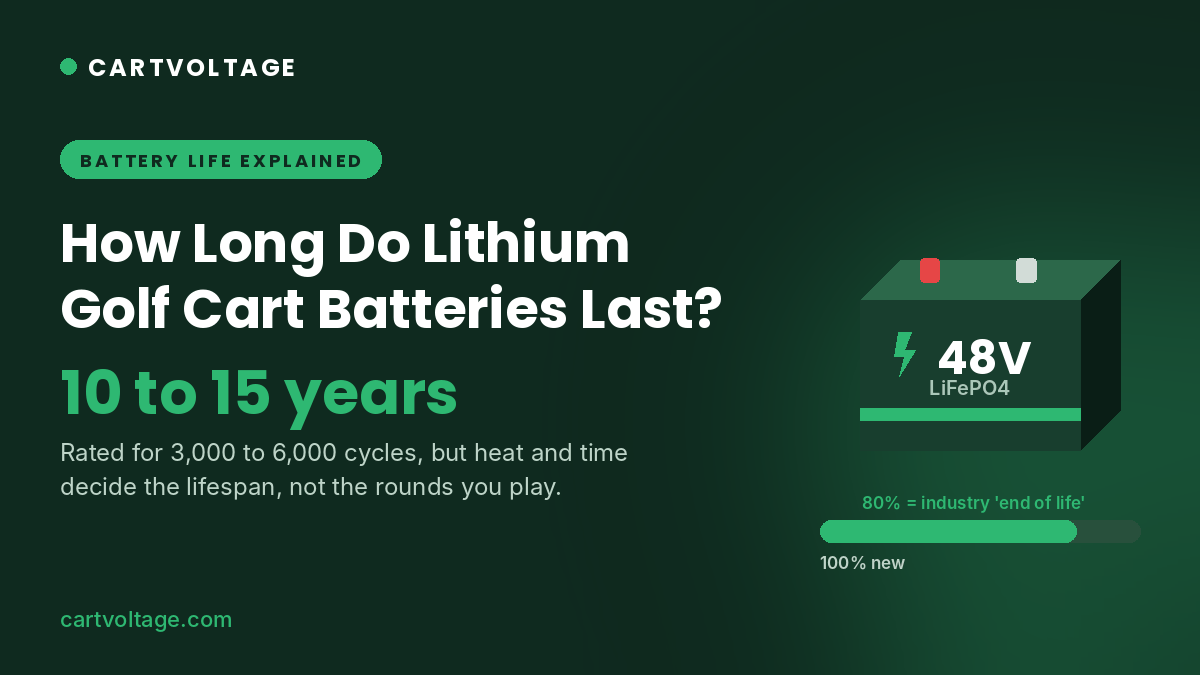
Cycle life is counted until the pack holds 80% of its original capacity, because that is the convention the battery industry uses for end of life. A 105Ah pack at “end of life” is an 84Ah pack. For a cart that used 35Ah on its longest day, that battery has years of service left in it. Nothing switches off at cycle 4,001; the range just keeps shrinking slowly.
Depth of discharge changes the number
Brands that publish the detail show how much the rating depends on how deep you drain the pack. LiTime’s standard spec, for example, lists 4,000+ cycles at 100% depth of discharge, 6,000+ at 80%, and 15,000+ at 60%. A listing that just says “6,000 cycles” without a depth is quoting the friendliest condition. Compare packs at the same depth or don’t compare them at all.
Cycle Math for a Golf Cart: Why Cycles Are Almost Never the Limit
Run the numbers for your own routine and the cycle rating stops looking like a limit. Eighteen holes on a stock cart uses roughly 25% to 35% of a 48V 105Ah pack. A community cart doing 8 to 10 miles a day uses about 40%. Even a rental fleet cart that gets driven hard every day of the season rarely exceeds one full cycle a day.
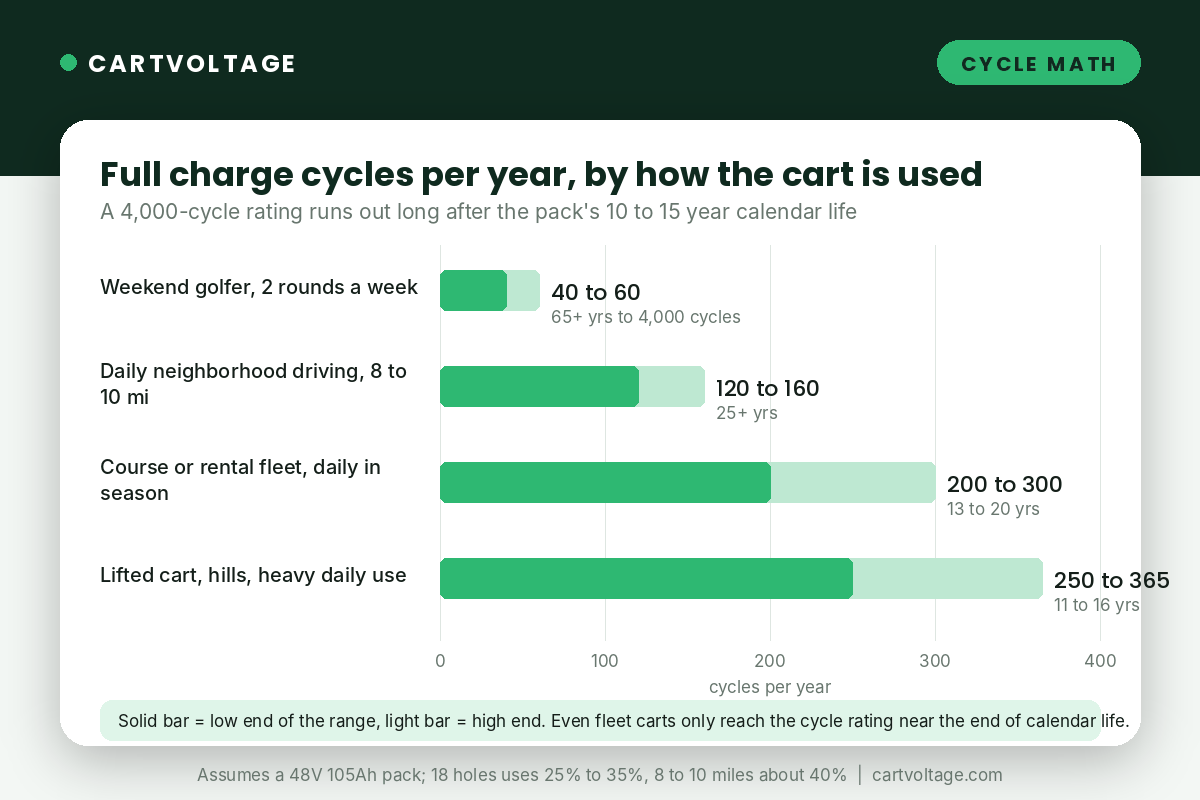
| How the cart is used | Full cycles per year (approx.) | Years to reach 4,000 cycles |
|---|---|---|
| Weekend golfer, 2 rounds a week in season | 40 to 60 | 65+ (calendar life ends first) |
| Daily neighborhood driving, 8 to 10 miles | 120 to 160 | 25+ (calendar life ends first) |
| Course or rental fleet, daily all season | 200 to 300 | 13 to 20 |
| Lifted cart, hills, heavy daily use | 250 to 365 | 11 to 16 |
Only fleet-level use gets anywhere near the cycle rating inside the pack’s natural lifespan. For everyone else, the clock that runs out is calendar aging. The range calculator will tell you what fraction of your pack a typical day uses, if you want your own number.
Calendar Aging: The Clock That Actually Runs Out
A lithium cell loses capacity even when it is doing nothing, through slow chemical reactions at the electrodes. How fast depends on two things: how warm the cell is and how full it is. A University of Waterloo study of LiFePO4 calendar aging found that temperature had the largest effect, followed by state of charge; cells stored hot and fully charged degraded fastest, part of that loss could not be recovered, and cells that had been stored hot kept degrading faster afterwards even once they were moved somewhere cooler. In plain terms: the summer your cart spent fully charged in a 100°F garage stays with the battery.
That is why the realistic answer is 10 to 15 years rather than the 25 or 30 the cycle math suggests. It is also why the long warranties are built around 8 to 12 years: the manufacturers’ own aging data points to roughly a decade of useful life in normal conditions, with the hot-climate, always-full packs at the short end and the shaded, moderately charged packs at the long end.
The Six Things That Shorten a Lithium Golf Cart Battery’s Life
In order of how much they matter for a golf cart, not for a phone or an EV.

- Heat. Every warranty excludes storage above 140°F, but the damage starts far below that. A pack that lives at 95°F ages noticeably faster than one at 75°F. Parking in direct sun, or in a metal shed, is the most common and least noticed way owners shorten battery life.
- Sitting at 100% for weeks or months. Full charge is the highest-stress state for a lithium cell. Charging to 100% and driving the next day is fine. Charging to 100% in October and leaving the cart until April is not; store at 50% to 60% instead.
- Charging below freezing. Lithium ions plate onto the anode as metal instead of entering it, and that capacity never comes back. Most packs have a BMS that blocks charging below 32°F; some cheaper ones don’t. The full rules are in the cold weather guide.
- Sustained high current. A lifted cart on big tires pulling 250A up a grade through a 200A BMS heats the cells and trips the BMS repeatedly. Heat inside the cell is aging, whatever the thermometer in the garage says. Match the BMS to the cart; the hills and lifted carts guide explains the 250A rule and this Engineer’s Note explains why peak ratings don’t count.
- Running to the BMS cutoff and leaving it there. Hitting the low-voltage disconnect occasionally does no harm. Leaving the pack at that state for months lets the cells self-discharge below the point where the BMS will accept a charge, which is one of the causes in the won’t-charge guide. Eco Battery’s warranty requires the pack to be charged at least once every six months for exactly this reason.
- The wrong charger. A lead-acid charger that pushes an equalize phase at 62V to 64V on a 48V lithium pack forces the BMS to disconnect at the top of every charge. A charger that never reaches 58.4V means the BMS never gets to balance the cells, and the weakest cell slowly drifts away from the rest. Both are covered in the charger compatibility guide.
What the Long Warranties Actually Promise
Warranty length is the number brands advertise; the fine print is what you get. We read the documents so you can compare them on the same terms.
| Brand | Advertised term | Full replacement period | After that | Conditions worth knowing |
|---|---|---|---|---|
| Vatrer (golf cart packs) | 10 years, 12 with registration | First 2 years | Years 3 to 5: you pay shipping. Years 6 to 12: shipping plus a monthly depreciation fee | Excludes storage above 140°F, reverse polarity, impact and submersion |
| Eco Battery | 8 years | First 36 months | Prorated: (purchase price x months owned) / 96. At 46 months on a $2,500 pack the owner pays about $1,198 | Register within 90 days or coverage drops to 1 year; must be charged at least every 6 months; no storage fully discharged |
| Dakota Lithium | 11 years | See Dakota’s terms | See Dakota’s terms | Rated 5,000+ cycles |
| Most Amazon brands (LOSSIGY, DC HOUSE, Cloudenergy, ELEFAST, OGRPHY) | Usually 5 years | Varies by seller | Varies by seller | Terms are on the listing, not in a document; screenshot them at purchase |
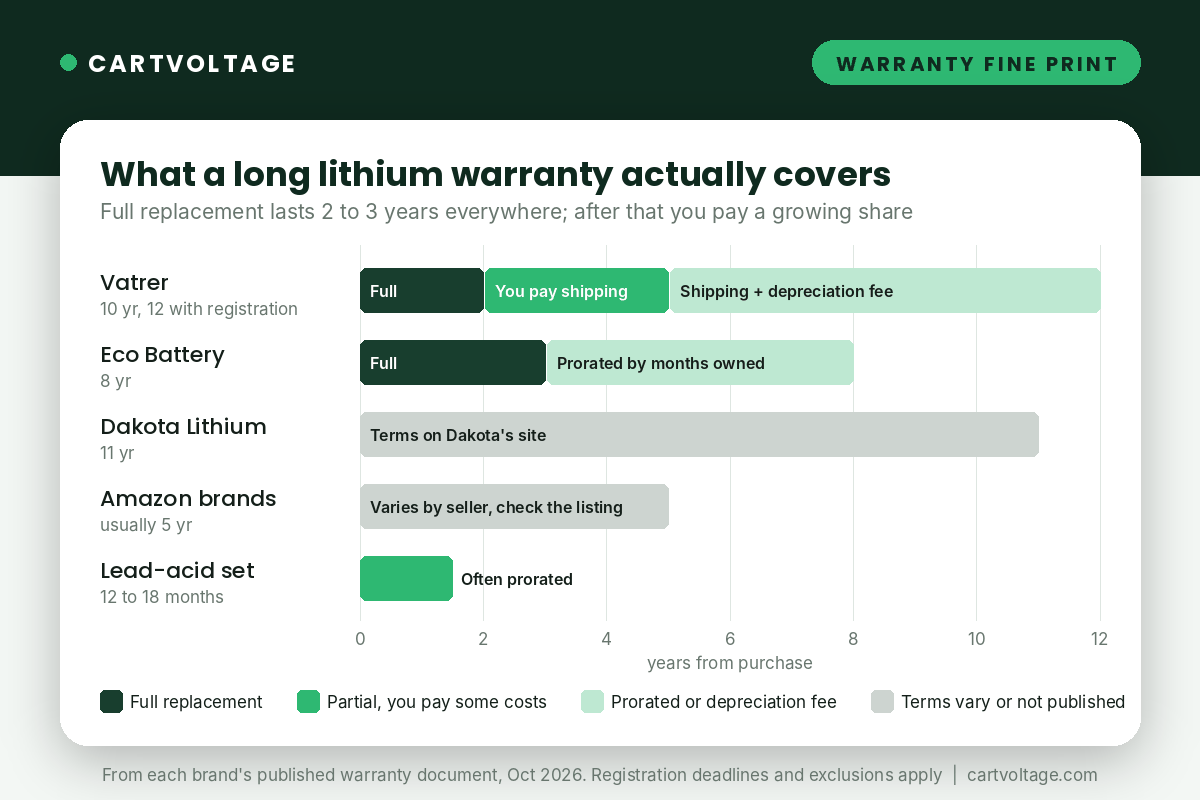
The pattern is the same everywhere: two to three years of real replacement coverage, then a sliding scale where you pay an increasing share. An “8-year warranty” is a 3-year warranty with a discount on a replacement afterwards. That is still better than lead-acid’s 12 to 18 months, but it is not a promise that the pack will be replaced free in year seven. Our Eco Battery review and Vatrer review go through each brand’s terms in more detail.
How to Tell Your Pack Is Aging (and Whether It’s Really the Battery)
- Range is shrinking but the app still shows 100% after a charge. That is capacity fade: 100% of a smaller tank. Compare the amp-hours the app reports going in on a full charge against the rated figure. Below about 80% of rated, the pack is at the industry’s end-of-life line, though still usable. Rule out the six fixable causes first: lithium golf cart battery losing range.
- The cart bogs or cuts out on hills it used to climb. Rising internal resistance makes voltage sag harder under load, so the BMS or controller trips sooner. On a pack under 3 years old this is more often an undersized BMS than aging; see why a cart cuts out after conversion.
- Cell spread in the app is more than 0.1V after a full charge and an hour of rest. One cell is aging faster than the others or the BMS balancing has fallen behind. A few full charges with the cart left on the charger overnight usually closes the gap; if it doesn’t, that cell is the pack’s weak link.
- Charging finishes suspiciously fast. A charger that used to take 5 hours and now takes 3 is filling a smaller pack, assuming the same starting point. The charge time calculator gives you the expected figure for your charger and capacity.
- The factory dash meter says it’s dying. Ignore it. A lead-acid meter reads lithium’s flat voltage curve wrong and will show empty while the pack has half its charge. Only the app, a lithium-calibrated meter, or a measured amp-hour count tells you anything. Why the factory meter reads wrong on lithium.
Seven Habits That Get You the Full 10 to 15 Years
- Charge when you’ll drive, not when you park for the season. Day to day, charging to 100% after use is fine if the cart will be driven within a few days. For storage of a month or more, charge to 50% to 60% and disconnect the pack or switch it off. Full routine: winter storage guide.
- Give the BMS a full charge every two to four weeks. Most packs balance their cells only near the top of charge. If you habitually stop at 80% to be kind to the battery, let it reach full and sit on the charger for an hour or two a couple of times a month.
- Never charge below 32°F. Drive first to warm the pack, or wait for the garage to get above freezing. Self-heating packs are the exception, and they cost extra for a reason.
- Keep the cart out of the sun. Shade or a garage is worth more to battery life than any other free change you can make, especially in Florida, Texas and Arizona.
- Match the BMS to the cart. 200A continuous is right for a stock cart. Lifted carts, big tires and hills want 250A or more, or two packs in parallel, so the BMS is never running at its limit.
- Use a lithium charger with the right termination voltage. 43.8V for 36V packs, 58.4V for 48V, and the charger must have no equalize or desulfate phase. The charger picks are sorted by cart plug.
- Check a stored pack every two months. Lithium self-discharges slowly, 2% to 3% a month, but a BMS that stays awake can drain a pack faster. If it has dropped below 30%, top it up to 60% and put it back.
Lithium vs Lead-Acid Lifespan in the Same Cart
If you are still deciding whether to convert, lifespan is where the lithium case is strongest. A flooded lead-acid set in a golf cart is rated for roughly 1,000 to 1,200 cycles at 50% depth of discharge, and that assumes watering on schedule, monthly equalizing and never leaving it discharged. In practice most owners replace lead-acid every 3 to 6 years, and the sets that get neglected go in 2 to 3. A lithium pack replaces two or three lead-acid sets over its life, which is the core of the math in Is a Lithium Conversion Worth It?; the cost calculator lets you put in your own prices and years. Trojan’s own lithium line against its lead-acid sets is compared in the Trojan guide.
Frequently Asked Questions
Do lithium golf cart batteries go bad if you don’t use them?
They age slowly whether used or not, and faster when stored hot and full. Stored at 50% to 60% in a cool place, a LiFePO4 pack loses only a few percent of capacity a year. The real risk of non-use is letting the pack drain to the point where the BMS locks out, so check it every couple of months.
Is it bad to leave a lithium golf cart plugged in all the time?
A proper lithium charger stops at full and does not float, so leaving it connected overnight or over a weekend is fine. Leaving the cart plugged in and fully charged for months is the problem, because of calendar aging at 100%, not because of the charger.
Should I charge a lithium golf cart battery after every use?
You can, and unlike lead-acid there is no penalty for partial charges or for charging from 70%. If you prefer to keep the pack between 20% and 90% most days and go to 100% a couple of times a month for balancing, that is the gentlest routine, but the difference over 10 years is small compared with keeping it out of the heat.
Does fast charging shorten the life of a lithium golf cart battery?
Not at the rates golf cart chargers use. An 18A or 20A charger on a 105Ah pack is under 0.2C, a gentle rate. Even a 30A charger is below 0.3C. Heat during charging matters more than the current; charging a pack that is already hot from a long drive is harder on it than the charger speed.
Can a lithium golf cart battery be repaired when it ages?
Sometimes. A sealed plastic pack with one weak cell can in principle have that cell replaced, but it needs a shop that works on lithium packs, and most brands void the warranty if the case is opened. For a pack past its warranty with one bad cell, a repair quote is worth getting before buying new.
How many years does a lithium golf cart battery last compared with lead-acid?
Plan on 10 to 15 years for lithium and 3 to 6 for flooded lead-acid in the same cart with the same use. Lithium’s advantage is larger in hot climates and for owners who don’t want to water and equalize batteries on a schedule.
Next Steps
Choosing a pack now? The all-voltage buyer’s guide covers every option and the 48V comparison lists the packs by BMS rating, case and warranty. Already converted? The cold weather guide and the charger guide cover the two mistakes that cost the most years.