Lithium Golf Cart Battery Problems: Common Issues, Causes and Fixes
CartVoltage is reader-supported. If you buy through links on this page we may earn a commission at no extra cost to you. As an Amazon Associate we earn from qualifying purchases. Details
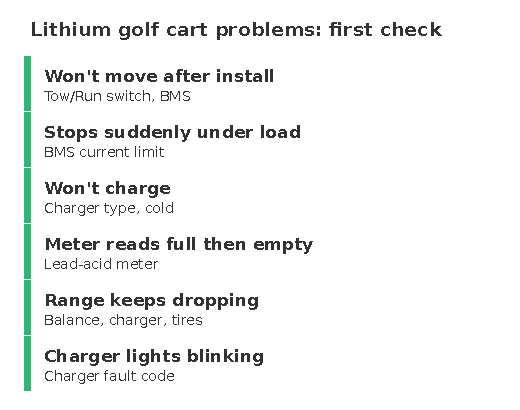
Most lithium golf cart battery problems are not battery failures. They come from fitting a battery with a built-in computer into a cart designed around six dumb lead-acid blocks: a charger that doesn’t recognize the pack, a meter calibrated for the wrong chemistry, a controller that asks for more current than the battery management system (BMS) allows, or a switch left in the wrong position. This page lists the problems owners run into most, the first thing to check for each, and the detailed guide that walks through the fix.
Why Won’t My Golf Cart Move After a Lithium Conversion?
This is the most common problem of all, and it almost always happens on the first drive. Check, in order: the Tow/Run switch is on Run, the pack is switched on and its BMS is awake (many packs sleep until a button press or charger connection), the main cables go to the right posts, and any on-board computer or charge interlock has been handled for your cart model. The full guide includes a two-minute multimeter test that narrows it down: golf cart won’t move after lithium conversion.
Why Does My Lithium Golf Cart Suddenly Stop?
A cart that cuts out climbing a hill, accelerating hard or carrying a full load, then works again after a pause or a key cycle, is usually hitting the BMS’s over-current protection. The controller is asking for more current than the pack’s continuous rating. Fixes range from gentler driving and controller settings to a pack with a higher continuous rating. See lithium BMS cutoff, and for hilly or lifted carts, batteries for hills and lifted carts.
Why Won’t My Lithium Golf Cart Battery Charge?
Start with the charger. A lead-acid charger may refuse to start on a lithium pack, or charge it to the wrong voltage (lead-acid charger on lithium). Many smart chargers also need to see a minimum voltage before they start, so a pack whose BMS has shut off after a deep discharge can look dead. Below freezing, LiFePO4 cells must not be charged, and most BMSs block it (cold weather). The step-by-step list is in lithium golf cart battery won’t charge, and charger lights are decoded in charger blinking and error codes.
Why Is My Battery Meter Wrong After Switching to Lithium?
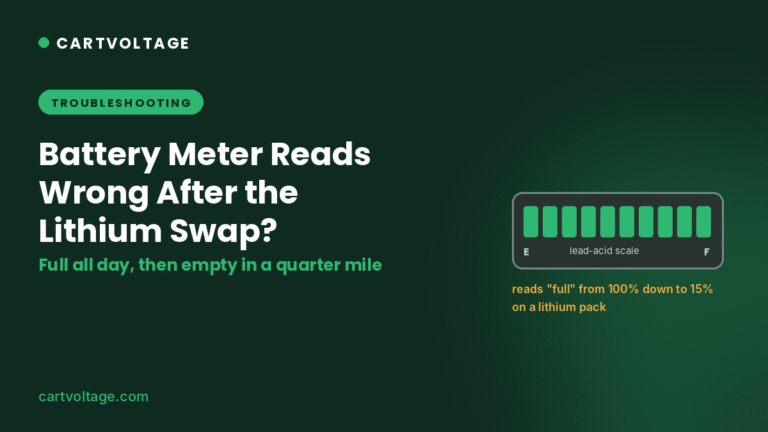
The factory gauge reads voltage on a lead-acid scale. Lithium holds a nearly flat voltage for most of its charge, so the gauge shows full for a long time and then falls quickly near the end. Nothing is wrong with the battery. Use the pack’s app, a shunt-based meter or a lithium meter (meter reads wrong, voltage chart, Bluetooth app, best lithium battery meters for golf carts).
Why Is My Lithium Golf Cart Losing Range?
Gradual range loss usually has a cause outside the cells: a charger stopping short of full, cells drifting out of balance, low tire pressure, dragging brakes, a heavier load or colder weather. Check them in order in why a lithium cart loses range, and compare your miles with the expected figures in the range calculator. Still on lead-acid? See golf cart batteries not holding a charge.
Other Problems Owners Run Into
- Battery slides or rattles in the tray. A lithium pack is far smaller than six lead-acid batteries and needs a proper hold-down (hold-down bracket).
- Hot cables or terminals, or a blown fuse. Usually undersized cable, a loose connection or a fuse sized wrong for the pack (wiring, cable and fuse sizes).
- Accessories or lights stop working. They were tapped off part of the old lead-acid string; they need a 48V to 12V reducer (voltage reducer guide).
- Solenoid clicks but the cart won’t go, or regen trips the BMS. See controller and solenoid.
- Two packs behave unevenly. Parallel packs must match and be charged together (adding a second battery).
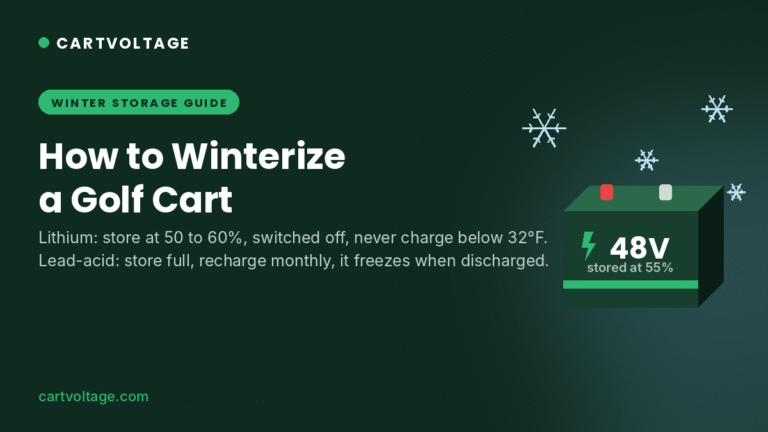
- Problems after winter storage. A pack stored empty can drop too low to wake (how to winterize a golf cart).
Are Lithium Golf Cart Batteries Reliable?
Generally, yes. A LiFePO4 pack has no watering, no corrosion and no end-of-day voltage fade, and quality packs are rated for thousands of cycles (how long they last). Most trouble comes from mismatches at installation: the wrong charger, a BMS rating too low for the controller, or an old meter. Choosing a pack whose continuous current rating covers your controller, and a charger built for lithium, prevents most of the problems above.
Frequently Asked Questions
What is the most common problem with lithium golf cart batteries?
A cart that won’t move right after the conversion, usually from the Tow/Run switch, a sleeping BMS or a wiring mistake. Close behind are BMS shutdowns on hills and charger mismatches.
How do I reset a lithium golf cart battery?
Most packs reset their BMS when the load is removed for a short time or when a compatible charger is connected; some have a power or reset button. The exact method is in the pack’s manual.
Can a bad charger damage a lithium golf cart battery?
The BMS protects the cells from over-voltage, but a charger with the wrong profile can trip it repeatedly, stop short of full or never finish. Use a charger made for LiFePO4 at your pack’s voltage.