36V vs 48V Golf Cart: How to Tell Which You Have, What It Changes, and Whether to Convert
CartVoltage is reader-supported. If you buy through links on this page we may earn a commission at no extra cost to you. As an Amazon Associate we earn from qualifying purchases. Details
Whether your golf cart is 36V or 48V decides which lithium battery you can buy, which charger plug you need, and how much the cart can be upgraded later. It’s a thirty-second check, and a surprising number of people get it wrong by guessing from the model year. This guide shows how to tell for certain, what the difference means for speed, torque, range and cost, whether it’s worth converting a 36V cart to 48V, and which lithium pack each voltage takes.
How to Tell if Your Golf Cart Is 36V or 48V
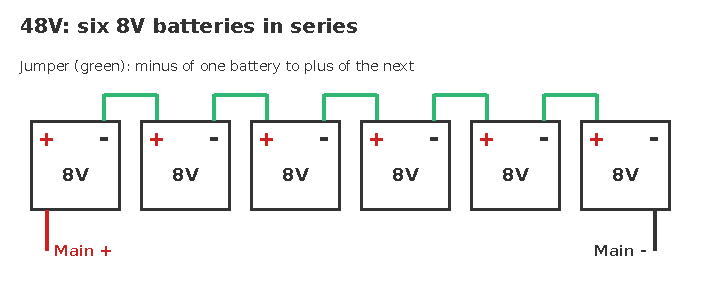
Lift the seat, count the batteries, and read the voltage printed on any one of them. Multiply. A charged pack’s resting voltage gives it away too; the readings for each are in the golf cart battery voltage chart.
| Batteries | Voltage on each | Your cart |
|---|---|---|
| 6 | 6V | 36V |
| 6 | 8V | 48V |
| 4 | 12V | 48V |
| 8 | 6V | 48V |
| 6 | 12V | 72V |
| 1 large box with a lithium label | Label states it | Read the label; “51.2V” means 48V, “38.4V” means 36V |
Can’t read the labels? Three more ways, in order of reliability:
- The controller label. The controller is the finned aluminium box under the seat or behind the battery bay; its label states its voltage.
- The charger. A charger that came with the cart is labelled 36V or 48V. A charger bought later might not be the right one, so treat this as a hint.
- The charger plug. On EZGO, the D-shaped Powerwise plug is only used on 36V carts; a 48V TXT has either the notched rectangular plug (2010 to 2013) or the 3-pin triangle (2014 onward), and the RXV uses the triangle. Club Car and Yamaha plugs don’t distinguish voltage. Pictures of every plug: golf cart charger plug types.
Don’t rely on the model year. EZGO sold 36V TXTs into 2009 and 48V TXTs from 2010, but the changeover wasn’t clean, and plenty of carts have been repowered since. Count the batteries. How they connect is shown in the golf cart battery wiring diagram.
Which Carts Are Which
| 36V carts | 48V carts |
|---|---|
| EZGO Marathon (1980s to 1994) | EZGO TXT48 (2010 onward) |
| EZGO TXT and Medalist (1994 to 2009) | EZGO RXV (2008 onward) |
| Club Car DS (1982 to 1994) | Club Car DS (1995 to 2013) |
| Yamaha G1 through G16 (electric models) | Club Car Precedent, Onward, Tempo |
| Older Columbia, Melex, Taylor-Dunn utility carts | Yamaha G19, G22, G29 Drive, Drive2 |
| ICON, Evolution, most 2018+ imports |
Full model-by-model detail, including tray sizes and charger plugs, is in the fitment guide.
What the Difference Actually Means
Power is voltage times current. For the same motor output, a 48V system draws a third less current than a 36V one, and that has knock-on effects everywhere.
| 36V | 48V | |
|---|---|---|
| Typical top speed (stock) | 12 to 14 mph | 14 to 19 mph, depending on controller and motor |
| Hill climbing and torque | Adequate on flat ground; fades on grades | Noticeably stronger, especially loaded |
| Current draw for the same power | Higher (more heat in cables, controller and BMS) | About 25% lower |
| Efficiency | Slightly lower (resistive losses scale with current squared) | Slightly higher |
| Range for the same kWh | A little less | A little more |
| Battery market | Smaller; fewer lithium options, fewer chargers | Largest; most packs, most plugs, most kits |
| Upgrade path | Limited without changing voltage | Wide: controllers, motors, 150 to 210Ah packs |
| Resale value | Lower | Higher |
The BMS point is worth spelling out for lithium buyers. Because a 36V cart pulls more amps for the same power, a 200A BMS is worked harder in a 36V cart than in a 48V one, and when it reaches its limit the cart stops dead for a second (BMS cutoff explained). A lifted or hard-driven 36V cart is the first place a 250A pack pays for itself; see the 36V comparison for which packs carry that rating.
Should You Convert a 36V Cart to 48V?
People ask this at the same time as “should I go lithium,” and they’re separate decisions. Going lithium at 36V is a battery swap. Going from 36V to 48V is a drivetrain project, whatever the battery chemistry. Here is why a voltage change needs a new controller and a lithium swap does not.
What a 36V-to-48V conversion involves
- Controller: a 36V controller fed 51V will fault or fail. A 48V unit, typically $350 to $900 depending on amperage.
- Solenoid: the coil is voltage-specific. $30 to $60.
- Motor: some 36V series motors tolerate 48V for a while; most will overheat under sustained use. Budget for a 48V motor, $300 to $700, or accept a shortened life.
- Charger: a 48V lithium charger with your plug (picks by plug).
- Accessories: the 12V reducer, if any, must accept 48V input; many 36V-only units don’t. See the reducer guide.
- Cables: often fine; check gauge if you’re adding a higher-amp controller.
Realistic total on top of the battery: $700 to $1,600 in parts, and a day of work that involves the controller wiring, which is a step up from a battery swap. What you get is a cart that climbs like a 48V cart, and access to the much larger 48V battery and upgrade market.
When it’s worth it
- You have a sound 36V cart, you want more hill performance, and you were replacing the controller anyway.
- You plan to keep the cart for years and want the 48V upgrade path.
- You live on hills or carry heavy loads.
When it isn’t
- The cart does neighbourhood miles on flat ground and you’re happy with the speed. Lithium at 36V gives you the weight saving, the maintenance-free running and the longer life without touching the drivetrain. The cost case is in is a lithium conversion worth it.
- The cart is old enough that the frame, brakes and suspension are the real limits. Spending $1,500 on the drivetrain of a $1,500 cart rarely makes sense.
- You’d be buying a used 48V cart for less than the conversion cost. Check local listings before you buy a controller.
Lithium Options at Each Voltage
| 36V lithium | 48V lithium | |
|---|---|---|
| Pack nominal voltage | 38.4V (12 cells) | 51.2V (16 cells) |
| Full-charge voltage | 43.8V | 58.4V |
| Common capacities | 60, 100, 105, 120Ah | 100, 105, 150, 160, 210Ah |
| Energy in a 105Ah pack | 4.0 kWh | 5.4 kWh |
| Established picks | Vatrer 36V 105Ah, DC HOUSE 36V kit | Vatrer 48V 105Ah, DC HOUSE 48V kit |
| Full comparison | Best 36V | Best 48V |
One thing that trips people up: a “36V” lithium pack doesn’t read 36V. It sits at about 38 to 40V and charges to 43.8V, which is fine for a 36V controller. Likewise a “48V” pack reads 51 to 54V. The nominal label is the one that has to match your cart, not the number on the meter. Pack dimensions for both voltages are in the size chart.
Frequently Asked Questions
Can I put a 48V battery in a 36V golf cart?
Not without replacing the controller and solenoid, and usually the motor. The 36V controller will fault or fail on 51V. If speed is the goal, see what lithium does and doesn’t change about speed.
Is a 48V golf cart faster than a 36V?
Usually, by a few mph in stock form, and it climbs much better. Top speed is ultimately set by the controller and motor, so a 36V cart with a performance controller can outrun a stock 48V cart on the flat; it just won’t match it on hills.
How many miles does a 36V golf cart get on lithium?
A 36V 100Ah pack holds about 3.8 kWh, roughly 14 to 20 miles on a stock cart depending on terrain and load. The range calculator has a 36V setting.
Does a 36V cart need a different charger plug than a 48V cart?
On EZGO, yes: 36V TXTs use the Powerwise D plug; 48V TXTs use the notched rectangular plug (2010 to 2013) or the 3-pin triangle (2014 onward). On Club Car and Yamaha the plug depends on the era, not the voltage. The plug types guide has the table by make and year, and the charger guide covers voltage and profiles.
Which is better to buy used, 36V or 48V?
48V, unless the price difference is large. The battery market, upgrade options and resale are all better, and the lithium conversion is the same job. Thinking about going further, to 72V? See 48V vs 72V golf cart.
Next Steps
Know your voltage? Go to the comparison for it: Best 36V or Best 48V. Ready to install? How to convert a golf cart to lithium walks through it step by step.


3 Comments